Understanding the Art of the Tansu Chest
Part furniture, part sculpture, the Japanese tansu chest rewards close looking: honest joinery, hand-forged iron and a restraint that carries a room.
 By Priya Nair
1 September 2026 · 6 min read
By Priya Nair
1 September 2026 · 6 min read
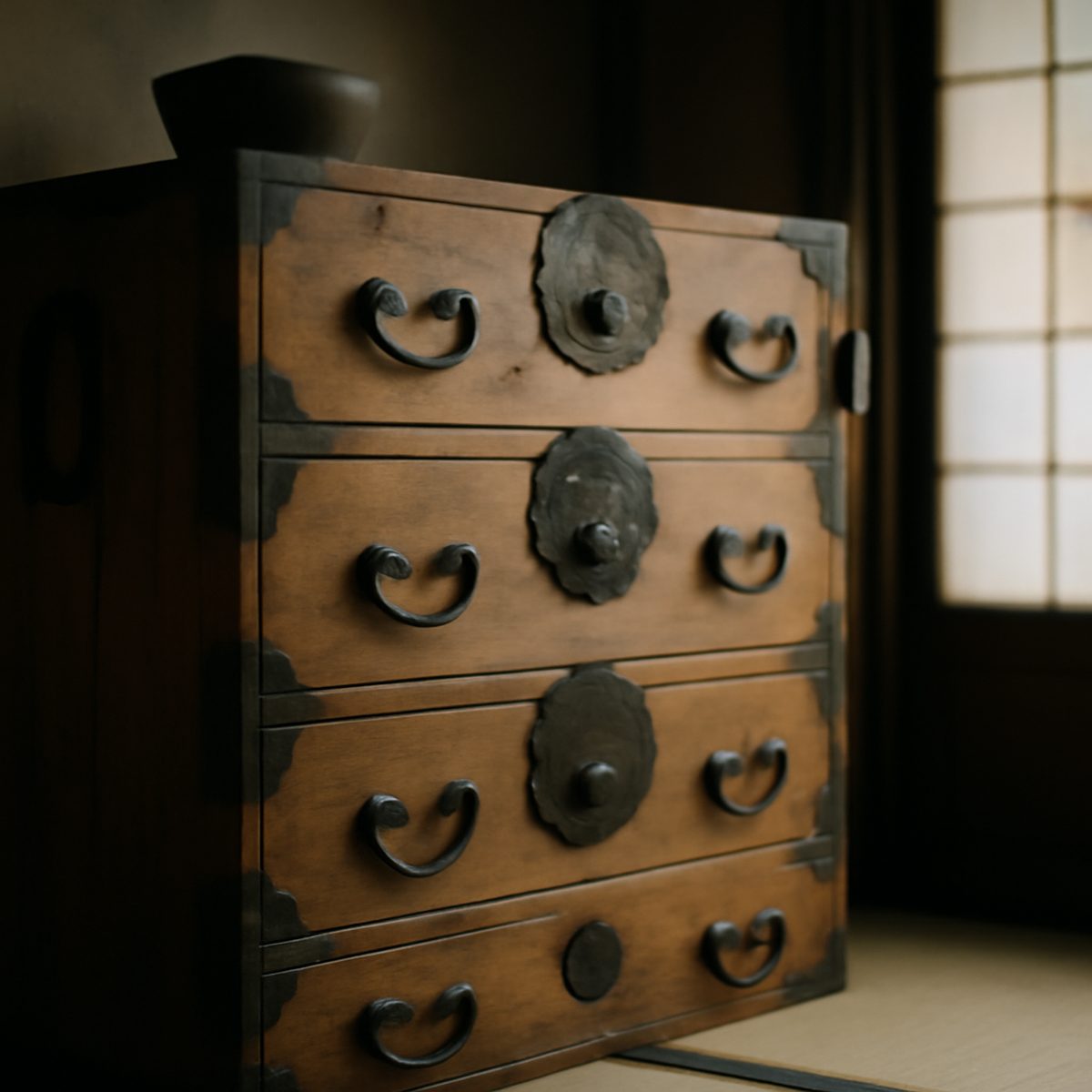
Set a good tansu against a plain wall and it does not so much furnish the room as compose it. The Japanese chest — all warm timber, dark iron and quiet geometry — has a way of anchoring a space that far larger, showier pieces cannot manage. Part storage, part sculpture, it is furniture pared to its essentials and then perfected, and understanding it means learning to read the craft that hides, deliberately, in plain sight.
Tansu is simply the Japanese word for a mobile chest of drawers or cabinet, but that plain translation undersells it. Over centuries, Japanese joiners developed the form into something between a tool and an artwork — practical enough to be hauled from a burning house, refined enough to be treasured for generations. To appreciate one is to appreciate a whole philosophy of making, in which nothing is wasted and nothing is faked. The West produced its own answer to furniture built to be moved, as our case for the campaign chest explains, with metal fittings that are just as much a part of its character.
Form that follows a hard life
The tansu evolved to be useful in a specific world, and its beauty is inseparable from that usefulness. Different regions and trades produced different types, each shaped by its job:
- Kaidan-dansu: the staircase chest, a run of steps with drawers built into the risers, saving space in a small house.
- Mizuya-dansu: the kitchen chest, with sliding doors and open shelves for storing tableware and food.
- Isho-dansu: the clothing chest, with broad, shallow drawers sized for folded kimono.
- Cha-dansu: the small tea chest, for the utensils of the tea ceremony.
- Funa-dansu: the sea chest, small, heavily ironbound and lockable, built to survive a ship.
Notice that the form always answers a need. The staircase chest exists because space was precious; the sea chest is armoured because it lived on a boat. This honesty — where every feature has a reason — is the first thing to understand about the tansu, and the first thing that distinguishes a genuine article from a decorative pastiche made to look Japanese without any of the underlying logic.
The joinery, and the iron
Two crafts meet in a fine tansu, and both reward close looking. The first is the joinery. Traditional tansu were built with intricate interlocking wooden joints rather than nails or screws — the same tradition of precise, glue-free jointing that produces the delicate latticework of the kumiko panel. Pull out a drawer and examine its corners; hand-cut dovetails and clean, tight joints are the signature of the real thing.
‘Turn it around and look at the back and the base,’ a dealer told me, tipping a chest gently forward. ‘The front can be dressed up. The parts no one was meant to see tell you the truth about who made it.’
The second craft is the metalwork. Tansu are famous for their hand-forged iron fittings — corner plates, hinges, lock plates and pulls, often cut and chased into patterns of cranes, waves or family crests. On the best pieces this ironwork is both structural and beautiful, protecting the corners of a chest built to be moved while turning it into something to look at. The interplay of dark iron against honeyed timber is the tansu’s visual signature, and much of its magnetism.
Buying one, and buying wisely
The market holds everything from genuine antiques to recent reproductions and cobbled-together ‘marriages’, so a little knowledge goes a long way. When you look at a tansu, weigh a few things:
- Wood: kiri (paulownia), keyaki (zelkova) and cypress were common; the timber should be solid, not veneer over particleboard.
- Ironwork: hand-forged fittings show slight irregularity and honest age; stamped, uniform metal suggests a modern piece.
- Originality: are the hardware and drawers original to the chest, or a later marriage of unrelated parts?
- Patina: a warm, deep surface built up over decades is worth more than a stripped and re-lacquered face.
- Function: drawers and doors should run true; a chest that racks or sticks may have been badly stored.
As with any serious antique, resist the urge to over-restore. The instinct to strip and refinish is the enemy of value here as much as anywhere, a lesson familiar to anyone who collects older furniture. A tansu’s patina is its biography; sand it away and you have a younger-looking, poorer object.
Living with a tansu
A tansu asks little and gives much. It stores, obviously — and stores beautifully, its drawers and cabinets more characterful than any flat-pack alternative. But its real gift is presence. A single good chest can carry an entire room, supplying warmth, craft and a still, grounded quality that modern furniture rarely achieves. It sits happily in a pared-back interior, where its geometry reads as sculpture, or against panelling and older pieces, where it feels entirely at home. Among the most striking forms is the staircase chest, explored in our piece on the art of the kaidan dansu, where storage literally becomes architecture.
Care for it as you would any fine timber piece — out of direct sun and harsh dry heat, dusted gently, the wood occasionally fed, the iron left alone. Do that and it will outlast you comfortably; many tansu are already well past their first century and merely getting better. It shares this quality of quiet, capacious usefulness with the apothecary cabinet, another piece whose many small drawers reward the collector who likes furniture with a job to do.
A quiet lesson in making
Spend time with a good tansu and it changes, subtly, how you look at everything else in the room. Against its honest joinery and hand-forged iron, the shortcuts of ordinary furniture — the stapled joints, the printed grain, the plastic pretending to be metal — become suddenly visible, and a little hard to unsee. This is the quiet education a single well-made object provides: it raises the standard by which you judge the rest. The tansu teaches that beauty and usefulness need not be at odds, that the parts no one sees deserve the same care as the parts on show, and that an object made honestly will outlast a dozen made cheaply. These are old lessons, and unfashionable ones in an age of the disposable, but they are the lessons a considered home is built on. You do not need a houseful of antiques to absorb them — one good piece, chosen carefully and lived with attentively, will do. The tansu makes an especially fine teacher, because it wears its craft so openly and rewards close looking so generously. Buy one, live with it, and let it quietly raise your eye.
To understand the tansu, in the end, is to understand a way of making in which beauty is never applied but always earned — the by-product of solving a real problem with real skill and honest material. That is why it belongs in a considered home half a world from where it was made. It does not need explaining or excusing; it simply needs looking at, closely, until the quiet intelligence of it comes clear. Then it will hold your room together for the rest of your life, and someone else’s after that.
Priya tours the homes most people only glimpse from the road, and asks how they are really lived in.