The Case for the Apothecary Cabinet
A wall of small labelled drawers, the apothecary cabinet turns storage into order and beauty at once. A case for the most characterful chest of all.
 By Priya Nair
1 September 2026 · 6 min read
By Priya Nair
1 September 2026 · 6 min read
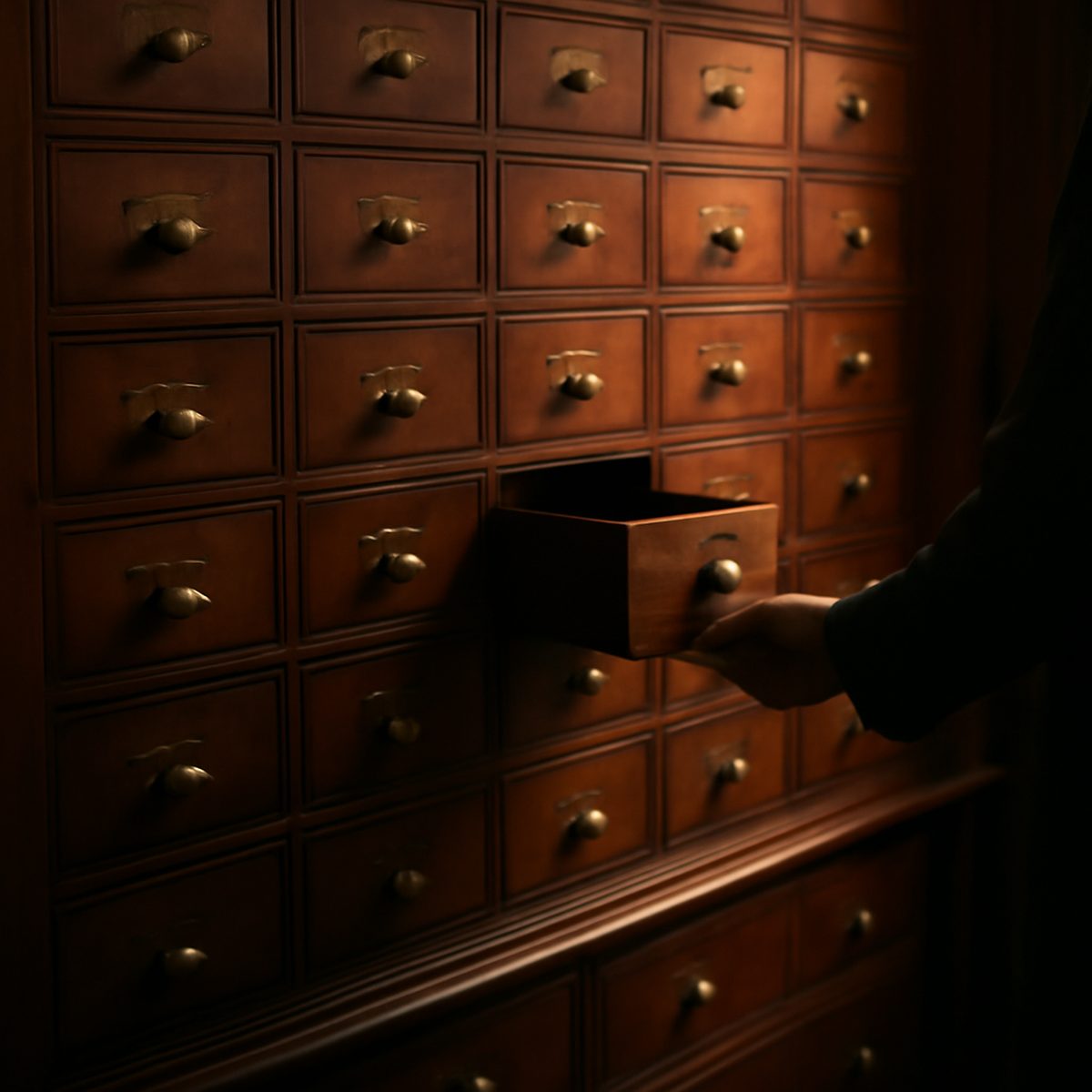
Of all the pieces of furniture a home can hold, few are as quietly satisfying as the apothecary cabinet. A grid of small, identical drawers — dozens of them, each with a little handle and often a card-holder for a label — it was built for a world of pharmacies and general stores, of herbs and hardware and haberdashery sorted into their own small compartments. That world has largely gone, but the cabinet endures, because it answers a need every home still has and most fail to meet: the need to store the small, scattered stuff of daily life in a way that is not merely tidy but genuinely beautiful. It turns storage into a pleasure, and that is a rare thing.
An object built for order
The genius of the apothecary cabinet is its multiplication of the drawer. Where an ordinary chest gives you four or five large drawers into which everything is thrown and lost, the apothecary cabinet gives you twenty or forty small ones, each large enough for one category of thing and no more. This granularity changes how you store entirely. A drawer for batteries, a drawer for string, a drawer for spare keys, a drawer for candles: everything gets its own place, and because each drawer is small and shallow, nothing hides at the back or piles up in a heap. The cabinet enforces order by its very structure.
There is deep satisfaction in this, the particular calm that comes from a place for everything and everything in its place. It is the same pleasure, scaled up, that a single well-organised drawer can give — the quiet order celebrated in the considered sock drawer — but multiplied across a whole wall of compartments. To open an apothecary cabinet and find each small chaos of modern life sorted into its own labelled home is to feel the room, briefly, under control.
Storage that is also sculpture
Most storage furniture asks to be ignored — the point of a cupboard is that you do not see what is inside, and ideally barely notice the cupboard itself. The apothecary cabinet is the glorious exception. With its rhythmic grid of drawers, its worn timber, its little handles and labels, it is a genuinely beautiful object, a piece of storage you actively want on display. It works as the visual anchor of a room in a way no chest of drawers ever could, its repeated geometry as pleasing as any pattern. For storage built to travel as well as to be admired, our case for the campaign chest makes a fitting companion piece.
Most storage hides. The apothecary cabinet is the one piece that earns its place in the open — a wall of small drawers as good to look at as it is to use.
This dual life — useful and beautiful at once — puts the apothecary cabinet firmly in the company of furniture bought as much for character as for function. The instinct to choose it is the same one that drives collecting design objects, where a piece earns its place by being interesting to live with, not merely by holding things. An old apothecary cabinet, with the patina and small repairs of its working life, is exactly such an object: storage that doubles as sculpture, utility that doubles as history.
Old or new, and where to put it
Genuine antique apothecary cabinets exist and are treasured, but they are increasingly rare and correspondingly dear. The good news is that the form is so useful that it has been reproduced in every register, from faithful antique-style reproductions to clean modern interpretations, so there is a version for every room and budget. When hunting an original, the pleasures and pitfalls are those of any furniture collecting; the same eye that serves in collecting mid-century furniture — checking construction, condition and honest wear against clumsy restoration — serves just as well here.
The beauty of the piece is its versatility, and it earns a place in almost any room.
- The hall: for keys, gloves, sunglasses, dog leads and all the small things that gather by the door.
- The kitchen or pantry: for spices, teas, seeds and the endless small tools of cooking.
- The study or workshop: for stationery, components, and the fiddly bits that defeat ordinary drawers.
- The bathroom: for soaps, remedies and toiletries, returning the cabinet to something like its original use.
The pleasure of the label
Part of the apothecary cabinet’s charm lies in the labelling. Those little brass card-holders on the drawer fronts invite you to name each drawer’s contents, and there is real satisfaction in doing it well — a considered hand-written card, a small ritual of deciding what belongs where. This act of naming and sorting turns the cabinet from mere furniture into a personal system, a map of your own small necessities. It is a related pleasure to the theatre of a well-arranged drinks cabinet, where the joy is partly in the ordered display and partly in the ritual of use; the apothecary cabinet brings that same considered pleasure to the humblest of contents.
The stories in the wood
An old apothecary cabinet carries something a new one never can: the evidence of its former life. Look closely at a genuine antique and you find the traces — a drawer front worn pale where a thousand hands pulled it, the faint ghost of an old painted label, a stain where some tincture or spice once spilled and soaked in, a repair made by a long-dead cabinetmaker. These marks are not flaws to be sanded away but the biography of the piece, the record of the pharmacy or general store or workshop it once served. To own such a cabinet is to become the temporary custodian of that history, adding your own small chapter of keys and candles and string to the many that came before. There is a quiet pleasure in that continuity, in giving new purpose to a piece that has already been useful for a century, and in knowing it will likely outlast you and be useful still.
Order made beautiful
What the apothecary cabinet finally offers is the reconciliation of two things we usually keep apart: the practical and the beautiful, the need to store and the wish to display. It takes the least glamorous problem in any home — where to put all the small stuff — and solves it with a piece of furniture you are proud to own and glad to look at. In a world of hidden, flush, invisible storage, there is something deeply appealing about a cabinet that makes order visible and turns it into a virtue. For more furniture that earns its place by being as characterful as it is useful, our Homes & Culture section is where to look. Give the small necessities of your life the dignity of their own labelled drawers, and watch order become, for once, a pleasure to behold.
Priya tours the homes most people only glimpse from the road, and asks how they are really lived in.