Understanding Watch Pallet Forks and Levers
The pallet fork is one of the smallest, most consequential parts of a mechanical watch. Here is how it actually works, and why it still dominates the industry.
 By Daniel Koh
1 September 2026 · 5 min read
By Daniel Koh
1 September 2026 · 5 min read
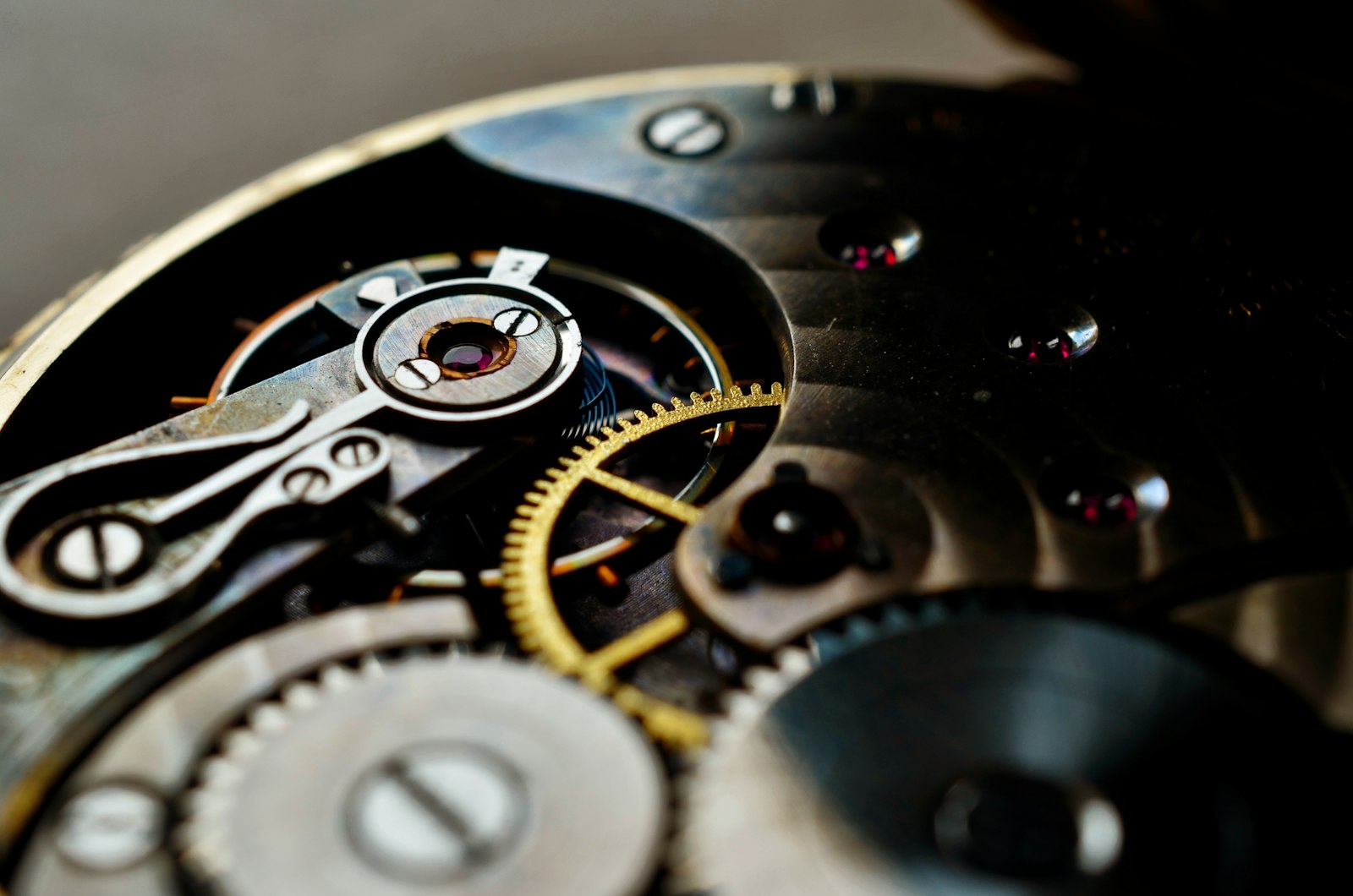
Of all the components inside a mechanical watch, none does more consequential work in less visible space than the pallet fork. It weighs almost nothing, spans only a few millimetres, and yet governs precisely how a watch’s stored energy gets released, tick by measured tick, into something a human being can actually read as time. Understanding the pallet fork, and the lever escapement it belongs to, is close to the single most useful piece of technical knowledge a watch collector can acquire — it explains, more than almost any other component, why mechanical watches behave the way they do.
What the escapement actually does
A mainspring, once wound, wants to unwind all at once, releasing its stored energy in an instant rather than a steady, measured flow. The escapement’s entire job is to prevent that — to meter the release of energy into small, regular increments that the balance wheel can regulate into consistent timekeeping. Without an escapement, a watch would simply spring its mainspring loose and stop within seconds, having told no useful time at all.
The lever escapement, the dominant design used in the overwhelming majority of mechanical watches made since the nineteenth century, achieves this through the pallet fork — a small, Y-shaped or fork-shaped component that sits between the escape wheel and the balance wheel, alternately locking and releasing the escape wheel’s teeth as the balance oscillates back and forth.
How the pallet fork works, step by step
- The escape wheel, driven by the mainspring’s stored energy, constantly tries to rotate
- The pallet fork’s two jewelled pallets — typically synthetic ruby — alternately catch and release the escape wheel’s teeth
- Each release gives the escape wheel a tiny, controlled turn, which in turn gives the pallet fork a small impulse
- That impulse is transferred to the balance wheel through the pallet fork’s fork-shaped end, engaging with a small pin — the impulse pin — set into the balance’s roller table
- The balance wheel swings, driven by its hairspring, and returns to reverse the whole sequence in the opposite direction
This entire sequence repeats several times a second in a typical modern watch — the source of the audible ticking sound, each tick corresponding to one lock-and-release cycle of the pallet fork against the escape wheel.
Why the lever escapement has endured
Numerous alternative escapement designs have been proposed and even produced over the centuries, some genuinely more efficient in theory, and yet the lever escapement remains the standard fitted to the vast majority of mechanical watches produced today. Its dominance comes down to a combination of reliability, relative ease of manufacture at scale, and — critically — a self-starting quality that means the watch reliably resumes motion after being knocked or interrupted, a property some rival designs lack, which matters enormously for a mechanism people wear on their wrist through everyday knocks and bumps.
Understanding this places the pallet fork within a wider mechanical story worth exploring further in our broader guide to watch escapements and design, which covers how the lever design compares against the handful of alternative escapements still occasionally seen in high-end independent watchmaking.
“Once a collector actually sees a pallet fork in slow motion, catching and releasing the escape wheel, the whole mechanical watch stops feeling mysterious and starts feeling like an extraordinarily elegant piece of clockwork logic,” one independent watchmaker said of demonstrating the mechanism to first-time visitors to his workshop.
Where it sits in the wider movement
The pallet fork does not operate in isolation. It sits at the direct interface between the gear train that delivers the mainspring’s energy and the balance wheel that regulates it into consistent time. Understanding how these systems connect — energy delivered through the gear train, metered by the pallet fork, regulated by the balance — gives a much fuller picture of how a mechanical watch actually functions as a coordinated whole rather than a collection of unrelated parts.
For collectors wanting the complete picture, it is worth reading this alongside a broader primer on watch movements, which situates the escapement within the full sequence from mainspring to dial, and helps make sense of exactly why servicing a mechanical watch is a genuinely specialised skill rather than simple maintenance.
What to ask a watchmaker about your own pallet fork
A collector taking a mechanical watch in for service is well within reason to ask specifically about the condition of the pallet fork’s jewels and the escapement’s overall wear — a good watchmaker will welcome the question rather than treat it as an unusual level of scrutiny. Signs that an escapement needs attention include unexplained rate deviation, a watch that stops unpredictably despite a full wind, or an audible change in the ticking rhythm to someone who has listened to the same watch for years.
It is also worth asking whether a service includes proper lubrication of the pallet stones and escape wheel teeth, since this is one of the areas most sensitive to old, degraded oil — a watch running dry at the escapement wears considerably faster than one properly maintained, regardless of how well the rest of the movement has been cared for. A watchmaker who can show a collector the worn pallet jewels under magnification, rather than simply asserting the need for a service, is generally one worth trusting with future work on the rest of the collection too.
Why this small part matters so much
A worn or poorly adjusted pallet fork is one of the most common sources of timekeeping inaccuracy in an older mechanical watch, which is precisely why regular servicing matters — over years of constant motion, the jewelled pallets can wear, subtly changing the timing of each lock-and-release cycle. Understanding the pallet fork’s role transforms a routine service from an abstract expense into something considerably more comprehensible: the periodic, careful maintenance of the single mechanism doing the most consequential work inside the watch. The wider Style & Watches archive covers more of the mechanics worth understanding before a next purchase or service.
Daniel has spent fifteen years arguing that the best watch is the one you never take off.