The Story of the Kopitiam Egg
The soft-boiled kopitiam egg looks trivial but demands real precision. Here is the story behind Singapore's most understated breakfast ritual.
 By Renée Tan
30 August 2026 · 6 min read
By Renée Tan
30 August 2026 · 6 min read
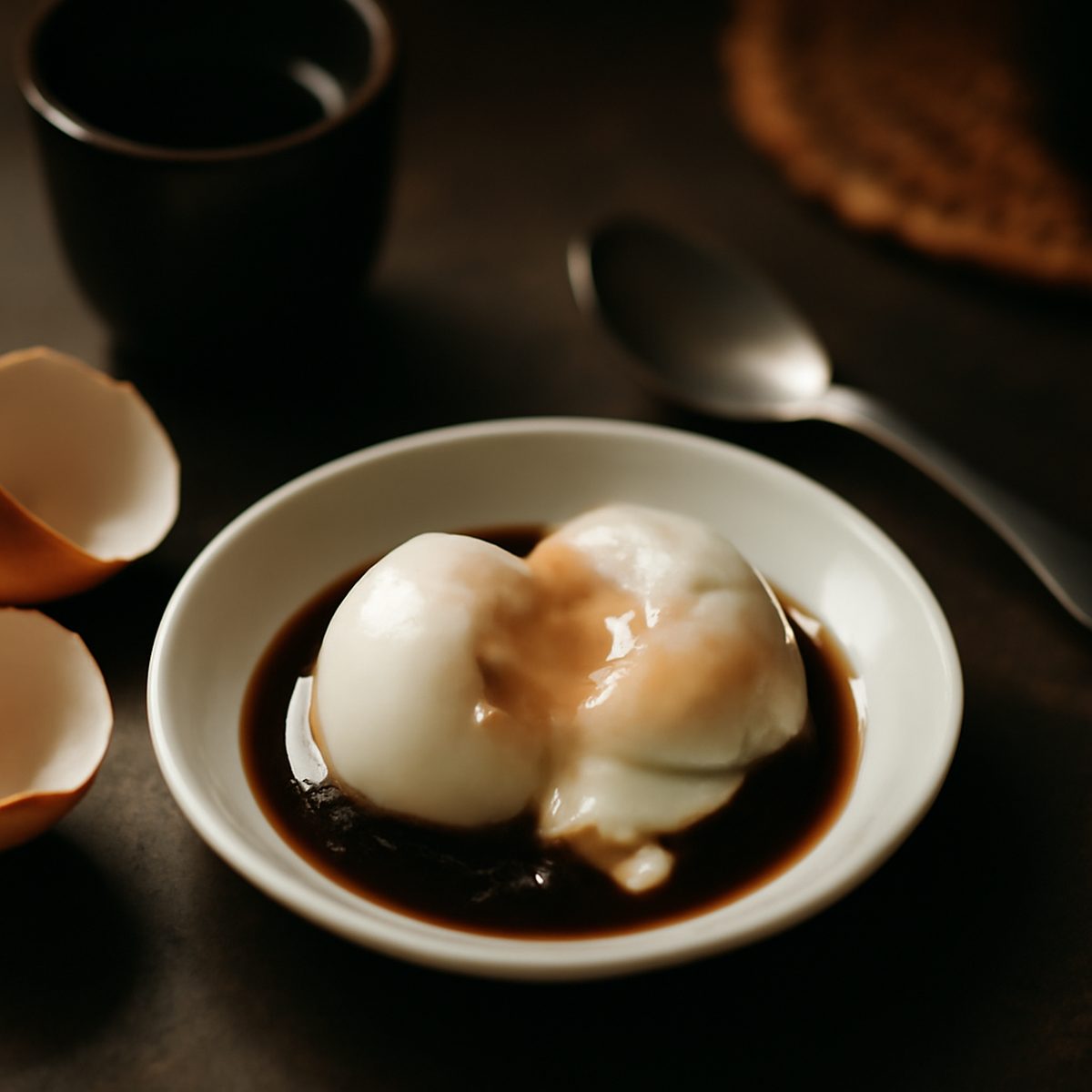
There is a particular choreography to ordering soft-boiled eggs at a Singapore kopitiam, one so familiar to regulars that it barely registers as ritual at all. Two eggs arrive in a small saucer, cracked open at the table, seasoned with a dash of dark soy sauce and a scattering of white pepper, then eaten straight from the shell with a teaspoon or, for the more traditional, sipped directly. It is among the simplest dishes imaginable, and yet a genuinely well-made kopitiam egg, its white just set and its yolk still fully liquid, is far harder to produce consistently than its humble presentation suggests.
The technique behind the perfect egg
A proper kopitiam soft-boiled egg is not boiled in the conventional sense at all. Traditionally, eggs are submerged in a covered container and steeped in near-boiling water for a precise window of time, usually somewhere between five and seven minutes depending on egg size and starting temperature, before being removed and cracked immediately. Too short a steep and the white remains translucent and unappetisingly runny; too long and the white turns rubbery while the yolk begins to firm, losing the silken, barely-set texture regulars expect. Because the technique depends so heavily on precise timing and water temperature, a stall’s consistency across hundreds of eggs a day is itself a meaningful marker of quality, a small but real test of a kitchen’s discipline.
Egg freshness matters more than most diners realise. A very fresh egg holds its white together more cleanly when cracked, producing a neater presentation in the saucer, while an older egg tends to spread thinner and looser. The best kopitiams source eggs specifically for this purpose, understanding that a dish this exposed, with nowhere to disguise a mediocre ingredient, rewards attention to sourcing that a more elaborate dish might not require.
Kaya toast, the egg’s constant companion
Soft-boiled eggs are rarely ordered alone, almost always paired with kaya toast, thin slices of bread toasted over charcoal or grilled until crisp, spread with kaya, a coconut and egg jam, and a slab of cold butter. The classic ritual involves dipping the toast into the egg mixture itself, soy sauce and pepper stirred through the yolk, creating a combination that manages to be simultaneously sweet, savoury, and rich. This pairing, along with a cup of strong local coffee, forms what many Singaporeans consider the definitive local breakfast, a set meal so ingrained in daily life that entire chains have built their business around perfecting this single combination.
The small rituals worth knowing
- Cracking both eggs into the saucer together before seasoning, rather than eating them one at a time
- Stirring rather than simply pouring the soy sauce, to distribute seasoning evenly through the yolk
- Ordering coffee or tea “kosong” for those who prefer it unsweetened, a small but meaningful customisation within kopitiam culture
Why this small dish carries outsized cultural weight
The kopitiam egg’s significance lies less in any single technical achievement than in its role as a daily anchor for an enormous number of Singaporeans, a dish eaten the same way, at the same tables, often by the same people, for decades. It belongs to a wider constellation of kopitiam classics that together define much of the island’s everyday food culture, dishes that rarely appear on tasting menus but which locals hold in genuine, sustained affection precisely because of their consistency and familiarity rather than any culinary spectacle.
“Every Singaporean has an opinion about how runny their egg should be,” one longtime kopitiam operator told us. “It’s the most personal order on the menu, even though it only has two ingredients.”
A dish that resists reinvention
Unlike many hawker classics that have been reimagined by ambitious young cooks in recent years, the kopitiam egg has remained largely untouched by culinary reinvention, and this seems entirely deliberate. Its appeal rests precisely on consistency and familiarity rather than novelty, and attempts to elevate or reinterpret it tend to miss the point of what makes the dish meaningful in the first place. For a broader look at how this steadfastness compares with the more adventurous corners of the city’s noodle and rice culture, our guide to ban mian and handmade noodles offers a useful contrast, while the same careful, hours-long approach to broth building described in our guide to prawn noodles and hae mee shows how differently patience expresses itself across Singapore’s breakfast and lunch traditions. Our wider Dining & Drinks coverage situates the kopitiam egg within Singapore’s broader breakfast and hawker traditions.
The economics of a two-ingredient dish
Despite its simplicity, the kopitiam egg set remains one of the more tightly margined items on a coffee shop’s menu, and this economic pressure has, if anything, reinforced rather than eroded the dish’s traditional preparation. There is little room in a low-priced set meal to experiment with premium ingredients or elaborate technique, which means the dish’s quality rests almost entirely on the operator’s consistency and care rather than on any capacity to spend more. This is part of why long-running kopitiam operators, some of whom have prepared the same egg-and-toast set for several decades, remain trusted by regulars in a way that newer, flashier interpretations struggle to match, since trust here is built through repetition rather than innovation.
Younger Singaporeans, even as their broader eating habits shift toward more international and experimental cuisine, tend to retain a particular loyalty to this specific breakfast, often citing it as one of the few dishes that reliably evokes childhood or family memory. That emotional weight, disproportionate to the dish’s cost or complexity, is arguably what has protected it most effectively from the kind of reinvention pressure that has reshaped so much of the rest of Singapore’s hawker landscape over the past decade.
Final word
The kopitiam egg’s genius lies in refusing to be anything more than what it is: two eggs, a splash of soy, a crack of pepper, eaten the same way morning after morning across the island. It is a dish built on consistency rather than ambition, and that consistency, repeated daily across thousands of tables, is precisely what has turned a two-ingredient breakfast into a genuine piece of Singapore’s cultural fabric, one unlikely to change even as the rest of the city’s food culture continues to evolve around it.
Renée has covered Singapore's restaurants for over a decade, with a soft spot for the kitchens most people walk past.