The Quiet Case for the Nehru Jacket
Collarless, clean and quietly formal, the Nehru jacket dresses a man without a tie. A case for the mandarin-collar cut and just how to wear it.
 By Daniel Koh
2 September 2026 · 6 min read
By Daniel Koh
2 September 2026 · 6 min read
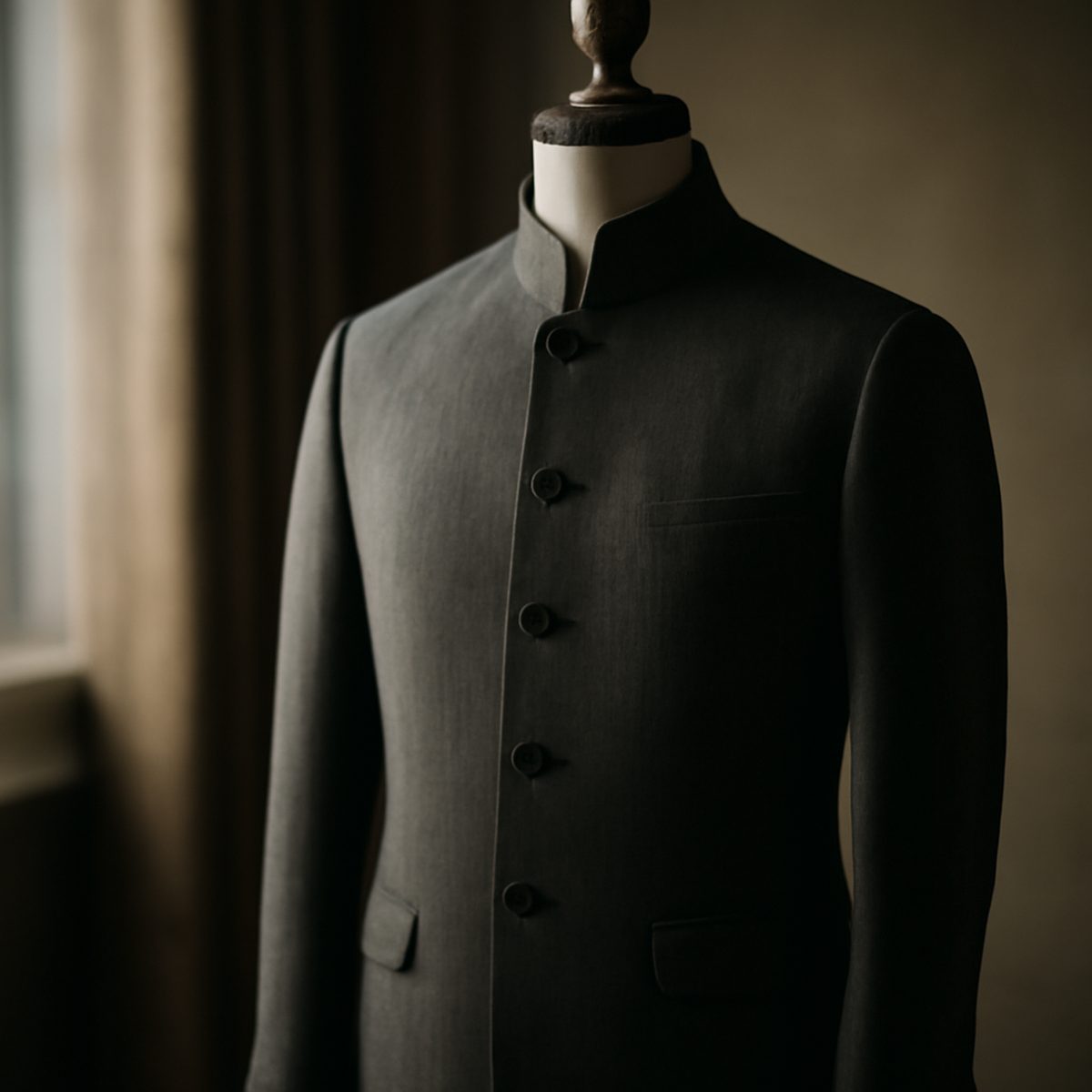
There is a particular power in a garment that dresses a man up while asking almost nothing of him. The Nehru jacket is exactly that. Collarless, clean-lined and closed to the throat, it reads as formal and considered without the fuss of a tie or the fullness of a lapel. In a Singapore climate, where the Western suit can feel like an act of stubbornness against the weather, it makes a quietly compelling case for itself, and it deserves a far larger place in the thoughtful man’s wardrobe than it currently enjoys.
What defines the Nehru jacket
The Nehru jacket is a tailored, hip-length coat with a short, upright band collar that stands away from the neck, no lapels, and a straight front usually fastened with buttons to just below the throat. Its defining feature is that standing mandarin collar, which frames the face cleanly and removes the need for a tie entirely. It draws on a long tradition of Indian court dress, adapted in the twentieth century into a garment of considerable elegance and simplicity. The defining feature is the collar itself, explored more fully in the art of the Nehru and mandarin collar.
That collar puts it in the same broad family as several other jackets that have quietly earned a place in a considered wardrobe, garments that reject the standard lapel-and-tie formula in favour of something cleaner. If that thinking appeals to you, the argument is a familiar one at Black Cow, made for a Continental cousin in the quiet case for the Teba jacket and for a more relaxed cut in the more relaxed cut of the shirt jacket.
Why it suits the modern man
The Nehru jacket answers a real problem, which is how to look properly dressed without a tie. In an age when the tie has become optional and often absent, a conventional jacket can look slightly unfinished at the open collar. The Nehru jacket has no such difficulty; its whole design assumes the absence of a tie and looks complete because of it. It is smart without being stuffy, formal without being fussy, and it lends the wearer an air of quiet, deliberate elegance.
The Nehru jacket is the answer to a question the open-collared suit keeps failing to resolve, how to look finished without a tie.
Cloth and climate
In a tropical city the choice of cloth is everything. A Nehru jacket in a lightweight wool, a linen, a cotton or a silk blend breathes in a way that a heavy Western suit never will, and its clean lines suit lighter fabrics beautifully. It can be dressed up in a fine dark cloth for evening or down in linen for a warm day, and it takes to texture and subtle pattern well. The care in choosing cloth that suits both the cut and the climate is the same care that governs any good tailoring decision, the kind of thinking behind the thinking behind a good charcoal suit.
How to wear it
The Nehru jacket is at its best kept simple. Worn over a fine shirt or a slim knit, with well-cut trousers and clean shoes, it needs no further ornament; the collar does the work. It suits a monochrome or tonal approach, a dark jacket over a lighter shirt, or a considered play of related shades. Avoid the temptation to over-accessorise it; part of its appeal is that it is already complete, and adding a scarf or a bright pocket square only fights the clean lines that are its whole point.
It works across a surprising range of occasions. In a dark cloth it is genuine evening wear, an elegant alternative to the dinner jacket for a man who wants to stand slightly apart. In lighter fabrics it becomes smart daywear for a warm climate, equally at home at a gallery opening or a good restaurant. The versatility that comes from a single, well-chosen jacket is one of the quiet luxuries of a considered wardrobe, and the Nehru earns its keep as few garments do.
A quiet, deliberate choice
Choosing to wear a Nehru jacket is, in a small way, a statement of independence from the default. It says that the wearer has thought about how to dress for his climate and his temperament rather than simply reaching for the standard suit. That kind of considered, slightly unconventional dressing is precisely the sort of thing Black Cow celebrates, the man who knows the rules well enough to depart from them with confidence.
For the Singapore man in particular, the Nehru jacket is close to an ideal garment, formal, elegant, breathable and quietly distinctive. It solves the tie problem, suits the heat, and lends its wearer an air of composed individuality. If you have never considered one, it is well worth the thought. For more on the jackets and tailoring that reward exactly this kind of attention, the wider collection under the wider Style & Watches collection is a fine place to continue.
A garment with a considered history
Part of the Nehru jacket’s quiet confidence comes from its lineage. It descends from a long tradition of elegant, collarless court dress, refined over the twentieth century into the clean, modern garment we know today, and it carries that history lightly. To wear one is to draw on a genuine sartorial heritage rather than a passing trend, and that depth is part of why it never looks like a costume or a gimmick. It has earned its place through decades of quiet good service.
For the man building a wardrobe of considered, long-lasting pieces, that heritage matters. The Nehru jacket is not a garment to be worn once and retired but one to be returned to for years, its clean lines and easy formality as useful at the next decade’s dinners as at this one’s. Choose it in a good cloth, have it cut properly to your frame, and it becomes one of those rare pieces that solves a real problem elegantly and goes on solving it indefinitely. In a wardrobe full of compromises, that kind of quiet, permanent usefulness is the highest praise a garment can earn.
Daniel has spent fifteen years arguing that the best watch is the one you never take off.