Understanding the Equation-of-Time Watch
It measures the difference between the sun's time and our own, a complication of pure poetry. Understanding the poetic equation-of-time watch.
 By Daniel Koh
2 September 2026 · 6 min read
By Daniel Koh
2 September 2026 · 6 min read
Most complications in a fine watch are practical, or at least pretend to be. They tell you the date, the phase of the moon, the time in another city. The equation of time is different. It measures something almost no one needs to know, the difference between the time our clocks keep and the time the sun actually keeps, and it displays it purely for the poetry of the thing. It is a complication for the contemplative, a small mechanical acknowledgement that the neat, even time on our wrists is a convenient fiction the sun never agreed to.
The idea behind the complication
Our clocks run on mean time, a smoothed-out average in which every day is exactly twenty-four hours long. The sun is less obliging. Because the earth’s orbit is elliptical and its axis is tilted, the length of a true solar day varies through the year, and the sun reaches its highest point a little early on some dates and a little late on others. The difference, which can run to around sixteen minutes either way, is called the equation of time, and it follows a graceful annual curve that crosses zero four times a year.
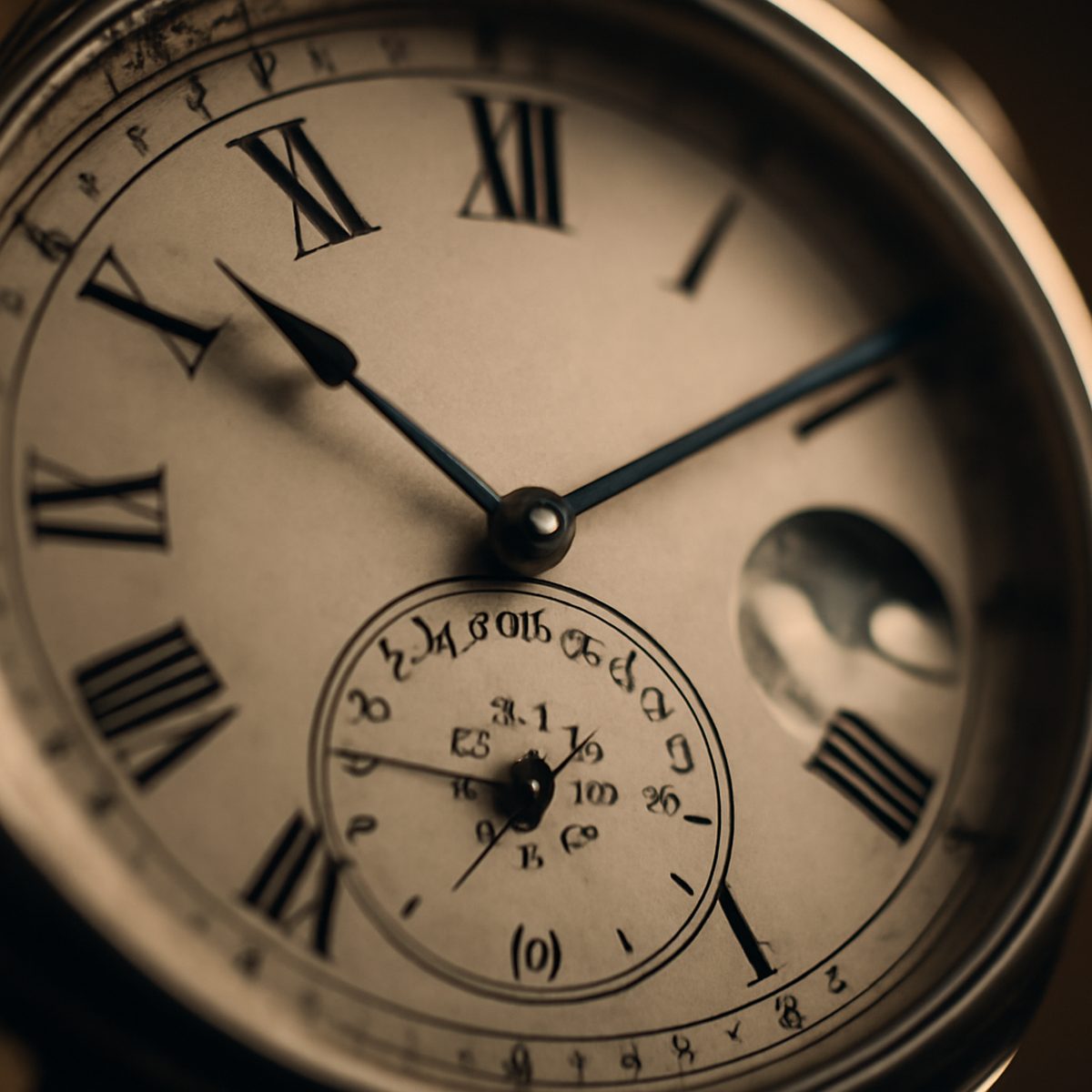
An equation-of-time watch displays this difference, usually on a curved, kidney-shaped scale or via a second minute hand, so the wearer can read at a glance how far the sun is running ahead of or behind the clock. It is one of the more poetic and less common horological complications, and understanding it deepens the pleasure of the whole subject, in the same way that learning to read the subtleties of a dial, as in learning to read a dial, opens up a watch’s character.
How it is displayed
Watchmakers show the equation of time in two main ways. The simpler is a subdial with a hand that swings across a scale marked from about minus sixteen to plus sixteen minutes, indicating the current difference. The more spectacular, and far rarer, is the running equation, in which a second, often skeletonised minute hand tracks true solar time directly alongside the ordinary hand, the gap between them widening and narrowing through the year. This is achieved by a cam shaped like the annual equation curve, read by a lever as the movement turns.
An equation-of-time watch tells you nothing you need to know, and does it so beautifully that you are glad to be told.
A complication of the calendar
Because the equation of time depends entirely on the date, the complication is almost always paired with a calendar, so the movement knows where in the year it stands. This makes it a natural companion to the great calendar complications, and it is often found alongside a perpetual or annual calendar in the most ambitious watches. The mechanical logic that lets a movement track the uneven year is closely related to that behind the calendar complications explored in the annual calendar complication, a shared feat of turning the messy realities of the solar system into gear teeth and cams.
Reading and owning one
To read an equation-of-time watch is to be reminded, daily, of the gap between human convenience and celestial fact. Near the solstices and equinoxes the curve does interesting things, and a wearer who pays attention comes to know the rhythm of the year through the small swinging hand on the dial. It is a complication that rewards attention and contemplation rather than utility, a companion for the sort of person who finds pleasure in understanding how the world actually works.
Owning one is a commitment to a certain kind of horological romance. These are not everyday tool watches but objects of contemplation, usually made in small numbers by makers who care about such things, and priced accordingly. They belong in the company of the other grand complications, the world timers and tourbillons and repeaters, that represent watchmaking at its most ambitious; the world-spanning display of the world-spanning display of the world timer and the mechanical showmanship of the mechanical showmanship of the tourbillon are close relatives in spirit, feats undertaken for their beauty as much as their use.
Why it endures
The equation of time endures as a complication precisely because it is useless in any practical sense, and therefore pure. In an age when a phone gives us atomic time to the millisecond, a watch that instead tells us how the sun is running is a deliberate turn away from mere accuracy towards meaning. It connects the wearer to the astronomy that underlies our timekeeping, and it does so through mechanism alone, no battery, no signal, just gears shaped to the curve of the year.
For the collector who has moved beyond the merely useful, the equation-of-time watch is one of horology’s most quietly rewarding pursuits, a complication that asks you to think about time itself rather than simply to check it. It is watchmaking as philosophy, rendered in metal. For more on the complications and the craft that make fine watches worth understanding, the wider collection under the wider Style & Watches collection is a fine place to keep reading.
A watch for the contemplative owner
The equation-of-time watch is not for everyone, and that is rather the point. It appeals to a particular temperament, the owner who finds pleasure in understanding rather than merely using, who would rather know why the sun and the clock disagree than simply be told the hour. For that person it offers a daily small reward, a reason to glance at the wrist and think, however briefly, about the tilt of the earth and the shape of its orbit. Few objects so small carry so much quiet meaning.
It is also, unavoidably, a connoisseur’s purchase, made in small numbers by makers who undertake it as much for the challenge as the market. To own one is to hold a piece of horological romance, a mechanism built to display something no one needs, beautifully. In a world that measures watches ever more by their accuracy and their price, the equation of time stands quietly apart, insisting that a timepiece can also be a way of thinking about time itself. For the collector who has come to value meaning over mere function, there are few more rewarding things to wear.
Daniel has spent fifteen years arguing that the best watch is the one you never take off.