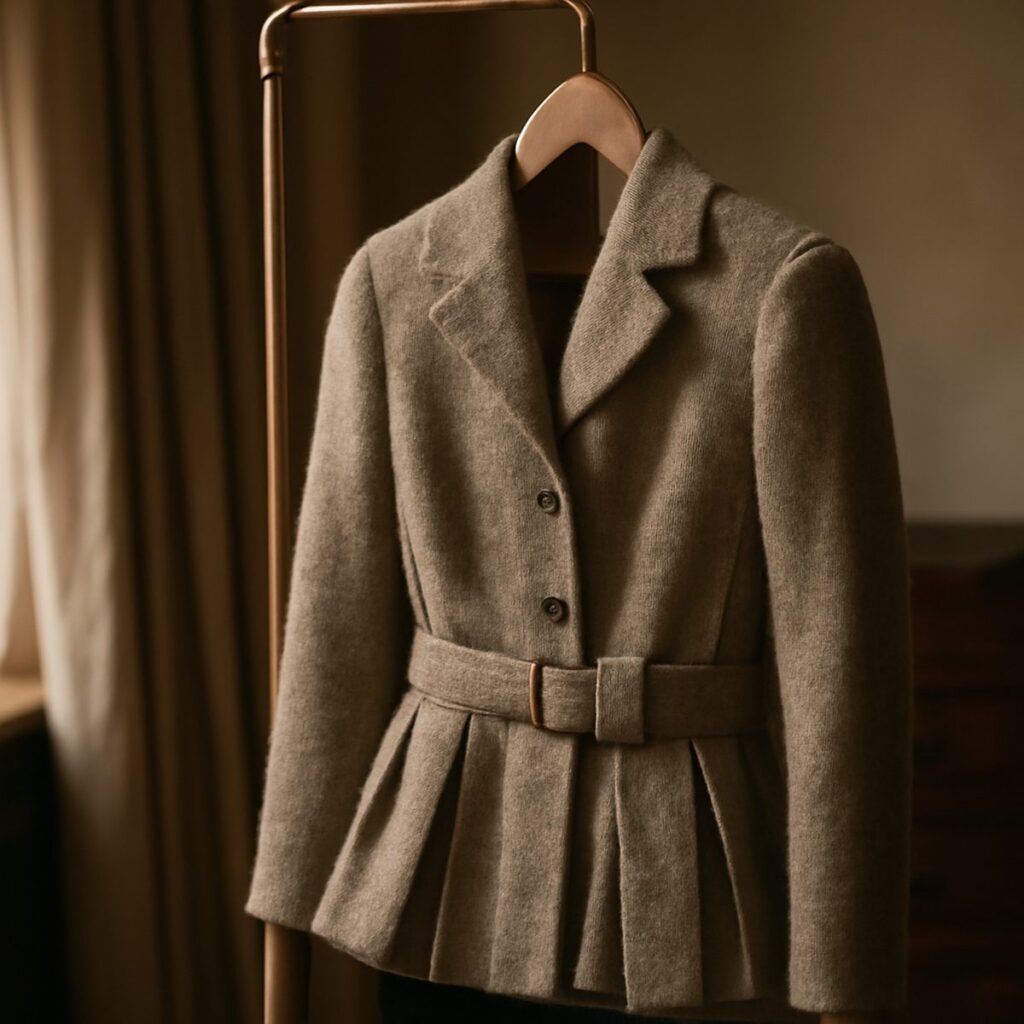
The Art of the Chesterfield in Cashmere
Cashmere lightens the chesterfield's traditional heft while keeping its warmth, though the softer fabric demands considerably more precise tailoring.
 By Daniel Koh
31 August 2026 · 6 min read
By Daniel Koh
31 August 2026 · 6 min read

The chesterfield has survived the better part of two centuries of shifting menswear fashion largely unchanged in its essential proportions — a single-breasted, knee-length overcoat, a concealed or fly-front button closure, a clean line unbroken by a waist seam. What has changed, gradually and considerably, is the fabric most often used to cut one, and a chesterfield made in genuine cashmere rather than the heavier wool of its Victorian origin represents perhaps the single most significant refinement the garment has undergone since its invention.
Why cashmere changes the character of the coat
A traditional chesterfield, cut in a dense melton or heavy worsted wool, carries real structural weight — a coat built to hold its shape through sheer density of fabric, standing away from the body slightly even when unworn on a hanger. Cashmere behaves differently. Its fibre is finer and considerably lighter per unit of warmth than conventional wool, which means a cashmere chesterfield can achieve the same insulating performance at meaningfully less weight, draping closer to the body and moving with a softness that heavier wool simply cannot replicate regardless of how well it’s tailored. The fibre itself repays closer study, and our piece on the Mongolian cashmere coat looks at where some of the finest comes from.
This softness comes with a genuine trade-off in structure. Pure cashmere alone can struggle to hold the crisp, architectural line that defines a proper chesterfield silhouette, which is why the best cashmere chesterfields are rarely spun from cashmere alone — a blend with a small percentage of fine wool, typically somewhere between ten and twenty percent, restores enough structural memory to the fabric to let the coat hold its shape through a full day’s wear without collapsing into something shapeless by evening. Alpaca sits somewhere between the two, and our piece on the chesterfield in alpaca considers how that fibre balances softness against the structure a good coat needs.
Construction details worth understanding
A well-cut chesterfield, regardless of fabric, relies on a handful of specific details to read correctly: a velvet collar, historically a mark of formality though increasingly optional in more contemporary cuts; a fly-front closure that conceals the buttons entirely for the cleanest possible line; and jetted, rather than flapped, pockets that preserve the coat’s flat, unbroken silhouette from shoulder to hem. In cashmere, these details demand even more precise tailoring than in heavier wool, since the fabric’s softness offers less forgiveness for an imperfect seam or an unevenly canvassed chest — flaws that a stiffer wool would simply mask through sheer structural rigidity.
Full canvas construction, where a layer of horsehair or wool canvas is hand-stitched between the outer cashmere and the lining rather than glued, matters more in a cashmere chesterfield than almost any other coat category. It is this canvas, not the outer fabric itself, that ultimately gives the coat its shape and drape, and a cashmere chesterfield built on a fused rather than floating canvas will noticeably lose its structure within a few seasons of regular wear.
What to check before buying
- A cashmere-wool blend rather than pure cashmere, unless you specifically want a softer, less structured silhouette and understand the trade-off.
- Full, floating canvas construction, checked by gently pinching the fabric away from the lining at the chest — a properly floating canvas moves slightly independently.
- A weight of cashmere suited to your actual climate — a heavier winter-weight cashmere will be genuinely uncomfortable in Singapore for anything beyond an air-conditioned evening.
- Consistent, even nap across the whole coat, checked in strong natural light — cashmere’s softness makes any weaving inconsistency more visible than it would be in a coarser wool.
Readers comparing fabric options for this same silhouette should also look at our guides to the art of the chesterfield overcoat and the art of the chesterfield in melton, both of which cover the heavier, more traditional fabric end of the same category. For the broader question of what makes any overcoat worth its price, the quiet power of a great overcoat is worth reading alongside this guide.
“Cashmere forgives almost nothing in the cut — a wool chesterfield hides a mediocre tailor, cashmere exposes one,” a bespoke tailor working primarily in fine cloths told us, running a hand along a half-finished chest canvas.
Wearing a cashmere chesterfield in Singapore
For readers based in the tropics, a full-weight cashmere chesterfield is, honestly, an occasional-wear garment at best — reserved for cooler-climate travel, a handful of genuinely air-conditioned evenings, or simply as a considered piece kept for trips abroad rather than daily local use. A lighter-weight cashmere, spun finer and woven more openly than a traditional winter cloth, offers a reasonable compromise for those determined to wear the coat locally, though even this remains, at best, an evening or indoor garment in Singapore’s climate rather than something worn outdoors for any real stretch of time.
What makes the investment worthwhile regardless of how rarely the coat is actually worn locally is the coat’s performance everywhere else. Packed carefully — cashmere resists creasing better than most people expect when rolled rather than folded — a chesterfield of this quality becomes the single most useful cold-weather garment in a Singapore-based traveller’s wardrobe, worn perhaps only a handful of times a year but earning its place each time through genuine comfort and a silhouette that has never gone out of fashion in nearly two centuries.
Caring for the coat between wears
Cashmere demands gentler handling than wool at every stage of ownership. Brushing after each wear with a proper cashmere brush removes surface dust before it works into the fibre; storage on a wide, well-shaped hanger, in a breathable garment bag rather than plastic, prevents the fabric from developing pressure creases during the long stretches between wear that a Singapore-based owner should honestly expect. Professional cleaning, when necessary, should go to a specialist familiar with fine cashmere specifically — a standard dry-cleaning process, run at the wrong temperature or with the wrong solvent, can flatten cashmere’s characteristic loft permanently.
Treated with this level of care, a genuinely well-made cashmere chesterfield can remain in excellent condition for decades, worn rarely but valued highly — precisely the kind of considered, occasional-use investment piece that rewards patience over frequency.
A coat that carries its history quietly
Part of the chesterfield’s enduring appeal, in any fabric, is how little it insists on being noticed. Unlike more overtly decorative overcoats, its power lies in proportion and cut rather than embellishment, which is precisely why cashmere — a fabric equally understated in its own way, all substance and no visible flourish — suits the silhouette so naturally. Worn well, a cashmere chesterfield reads not as a statement piece but as evidence of a wardrobe built with genuine care over years rather than assembled quickly for effect. Explore further considered outerwear guidance in our Style & Watches section.
Daniel has spent fifteen years arguing that the best watch is the one you never take off.