Why the Atlas Mountains Reward the Patient Traveller
Beyond the souks, Morocco's High Atlas asks for patience and repays it: mud-brick villages, mint tea on a terrace, and mountains that change by the hour.
 By Marcus Lim
1 September 2026 · 6 min read
By Marcus Lim
1 September 2026 · 6 min read
Most travellers meet the Atlas Mountains from a car window, a blur of red rock on the road between the imperial cities and the desert. It is a shame, because the mountains are not scenery to be driven through. They are a place to stop, and the longer you stay the more they give. The High Atlas rewards the patient traveller in a way that the busy circuit of Morocco does not, and understanding why is the beginning of a better kind of trip.
The range runs for hundreds of kilometres, a great wall of rock rising abruptly from the plains, its highest peaks holding snow into the early summer. In its folds live the Berber communities who have farmed these valleys for centuries, terracing the slopes for barley and walnuts, moving flocks up to the high pastures as the season turns. Their world moves at the pace of water and weather, and to travel among them is to be gently pulled back into that older rhythm.
Slowness is not optional
You cannot rush the mountains, and the roads make sure of it. The passes climb in hairpins, the tracks to the villages are often walkable only on foot or by mule, and the weather can close a road for a morning without apology. This is a feature, not a fault. It filters out the impatient and delivers you into valleys where the loudest sound is a river and the ring of a smith’s hammer. Italy’s own quieter high country rewards the same willingness to slow down, as why the Abruzzo mountains reward the patient traveller explains.
Once you accept the pace, the trip reorganises itself. A single valley becomes a week rather than an afternoon. You walk to the next village for lunch and walk back changed by what you saw. The Atlas belongs to the same family of destinations that reward the traveller willing to stay still, where the reward is proportional to the patience.
The hospitality of the high valleys
Berber hospitality is not a performance for tourists; it is a deep cultural obligation, and it is humbling to receive. Arrive at a village and you will be given mint tea, poured from a height into small glasses, before anyone asks your business. The tea is sweet and green and endless, and refusing it is not really an option. Around it grows conversation, often in three languages and much gesturing, and out of that grows the trip’s real texture.
In the mountains a guest is a gift from God, and you feel the weight of that phrase in the way a family will empty its larder for a stranger who arrived an hour ago.
The food is honest mountain fare: bread baked in a communal oven, tagines heavy with preserved lemon and the valley’s own vegetables, walnuts and honey and more tea. Stay in a village guesthouse rather than a resort and you eat what the family eats, which is far better than anything the road can offer.
Light, stone and water
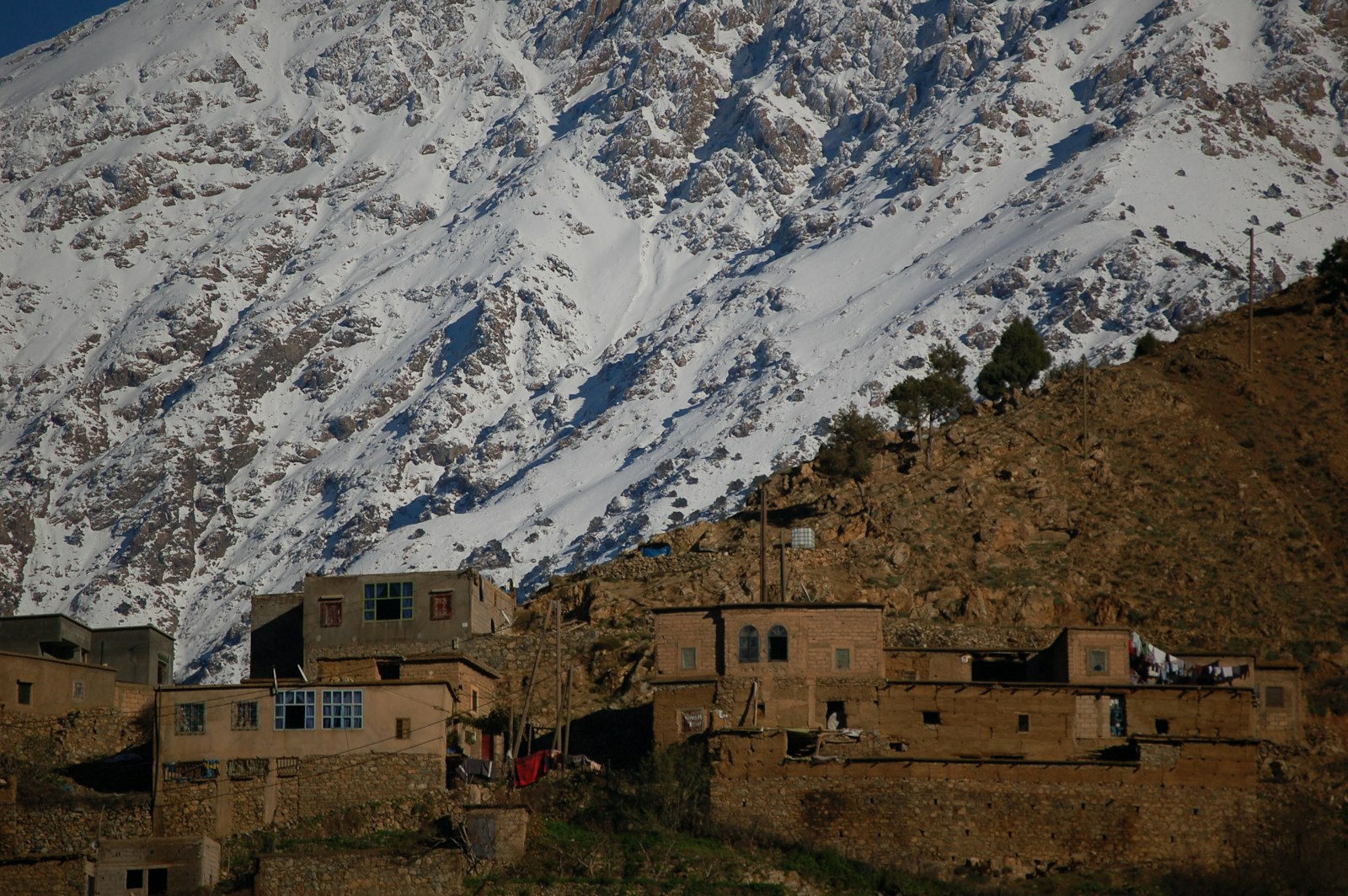
The Atlas is built from earth, quite literally. The villages are made of rammed earth and mud brick, the same red-brown as the mountains behind them, so that a settlement can seem to grow out of the slope rather than sit on it. In the changing light the whole valley shifts colour through the day, from rose at dawn to ochre at noon to a deep bruised purple as the sun drops. It is a landscape that teaches you to notice light, the way the great limestone landscapes teach you to notice stone.
Water is the other protagonist. The whole civilisation of the valleys is organised around the snowmelt, channelled into ancient irrigation systems that turn a dry slope into a ribbon of green orchards and terraced fields. To walk beside these channels, under the walnut trees, past women washing clothes in the cold clear water, is to see a landscape that human care has made beautiful over a thousand years.
How to travel well here
Go with a good local guide; the mountains are not a place to improvise, and a guide from the valleys unlocks doors that stay shut to the independent traveller. Walk more than you drive. Choose one or two valleys and know them well rather than skimming a dozen. And build in empty time, whole afternoons with no plan, because the best moments in the Atlas are the ones you did not schedule.
Season matters. Spring brings blossom and rushing meltwater; autumn brings the walnut harvest and a low golden light. Both share the reflective quality of the finest mountain journeys, the sense that a well-planned slow itinerary is really a plan to do less, better. Summer bakes the plains but the high valleys stay bearable, and winter closes the passes to all but the hardy.
The point of patience
It helps to arrive with the right expectations, because the Atlas withholds its rewards from anyone hunting for spectacle. There are no grand set pieces here, no single view that justifies the journey on its own. Instead the pleasures accumulate slowly and quietly: the particular blue of a painted door, the sound of a loom in a house you pass, the taste of bread still warm from the communal oven, the way a shepherd raises a hand in greeting from across a valley. These are small things, and a traveller moving at speed will miss every one of them. Stay long enough, walk far enough, and they gather into something that a faster trip could never deliver, a sense of having been briefly admitted to a way of life rather than merely having looked at it from the window of a passing car.
There is a version of Morocco that is all souk and spectacle, consumed at speed and photographed relentlessly, and it is not without its pleasures. But the Atlas offers the opposite, and the contrast is the point. Up here nothing performs for you. The villages simply carry on, and if you slow to their pace they let you in, quietly, over tea. For more on building a trip around that kind of stillness, our travel and stays section makes the wider case. The mountains have waited a very long time. They are in no hurry, and they will teach you, if you let them, not to be either.
Marcus writes on travel and hospitality across Asia, and is happiest a long way from a lobby.