
The Well-Considered Dressing Room
Why the dressing room has become the most considered room in the home, and a practical guide to building one that organises rather than just stores.
 By Priya Nair
29 August 2026 · 6 min read
By Priya Nair
29 August 2026 · 6 min read
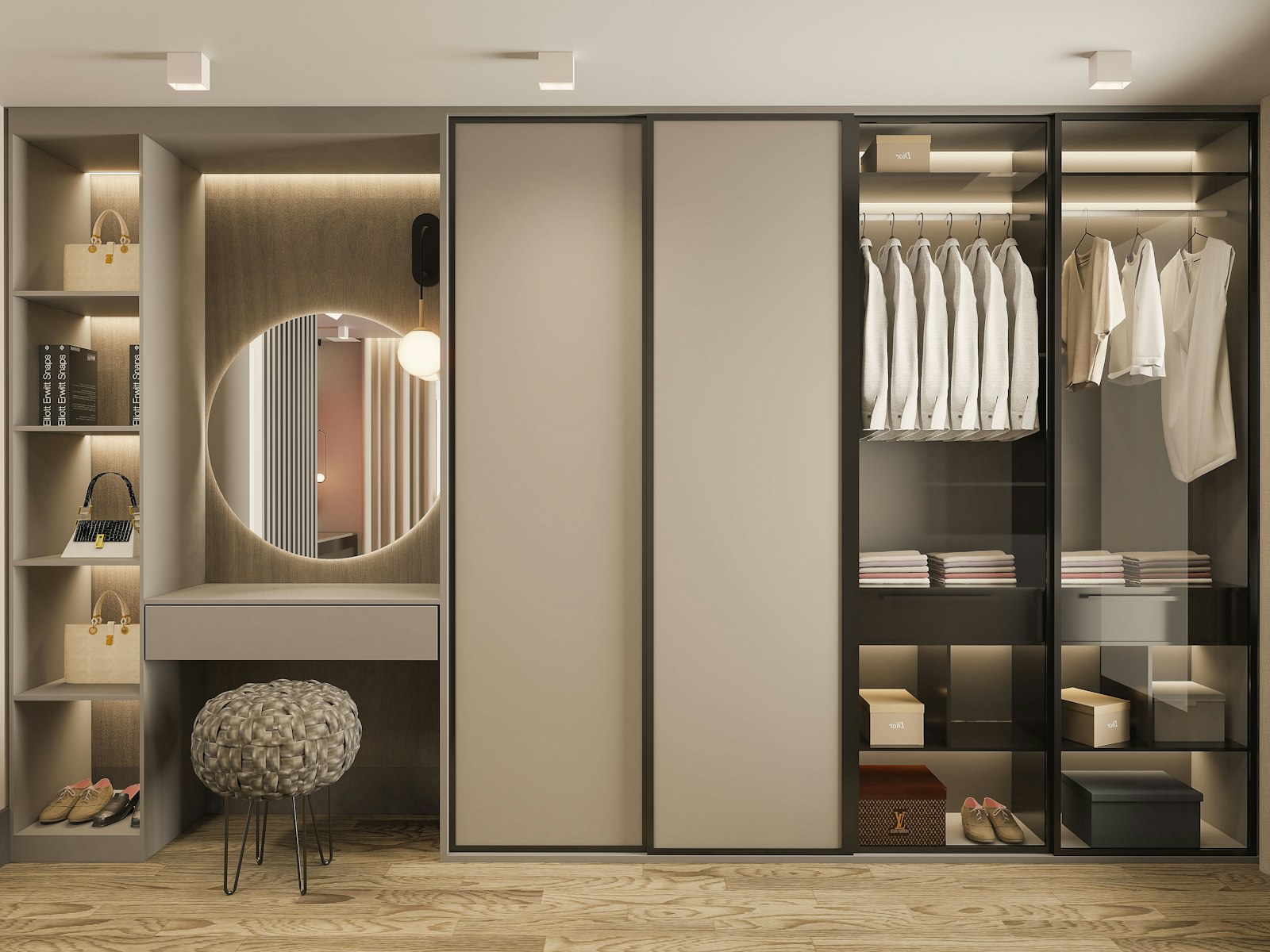
The dressing room occupies a strange position in most homes — larger and more expensively fitted than almost any other single-purpose room, and yet routinely treated as an afterthought in the planning process, squeezed into whatever leftover space remains once the bedroom, bathroom, and everything else has claimed its share. That is beginning to change. A well-considered dressing room is increasingly treated as one of the most important rooms in a renovation brief, not because it needs to be large, but because it is where a household’s daily relationship with its own clothing either works smoothly or quietly frustrates everyone who uses it.
Organisation, Not Just Storage
The fundamental distinction between a good dressing room and a merely large one is the difference between organisation and storage. A wall of hanging rail with no further thought behind it will hold clothes, but it will not help anyone actually get dressed efficiently, and it will not protect the more delicate pieces in a wardrobe from the wear that comes with careless storage. A properly organised dressing room zones its space deliberately: long hanging for coats and dresses, double hanging for shirts and folded trousers, drawer space for knitwear that would otherwise stretch on a hanger, and dedicated, considered storage for accessories that would otherwise end up tangled in a drawer together.
Building Around the Wardrobe That Actually Exists
The most common planning mistake is designing a dressing room around an imagined, idealised wardrobe rather than the one a household genuinely owns. A useful exercise before any renovation begins: catalogue what is actually being stored, roughly by category, and let those real proportions drive the layout rather than a generic template. A household with a strong capsule wardrobe approach needs a very different configuration from one with an extensive collection of formalwear or a serious shoe collection — and designing for the wardrobe that exists, rather than the one a showroom display suggests, produces a far more useful room.
Shoes Deserve Their Own Careful Thought
Good shoes, properly cared for, are an investment worth protecting, and a dressing room’s shoe storage should reflect that rather than treating footwear as an afterthought crammed into a shallow cubby. Open shelving with a slight incline, allowing a shoe’s toe to rest slightly upward, both displays a collection attractively and helps the shoe hold its shape between wears. This matters more than it might first appear — the care that goes into building a shoe wardrobe is only fully honoured by storage that protects the investment properly, rather than storage that lets good leather crease and deform from being stacked or crowded.
A short list of shoe-storage habits worth building
- Cedar shoe trees for leather shoes, inserted immediately after wearing while the leather still holds some warmth and moisture.
- Enough shelf depth for the full length of a shoe, rather than a shallow ledge that leaves the heel unsupported.
- Separate, breathable storage for suede, which does not tolerate the same handling as smooth calfskin.
Materials That Actually Belong in a Dressing Room
Cedar-lined sections offer genuine, practical protection against moths and musty air in Singapore’s humidity, not merely a pleasant scent. Open shelving in a natural material such as oak or rattan tends to feel warmer and less clinical than an all-white fitted system, and it echoes the enduring case for natural materials found elsewhere in a considered home. Glass-fronted or open display sections for a small, genuinely prized collection — watches, jewellery, a handful of exceptional accessories — turn the room into something closer to a personal boutique than a purely functional storage space.
A dressing room’s real success is measured on an ordinary Tuesday morning, not in how it photographs when perfectly styled.
Lighting a Dressing Room Correctly
Colour-accurate lighting is essential in a room whose entire purpose is helping someone judge how clothes actually look, and it is a detail frequently overlooked in favour of purely decorative fixtures. A lighting temperature close to natural daylight, ideally supplemented by a full-length mirror positioned to catch that same light rather than standing in its own shadow, prevents the common frustration of an outfit that looks entirely different once a person steps outside the room.
Scaling the Idea Down
Not every home has the square footage for a dedicated walk-in room, and the same organising principles scale down comfortably to a well-fitted section of a bedroom or a considered reach-in closet. The zoning logic — long hang, double hang, folded storage, protected shoe storage — matters far more than the room’s overall size, and a small, genuinely well-organised space will always outperform a larger one arranged without the same care, much as the bedroom, pared back argues for the room next door.
Mirrors and the Getting-Dressed Ritual
A dressing room’s mirror is easy to treat as an afterthought, mounted wherever a gap in the layout happens to allow, when in fact its size, position, and lighting shape the entire daily experience of getting dressed. A full-length mirror positioned with enough clearance to step back several paces, rather than one mounted flush against a wall with no room to properly assess an outfit, makes an outsized difference to how confidently someone leaves the room each morning. A second angled mirror, where space allows, lets a person check details — a collar, the back of a jacket — that a single flat mirror simply cannot show. Those who want the room to serve as a private retreat as well as a place to dress may enjoy our piece on the return of the boudoir.
Placement relative to the room’s light source matters just as much as the mirror itself. A mirror lit from directly overhead casts unflattering shadows across the face and creates a genuinely misleading impression of how an outfit will look under normal daylight or evening lighting elsewhere. Positioning the mirror so that light falls evenly across a person standing in front of it, ideally supplemented by the same daylight-balanced fixtures discussed above, removes one of the more common small frustrations of an otherwise well-planned room. The same attention to daylight once shaped an entire room of the house, as our piece on the return of the morning room explains.
A Room Worth the Investment
A well-considered dressing room rewards its owner daily, in a way many more visually impressive rooms in a home do not — a smoother morning, clothes that last longer because they are stored properly, and a genuine pleasure in seeing a wardrobe displayed with the same care that went into choosing each piece in the first place. It is, in the end, one of the few rooms in a home whose value is measured almost entirely in convenience rather than appearance, which makes it easy to underrate and genuinely worth getting right, and it sits well alongside the rest of Homes & Culture‘s case for rooms built around genuine daily use.
Priya tours the homes most people only glimpse from the road, and asks how they are really lived in.


