The Ceramicists Shaping the Modern Table
Inside the studios where handmade ceramics are quietly replacing the matching dinner set, and why an imperfect glaze has become its own kind of prestige.
 By Priya Nair
29 August 2026 · 6 min read
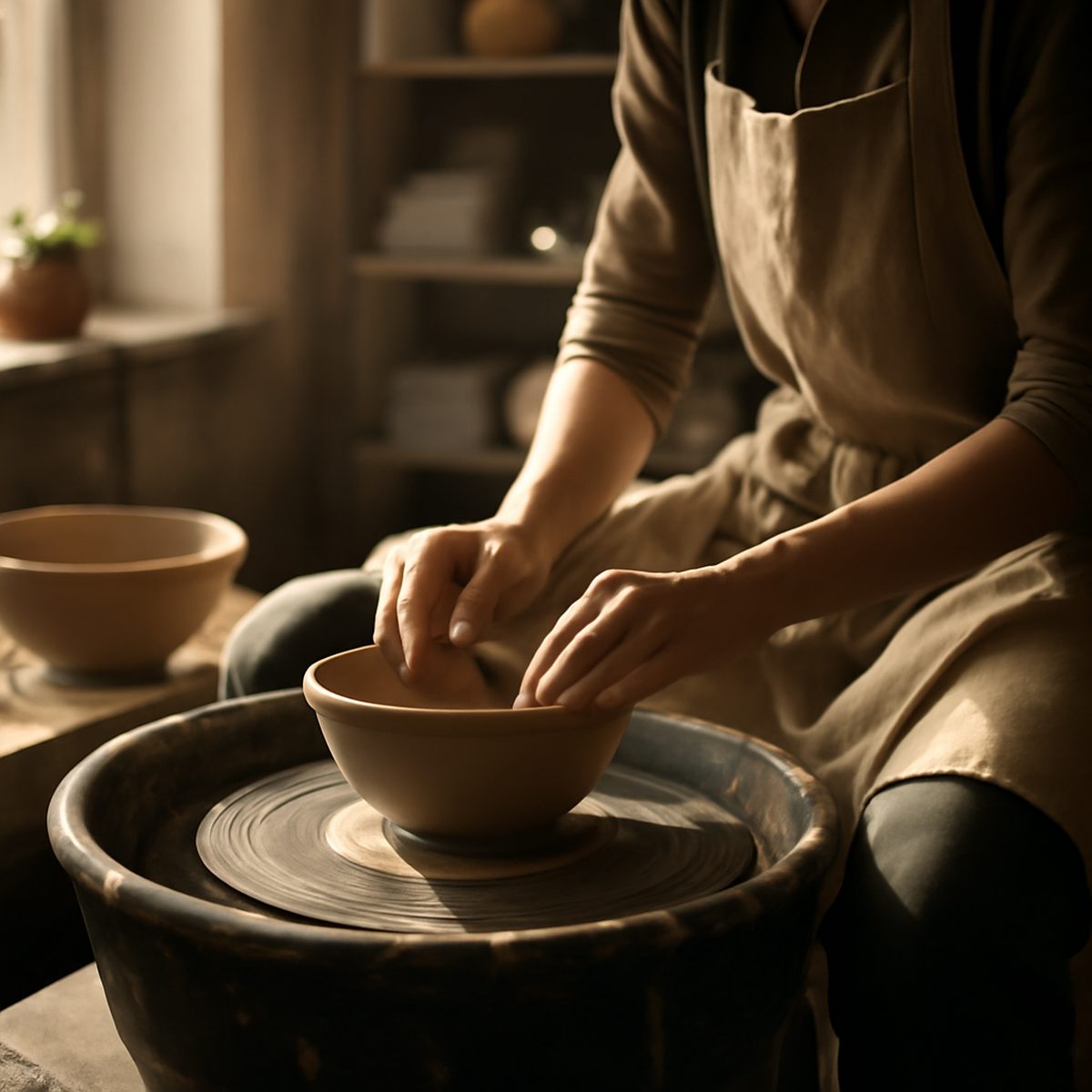
In a walk-up unit above a row of shophouses, the wheel turns at a pace that has nothing to do with anyone’s delivery deadline. A composite ceramicist working out of a converted shophouse studio in the Joo Chiat area describes her practice simply: “I make forty bowls to keep six.” That ratio, once explained, tells you almost everything about why handmade ceramics have become the quiet obsession of a certain kind of Singapore household — the kind that has already done the renovation, bought the good sofa, and is now looking for something with more soul than a matching sixteen-piece dinner set from a department store.
Why the imperfect bowl won
For a decade, the dominant aesthetic in local dining rooms was flawless uniformity — white porcelain, identical rims, the sort of set that photographs well and says nothing. The shift towards handmade ceramics is, in part, a reaction to that sameness. A hand-thrown bowl carries the faint spiral of the potter’s fingers, a glaze that pools slightly differently on each piece, an asymmetry that machine production simply cannot replicate. Collectors describe this as “the tell” — the detail that proves a human being, not a factory line, made the object in front of you. It is the same instinct explored in why the best interiors now whisper, where restraint and texture have quietly overtaken statement pieces as the mark of a considered home.
What separates a serious studio from a hobbyist
Singapore’s ceramics scene has grown from a handful of hobbyist kilns to a genuine, if small, professional ecosystem, and the difference between the two is easy to spot once you know what to look for.
- Glaze consistency within intentional variation — controlled imperfection, not accidental failure.
- A foot ring that has been properly trimmed and finished, not left rough underneath.
- A stated clay body and firing temperature, which speaks to durability for daily use rather than display only.
- Pieces that are dishwasher-honest about their limits — a good studio will tell you plainly what needs hand-washing.
The serious studios tend to fire in small batches, often no more than a dozen pieces per glaze run, which is part of why a favourite bowl can never quite be replaced once it chips. That scarcity is not a marketing device; it is simply the physics of a wood-fired or gas kiln operated by one or two people rather than a factory.
What you’re actually paying for
The price gap between a handmade bowl and its mass-produced equivalent can look startling until it is broken down properly. A studio piece carries the cost of the potter’s years of training, the slow attrition of a kiln firing where a meaningful share of any batch can crack or warp beyond saving, and the simple fact that one person can only throw so many pieces in a working day. None of this is padding; it is the actual cost structure of small-batch production, and it is worth understanding before assuming a handmade mug is somehow overpriced next to a department-store equivalent made by machine in the thousands. The same respect for craft and handwork informs another group of makers, profiled in our piece on the lighting designers shaping the mood.
Buyers new to the category often ask how to judge value across different studios, and the honest answer is that it rarely correlates neatly with price alone. A newer potter still developing their glaze chemistry may charge less than an established name and produce work that, piece for piece, holds up just as well at the table. The more reliable signal is consistency across a body of work — visiting a potter’s past output, whether online or in person, tells you far more about what to expect from a future commission than the price tag on a single piece.
Building a table from artisan tableware, sensibly
The temptation, once a household discovers handmade ceramics, is to replace everything at once. Resist it. The better approach mirrors how a considered wardrobe or a fine jewellery collection is built — slowly, piece by piece, favouring things that will be used constantly over things that merely complete a set. Start with the pieces used daily: a rice bowl, a set of small plates, a single serving dish substantial enough to anchor a table. Cups and mugs, handled constantly, are an excellent place to learn a maker’s hand before committing to larger, more expensive forms.
“A good ceramic table doesn’t match. It agrees,” one collector who has spent five years assembling her own from studios across the region told us.
Where the craft is heading next
The next generation of local ceramicists is pushing beyond the now-familiar earthy palette of browns and off-whites into more ambitious territory — layered glazes, reactive finishes that shift colour depending on what is placed inside the vessel, and forms borrowed from architecture rather than tradition. Several are also collaborating directly with chefs, designing plateware specifically for tasting menus, a partnership visible in kitchens covered in Inside Singapore’s Most Ambitious New Tasting Menu, where the ceramics are as considered as the food they carry. It is a natural pairing: both disciplines reward patience, and both punish anyone chasing trend over technique, a discipline shared by the makers profiled in the furniture makers betting on patience.
Caring for what you collect
Handmade ceramics ask a little more of their owners than mass-produced tableware. Avoid sudden temperature changes, which can crack a hand-thrown piece that a machine-fired one might survive. Store bowls with soft dividers rather than stacked rim-to-rim, where the unglazed foot can scratch the glaze below. And accept, eventually, that something will break — most serious collectors we spoke with described the first breakage not as a tragedy but almost a relief, proof the piece had actually been used rather than merely displayed, much like the well-worn shophouse interiors documented in a shophouse reborn in concrete and teak.
A table worth setting
What draws people back to these studios, again and again, is not really the object itself but the relationship to it — knowing the hands that made your bowl, understanding why the glaze pooled the way it did, feeling the faint asymmetry under your fingers each time you eat. It is a small, deliberate rebellion against a world of identical things, and it fits neatly within the broader shift covered across our Homes & Culture pages, where craft, patience and imperfection have quietly become the new luxury.
Priya tours the homes most people only glimpse from the road, and asks how they are really lived in.