The Case for the Gun Club Check Jacket
A gun club check reads as a plain jacket from across a room and rewards a close look. Here is the case for this quietly clever tweed, and how to wear it.
 By Daniel Koh
2 September 2026 · 6 min read
By Daniel Koh
2 September 2026 · 6 min read
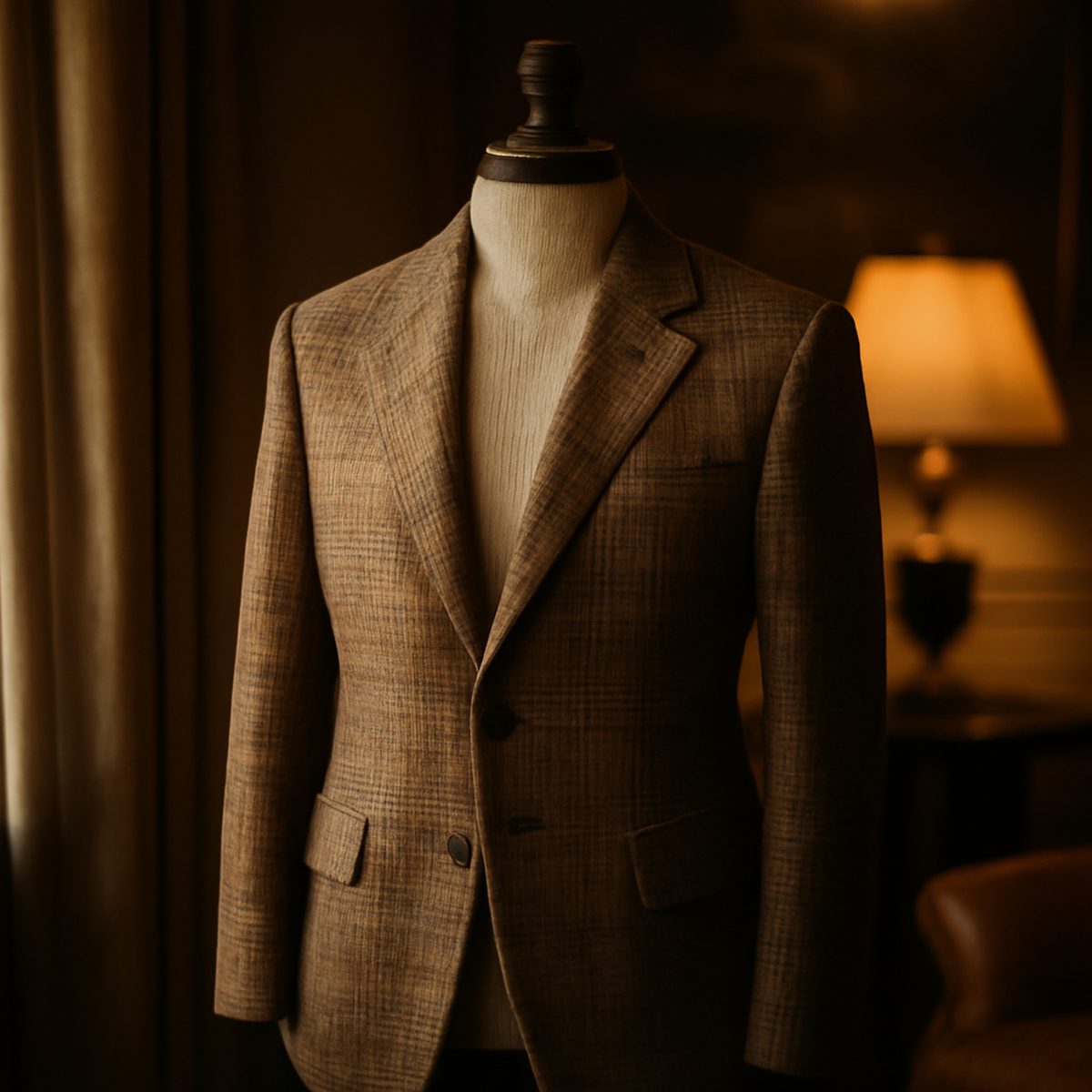
From across a room it reads as a plain brown jacket, the sort of quiet, earthy tailoring a discerning eye barely registers. Step closer and it resolves into something cleverer: a small, dense check of overlapping colours, each square holding two or three earth tones at once. This is the gun club check, one of tailoring’s great sleights of hand, a pattern engineered to behave like a solid at distance and reward attention up close. It is, for my money, the most useful check a man can own.
The name carries a whiff of the field, and the origins are sporting, but there is nothing costume about a good gun club today. Worn with modern restraint it is simply a warm, versatile jacket that flatters almost everyone and quarrels with almost nothing. Making the case for it means understanding what the pattern actually does.
What the pattern is doing
A gun club check is built from a small, repeating check woven in several colours, typically a run of muted earth tones such as brown, rust, gold, moss and a whisper of blue. Because those colours sit close together on the wheel and none shouts, the eye blends them at any real distance into a single warm, indeterminate brown-green. It is optical mixing, the same trick a painter uses, worked in wool.
This is why the jacket is so forgiving. A bold windowpane commits you; a gun club lets you have pattern and quiet at once. It brings texture and depth to an outfit without asking to be the centre of it, which is exactly the balance the best tailoring strikes. If you are drawn to that logic, our case for the cheviot tweed jacket makes a related argument for honest, hard-wearing cloth.
Choosing the cloth
Gun club checks live almost exclusively in tweed and other woollens, which suits their character. The weight matters more than the label. A heavier tweed, in the region of a proper autumn cloth, drapes with authority and shrugs off weather; a lighter one travels and layers better in a warm climate. For most wardrobes a mid-weight is the sweet spot, and understanding where a cloth sits on that scale is worth the small study we set out in understanding the difference in wool weights.
Look closely at the ground colour, because it sets the whole tone. A brown-based gun club is the workhorse, sliding under almost any trouser. A grey-based one leans smarter and cooler. A green-based one is the most characterful and the hardest to place. When in doubt, brown earns its keep first and leaves the more particular choices for later.
A gun club check is the jacket that lets a careful dresser wear a pattern without ever looking as though they are trying to.
How to wear it
The gun club rewards a restrained hand, because the jacket already carries the interest. Let it lead and keep everything around it calm.
- Trousers: Plain flannel or cavalry twill in grey, tan or cream lets the check breathe. Avoid a second pattern below the waist unless you are very sure.
- Shirts: A plain oxford, a soft blue, a cream or a fine tattersall all sit happily beneath. The check does the talking.
- Knitwear: A fine roll-neck or a lambswool crew under the jacket makes it a cold-weather staple, and our return of the covert coat shows the kind of quiet outerwear that layers over the top without a fight.
Footwear should stay in the same earthy register: suede in tan or snuff, or a country-weight brogue in brown. The whole point of the jacket is warmth and cohesion, so let the palette gather rather than scatter.
A short history worth knowing
The gun club check earns part of its charm from its lineage. The pattern descends from the district checks worn on British and Scottish estates, designed so that the men of a particular ground could be recognised at a distance and, just as usefully, so that the wearer melted into the moor and heather rather than standing out against it. The gun club version, with its warm run of overlapping earth tones, was a later refinement of that idea, and it carries the same double logic: to be quietly identifiable up close and effectively invisible far off. Its most famous relative in the district-check family has long since moved from field to city, as our case for the Prince of Wales check suit explains.
That heritage is not a reason to dress in costume, but it does explain why the jacket works so well. A pattern engineered for camouflage in a natural landscape will always sit comfortably in the muted, earthy palette that flatters most people, which is why the gun club has outlived its sporting origins so completely. Wearing one today is less an act of nostalgia than of borrowing a genuinely clever old idea, in much the way we argue for other estate-born cloths in the case for the Donegal tweed jacket.
Where it belongs
A gun club is the most quietly versatile jacket in a considered wardrobe. It is too textured for a boardroom that still insists on worsted, but everywhere less formal it excels: dinner with friends, a weekend in the country, an autumn city day when you want to look put together without looking as though you tried. It bridges town and country as few garments do, which is precisely the balance our Style & Watches pages return to again and again.
Buy one good gun club and you will find yourself reaching for it far more than for flashier things. It is the jacket that solves the middle of the week, the odd occasion, the day with no dress code, and it does so while looking, from a distance, like nothing much at all. That combination of usefulness and modesty is the whole argument for tweed in general, and the gun club states it more elegantly than most. It is the rare jacket that grows more useful the longer you own it, softening with wear and quietly proving its worth on the days when you least expect to need it. Own one good gun club and you will wonder how you ever dressed for autumn without it.
Daniel has spent fifteen years arguing that the best watch is the one you never take off.