The Best Materials for a Statement Kitchen Apron
The apron-front sink is the hardest-working fixture in a considered kitchen. How to choose a material that will still look right in twenty years.
 By Priya Nair
31 August 2026 · 6 min read
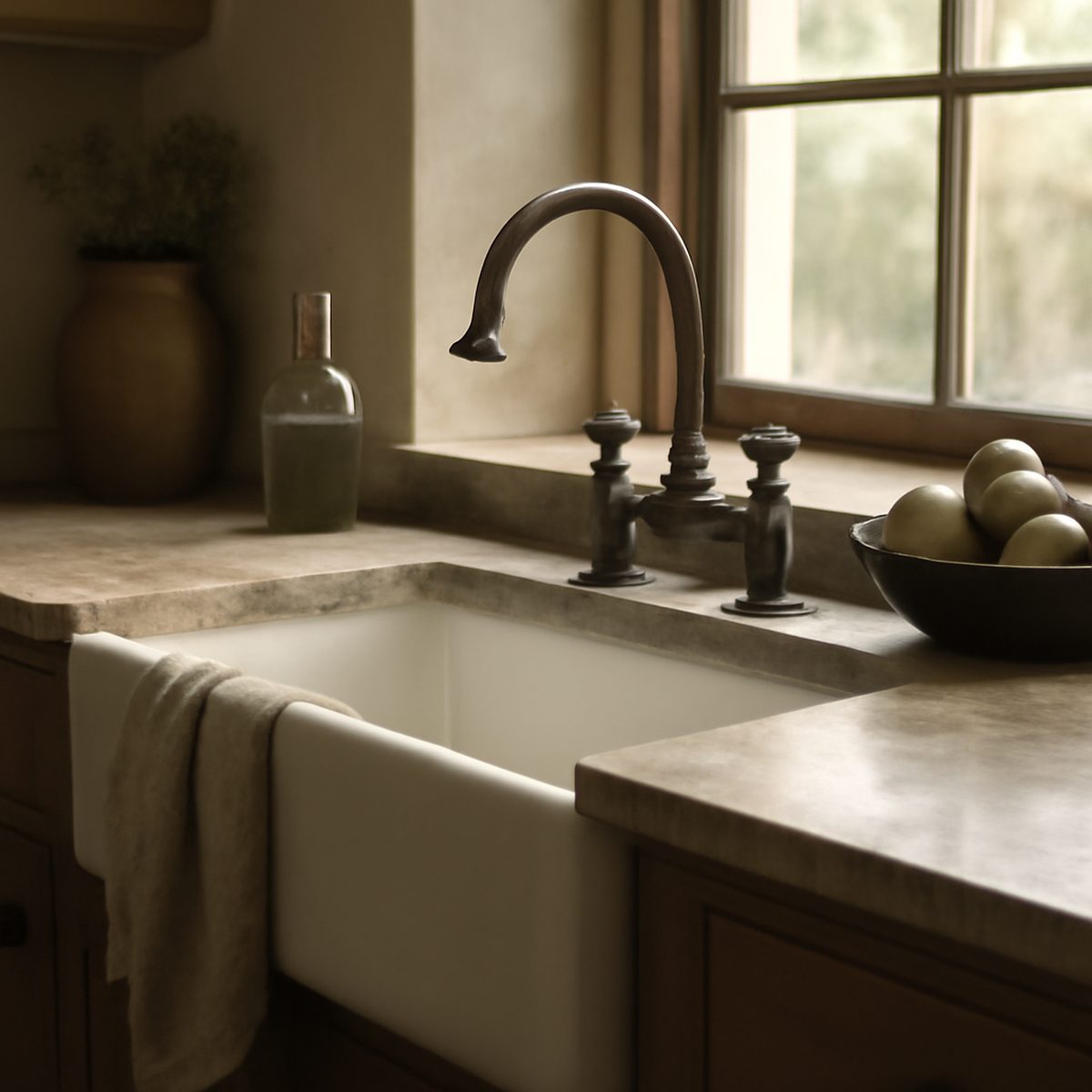
Long before the apron-front sink became a fixture of the considered kitchen, it was simply the practical solution to a very old problem: how to make a sink deep enough and sturdy enough to survive decades of daily use without cracking. The exposed front panel — the “apron” — traces back to farmhouse kitchens where a single deep basin needed to serve laundry, produce washing and dishes alike, all day, every day. That functional history is worth remembering when choosing a material today, because the apron sink is still, in most homes, the single hardest-working surface in the kitchen, and the wrong material choice shows its wear within a few years rather than a few decades.
Fireclay: The Traditional Choice
Fireclay remains the benchmark material for a reason. Fired at extremely high temperatures until the clay body vitrifies into a dense, glass-like surface, a genuine fireclay sink resists chipping, staining and scratching far better than most alternatives, and its glossy finish is fused through rather than applied as a coating — meaning it cannot wear thin the way an enamel-over-cast-iron sink eventually does. The trade-off is weight and price: a fireclay apron sink needs proper cabinetry support beneath it, and the material commands a premium over stainless steel for an equivalent size. The same appetite for considered, traditional rooms extends beyond the kitchen, as our piece on the return of the parlour suggests.
What to check before buying fireclay
- Wall thickness — a genuinely dense fireclay sink should feel substantially heavier than it looks.
- Glaze consistency — pooling or thin patches at corners suggest a rushed firing.
- Radius corners — tighter, more precise corners generally indicate a higher-quality mould.
Stainless Steel: The Practical Workhorse
A well-made stainless steel apron sink, in a heavier gauge than the thin stamped sinks common in budget kitchens, offers genuine practicality: it resists heat, will not chip or crack, and is straightforward to repair or replace if damaged. Its detractors point to visible scratching over time and a colder, more utilitarian look than fireclay or stone — though a brushed rather than polished finish disguises most everyday marking, and many considered kitchens now use steel deliberately for its honest, unfussy character rather than in spite of it.
Concrete and Composite Stone
Concrete apron sinks, typically cast to order, offer a material warmth and a genuinely bespoke option — colour, texture and even embedded aggregate can all be specified — but require sealing and are more porous than fired ceramic, meaning staining from wine, turmeric or coffee is a real risk without diligent maintenance. Composite granite sinks split the difference reasonably well: engineered from crushed stone and resin, they resist heat and scratching close to fireclay’s standard while costing meaningfully less, though the surface reads as more matte and less luminous than true fireclay’s fired glaze.
“We chose fireclay because our architect told us plainly: this sink will outlast the cabinetry around it. Twelve years on, she was right.”
Undermount, Top-Mount and the Apron Alternative
Worth noting for anyone weighing up options is that the apron front is not the only way to achieve a similar deep-basin practicality — undermount sinks, fixed beneath the counter’s edge, offer a cleaner sightline and easier wiping-down of crumbs directly into the basin, though without the visual presence an apron front provides. A statement apron sink is chosen deliberately for that presence: it announces itself as the kitchen’s focal point in a way an undermount sink, by design, deliberately avoids. Anyone unsure which suits their kitchen better should think about how much the room is meant to showcase craftsmanship versus disappear quietly into the background — a question worth answering before, not after, cabinetry is ordered. A kitchen leaning toward simplicity elsewhere often benefits most from letting the sink carry that visual weight instead.
Copper and the Case for Patina
Copper apron sinks are the outlier on this list, chosen almost entirely for character rather than practicality. Living metal patinas over time, developing a warm, uneven colour that many owners come to prize precisely for its imperfection — though this requires accepting the material’s soft surface, which will show marks readily, and its need for periodic waxing to slow (though never stop) the patina’s progress. It is a material choice for a kitchen where character is valued over pristine consistency, and it pairs particularly well with a wider material palette already leaning warm — brass hardware, timber cabinetry, and a similarly considered statement kitchen backsplash.
Sizing, Depth and the Cabinetry Beneath
An apron sink is defined as much by what sits beneath it as by the material of the basin itself. Because the front panel is exposed rather than concealed behind a cabinet door, the base cabinetry has to be built or retrofitted specifically to accommodate it — a standard cabinet run cannot simply have a sink dropped in. Depth is worth considering carefully too: a deeper basin, in the 25–28cm range, accommodates large stockpots and baking trays far more comfortably than the shallower 18–20cm basins common in smaller kitchens, though the trade-off is a lower working height that can strain the back of a taller cook over long sessions. A proper single-lever or bridge tap, mounted with enough clearance for the apron’s protruding front, is worth specifying alongside the sink rather than left to a plumber’s default choice, since a tap mounted too low will clash with the basin’s exposed lip.
Matching the Sink to the Kitchen’s Working Life
The right choice ultimately depends less on aesthetics than on how the kitchen is actually used. A household that cooks daily and hard — real produce washing, large pots, heavy daily traffic — is generally better served by fireclay or heavy-gauge steel than by concrete or copper, whatever the latter offer in character. A kitchen used more occasionally, where the sink is as much a design statement as a workhorse, can afford to prioritise material warmth over sheer durability. Colour is worth weighing against the rest of the room too: a pure white fireclay basin reads crisply against warm timber cabinetry but shows limescale and tea staining more readily in hard water than a putty or graphite tone, which is why many considered kitchens now specify a mid-tone glaze deliberately, trading a little brightness for years of easier upkeep.
Either way, the sink is worth specifying early in a kitchen renovation rather than as an afterthought, since cabinetry, plumbing and even counter depth often need to be built around it rather than the reverse. Get the sequencing wrong and the sink becomes the one fixture that cannot be changed without unpicking the whole kitchen around it — exactly the outcome careful planning at the outset is meant to avoid. For related fixtures worth considering alongside it, our notes on the butler’s sink and larder and choosing the right kitchen sink are useful companion reading, and the broader Homes & Culture section carries further material guides for a kitchen built to last.
Priya tours the homes most people only glimpse from the road, and asks how they are really lived in.