The Art of the Greatcoat
The greatcoat was built to survive a battlefield winter. Worn correctly today, it still carries that same quiet, unshowy authority through a cold commute.
 By Daniel Koh
31 August 2026 · 6 min read
By Daniel Koh
31 August 2026 · 6 min read
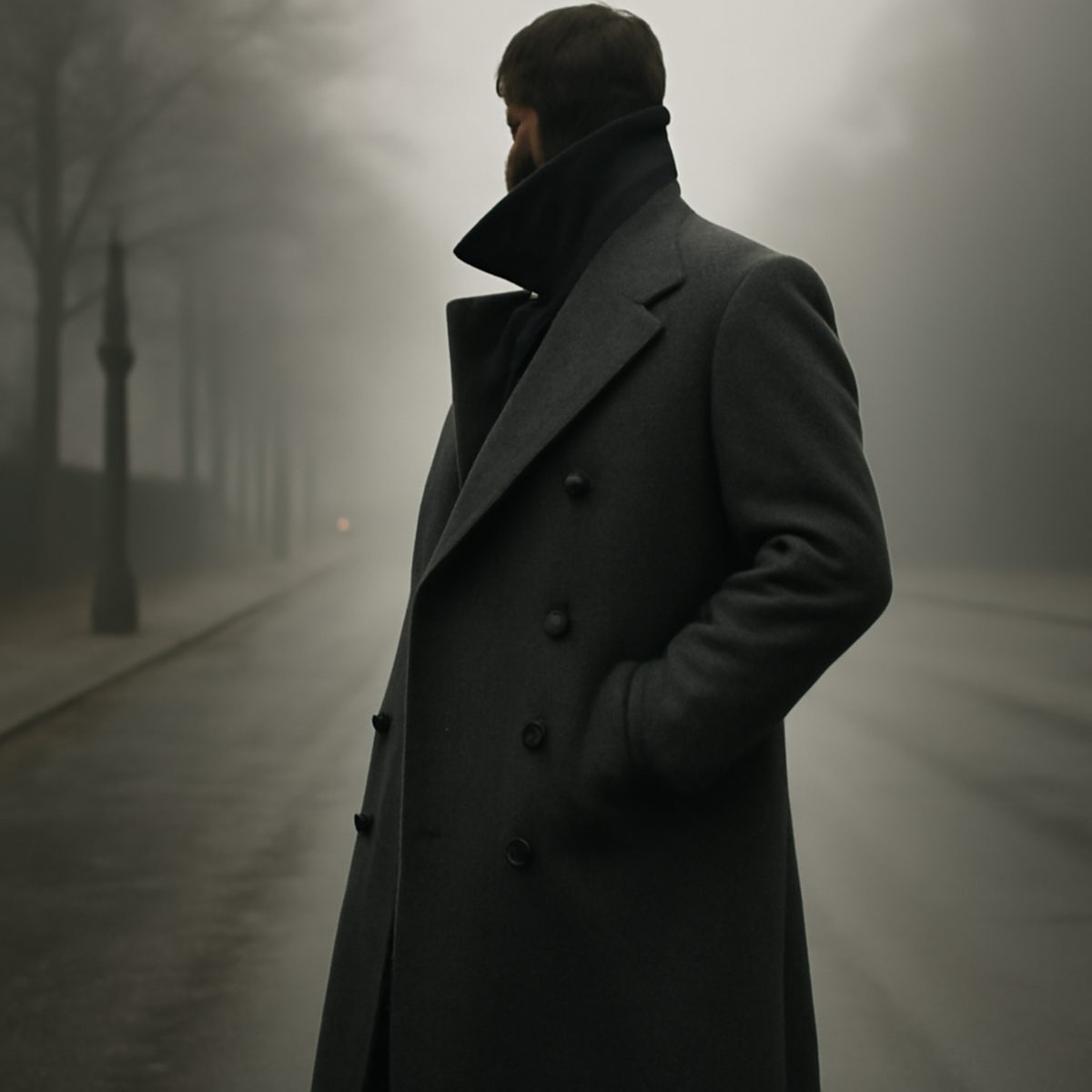
Few garments carry their origin story as plainly as the greatcoat. Descended directly from military dress — heavy wool coats issued to officers and infantry alike to survive extended exposure through cold campaigns — it retains, even now in its civilian form, a certain unmistakable authority that lighter overcoats simply cannot replicate. Put one on and the posture changes slightly. This is not accidental; it is a garment engineered, quite literally, to be stood up straight in.
A history built for endurance
The greatcoat’s defining features — a heavy wool cloth, generous double-breasted closure, a deep collar that could be turned up against wind, and a cut long enough to cover the knee — all trace back to genuine battlefield necessity rather than aesthetic preference. Officers needed a coat that could function as both outerwear and, when required, a makeshift blanket. The weight of the cloth, often a dense melton or heavy wool twill, was chosen for its wind resistance and durability rather than its drape, and it is precisely this uncompromising practicality that gives the modern greatcoat its distinctive, slightly severe silhouette.
How the cut has softened, and where it hasn’t
Contemporary tailors have inevitably softened the greatcoat’s most extreme proportions — modern versions are generally cut with slightly narrower shoulders and a marginally shorter length than their military ancestors, better suited to city streets than a campaign trail. What has not changed is the coat’s essential structure: the double-breasted front, the substantial collar, the sense of real weight on the shoulders when you put it on. A well-made greatcoat should feel, if not literally heavy, at least serious — this is not a coat designed to be light and forgotten about, in the way a raincoat or a mac often is. Readers weighing the greatcoat against its closest tailored relatives should also consult our pieces on the art of the guards coat and the art of the Ulster and storm coat, both drawn from similarly military lineages but with distinct cuts of their own.
Choosing cloth and colour
The classic greatcoat comes in charcoal, navy or a deep military grey — colours that echo the garment’s origins without demanding a full period costume around them. Cloth weight matters enormously here; anything under 600 grams per metre will struggle to hold the structure the silhouette depends on, and the coat will read as an imitation rather than the genuine article. A proper greatcoat should be able to stand nearly on its own when hung, a small but telling test of the cloth’s quality. Our companion piece on the return of the greatcoat considers why this severe, practical coat has found its way back into modern wardrobes.
Wearing it well in a modern wardrobe
- Layer it over tailoring rather than casualwear where possible — the coat’s formality expects a collar and a proper trouser beneath it.
- Leave the top button or two undone rather than closing every fastening; a fully buttoned greatcoat can read as costume rather than clothing.
- Resist the urge to belt it tightly at the waist — the silhouette works best with a straight, architectural drop.
Getting the proportions right
Fit matters more with a greatcoat than with almost any other outer layer, precisely because the garment’s silhouette is so architectural to begin with — a coat this substantial, cut even slightly wrong, reads as ill-fitting rather than simply oversized. The shoulder seam should sit exactly at the shoulder’s natural edge, with no excess fabric pooling or pulling; everything below that point is where the coat is meant to carry its volume. Sleeves should allow a jacket or heavy knit underneath without binding at the elbow, since a greatcoat is, by design, a layering piece rather than something worn directly over a shirt alone.
Length is the other proportion worth getting precisely right. Too short, and the coat loses the sense of coverage and gravity that defines the style, edging closer to an ordinary overcoat; too long, and it risks reading as costume rather than tailoring. A length falling somewhere between mid-calf and just above the ankle tends to hit the mark most reliably, though this should always be balanced against your own height and the proportions of whatever trouser or boot you intend to wear beneath it. A good tailor will adjust hem length as a matter of course, and it is worth the alteration rather than accepting an off-the-rack length that does not quite suit your frame.
“People think a greatcoat is a costume piece until they actually wear one through a proper cold snap,” one bespoke tailor told us. “Then they understand why officers refused to give theirs up even once the uniform requirement changed.”
A coat that still means something
What the greatcoat offers a modern wardrobe is not simply warmth, though it delivers that comprehensively, but a genuine sense of occasion. It is not a coat you reach for absent-mindedly; putting one on is a small act of formality, a decision to look considered rather than merely covered.
Buying one, then, is worth treating as a considered purchase rather than an impulse against a sudden cold snap. A greatcoat bought in genuine need, in the depths of an unexpected winter, is more likely to be chosen for immediate availability than for cloth quality or proper fit, and the compromises made under that kind of pressure tend to show for years afterward. Shopping ahead of the season, with time to have a coat properly altered and to compare cloth weights across several options, produces a considerably better outcome — and a coat genuinely worth the weight it carries on your shoulders every time you put it on, season after season, for as long as you own it, and very possibly for a good deal longer than that, passed down eventually to someone who will value it just as much. For a wardrobe otherwise built around the more forgiving pieces catalogued in our guide to how to build a cold-weather wardrobe, the greatcoat functions as the anchor piece — the one item that raises the register of everything worn beneath it. The wider range of our tailoring and outerwear coverage sits within Style & Watches.
Daniel has spent fifteen years arguing that the best watch is the one you never take off.