How to Choose and Style Gooseneck Lamps
A gooseneck lamp brings a distinctive curved silhouette and real task flexibility. Here is how to choose the right one and place it well in a room.
 By Priya Nair
1 September 2026 · 6 min read
By Priya Nair
1 September 2026 · 6 min read
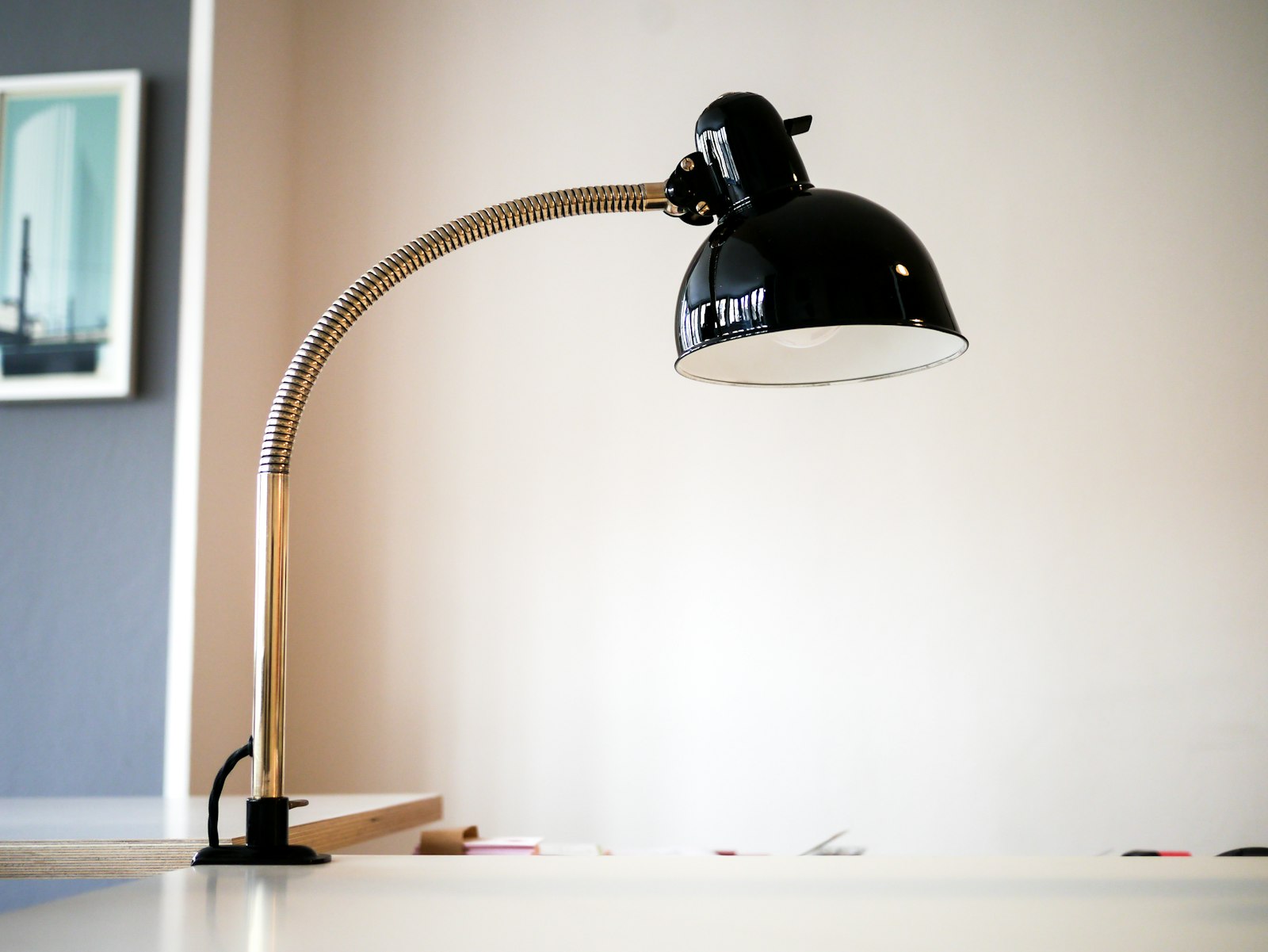
The gooseneck lamp occupies a particular niche in lighting design — instantly recognisable by its long, curved arm, sourced originally from industrial and workshop settings where a flexible, repositionable light was a genuine functional necessity rather than a style choice. That heritage is exactly what gives the form its enduring appeal in a home setting: it looks purposeful rather than purely decorative, and it genuinely performs the task it was designed for, bending and adjusting to direct light with real precision.
Understanding the silhouette variations
Not all gooseneck lamps share the same curve. Some feature a single continuous arc from base to shade, a form borrowed most directly from vintage industrial fixtures; others use a jointed, articulated arm with one or two hinge points, offering more precise directional control at the cost of some of the pure sculptural elegance of an unbroken curve. The choice between the two is largely a question of use — a jointed arm suits close, precise task work like reading or fine handiwork, while a single sweeping curve tends to work better as an ambient or accent light where exact positioning matters less than overall silhouette.
Sizing for the room
- A floor-standing gooseneck, arching over a reading chair or sofa end, needs enough clearance in its curve to sit comfortably above a seated head without feeling looming.
- A desk or table gooseneck should have an arm long enough to reach comfortably over a work surface without the base crowding other desk items.
- Clamp-mounted goosenecks, which attach directly to a shelf or desk edge, suit smaller spaces where a weighted base would eat into limited surface area.
Finish and how it reads in a room
Blackened or matte steel remains the classic gooseneck finish, and it suits almost any interior style precisely because its industrial origin reads as honest rather than decorative — it does not compete with other finishes in a room the way a more ornate fixture might. Brass and bronze goosenecks bring a warmer, slightly more refined register, suited to a room already leaning toward that warmer material palette, though the curve’s inherently utilitarian silhouette keeps even a brass version from tipping into anything overly formal. For a room that pairs task lighting with other reading-specific fixtures, our guide to choosing the right reading nook lighting covers how a gooseneck fits into a wider layered lighting scheme rather than standing alone.
Where a gooseneck genuinely earns its place
Beyond the obvious desk application, a gooseneck lamp works particularly well beside a reading chair, arched to direct light precisely onto a page without the fixture itself intruding into the sightline the way a boxier floor lamp might. It also suits a kitchen island or a bar counter as an accent piece, where its slim profile takes up minimal visual and physical space compared to a wider pendant. Compare this to the more fixed, wall-mounted alternative discussed in our piece on choosing and styling swing-arm wall lamps, which solves a similar flexibility problem through a different mechanism — useful where floor or table space is more limited than wall space.
The gooseneck’s whole appeal rests on its ability to actually move and adjust — buying one purely for its silhouette, without using its flexibility, misses most of what makes the form worth choosing in the first place.
Bulb and light quality considerations
Because a gooseneck is so often used for close task work, bulb choice matters more here than in many fixture types — a warm colour temperature around 2700 to 3000 Kelvin generally suits reading and close work best, and a dimmable option is worth prioritising given how frequently a gooseneck’s brightness needs vary between daytime and evening use. Exposed-bulb goosenecks, where the shade is minimal or absent by design, need a bulb chosen partly for its own aesthetic given how visible it is — a filament-style bulb suits the fixture’s industrial heritage considerably better than a plain frosted alternative.
Styling it within a wider scheme
A gooseneck lamp’s strong, graphic silhouette means it rarely needs much company to make an impact, and pairing it with too many other strongly shaped fixtures in the same sightline can create visual competition rather than a considered layered scheme. It pairs particularly well with simpler, quieter furniture forms that let the lamp’s curve stand out clearly against the surrounding room. For more on choosing and styling task and accent lamps across different parts of a home, our guides to choosing and styling desk lamps and choosing and styling reading lamps both cover closely related territory worth reading alongside this piece.
A well-chosen gooseneck lamp is one of those rare lighting pieces that manages to be both a genuine style statement and a hard-working, flexible tool in daily use — a combination that explains why the form has outlasted the industrial settings it was originally designed for by nearly a century. For more on choosing lighting that works as hard as it looks good, browse our full Homes & Culture section.
Base weight and stability
A gooseneck’s extended, cantilevered arm places real demand on its base, and a lightweight or poorly weighted base is one of the most common practical failures buyers encounter after purchase — a lamp that tips or wobbles every time the arm is repositioned quickly becomes an irritation rather than a pleasure to use. Look specifically for a solid metal base with genuine heft, rather than a hollow or lightly weighted one, and test the arm’s full range of motion in person where possible before buying, since a floor model in a showroom reveals stability issues that photographs and specifications alone rarely convey.
Cord management
Because a gooseneck is designed to be repositioned regularly, cord management matters more here than for a fixed fixture — a cord that is too short or too stiff will fight the arm’s movement and can, over time, pull a lighter base off balance. A braided fabric cord, slightly longer than seems necessary at first, gives the lamp room to move freely without tension, and is worth the small additional cost over a standard rubber-sheathed cable that tends to stiffen and crack with age in a humid climate.
Priya tours the homes most people only glimpse from the road, and asks how they are really lived in.