Understanding the Craft of Real Stilton
Crumbling, creamy and threaded with blue, real Stilton is a made thing with rules and rituals behind every wedge. Here is how to understand it.
 By Renée Tan
1 September 2026 · 6 min read
By Renée Tan
1 September 2026 · 6 min read
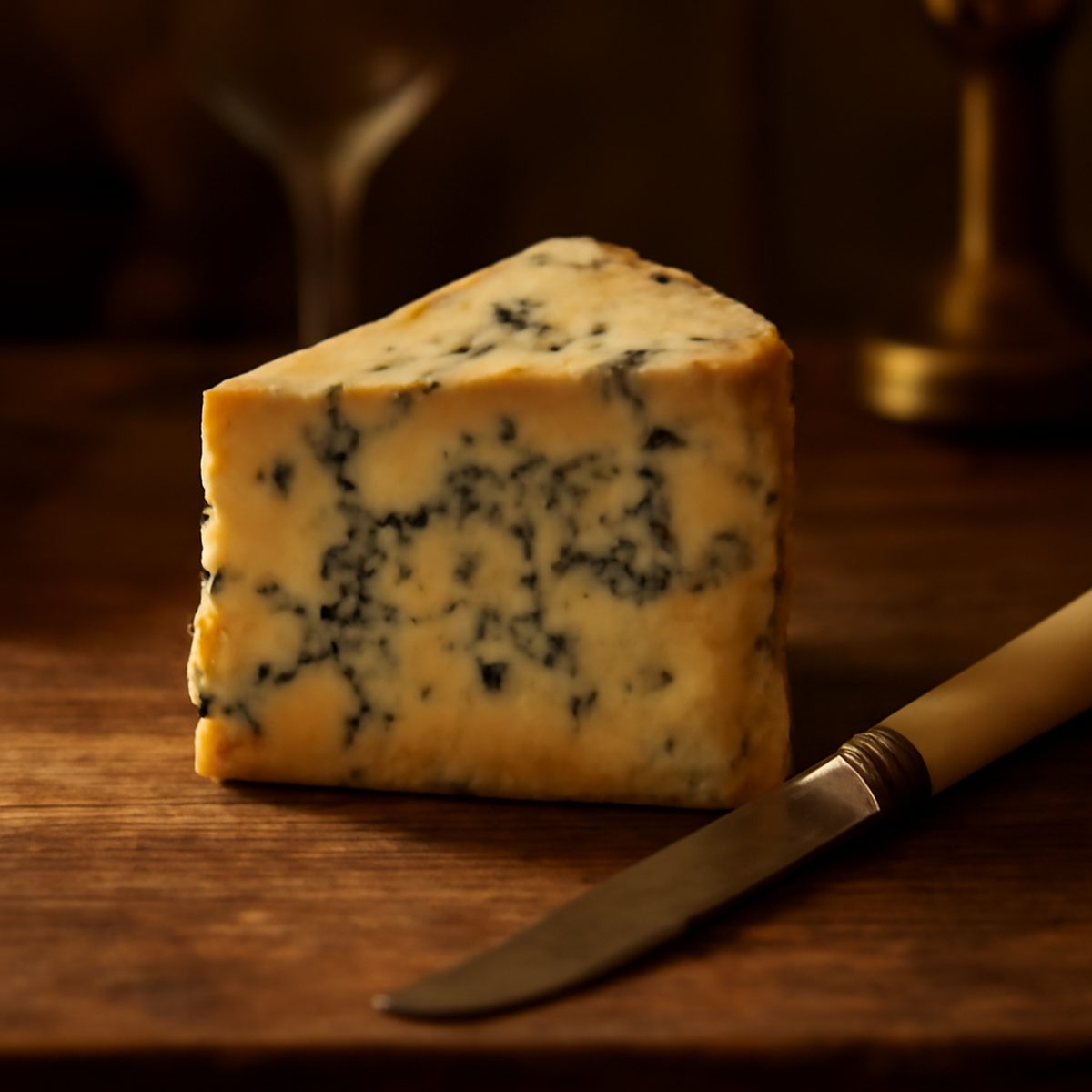
There is cheese, and then there is Stilton cheese, and the gap between the two is wider than the supermarket shelf suggests. Real Stilton is a made thing, governed by tradition and geography, threaded with blue and built over weeks of patient attention. To understand it is to understand something about how the best food is produced: slowly, by hand, according to rules that exist for good reasons. It rewards the curious eater more than almost any cheese I know.
Most people meet Stilton at the end of a meal, crumbled beside a glass of port, and never think about how it came to be. But the journey from milk to wedge is a quietly remarkable one, and knowing it changes how the cheese tastes, or at least how attentively you eat it. A very different but equally patient journey shapes a great Alpine cheese, as the craft of real Gruyere sets out.
What makes it what it is
Stilton is a protected cheese, which means it can only be made in a defined way, in a defined place, from local cow’s milk. That protection is not mere bureaucracy; it guards a method. The milk is gently warmed, cultured and set, and the curd is cut and drained with a care that keeps it open and loose rather than dense. That openness matters, because it leaves room for the blue to travel later. Protected status shapes many of Europe’s finest cheeses, including the sheep’s milk tradition explored in our piece on the craft of real Ossau-Iraty.
The young curds are salted, milled and packed into cylindrical moulds, then turned and drained without pressing, so the cheese knits together under its own weight. This unpressed, hand-formed structure is central to Stilton’s character: crumbly at the edge, creamy toward the centre, never rubbery. It is the opposite of an industrial block.
The blue, and how it gets there
The veins of blue are not an accident but a cultivated feature. A blue mould is introduced to the milk, but it needs oxygen to grow, and a freshly formed cheese is airless inside. So after a few weeks the maturing cheeses are pierced with steel needles, opening channels for air to reach the interior. Along those channels the blue blooms outward, giving Stilton its marbled interior and its savoury, peppery bite.
This deliberate encouragement of mould is one of the quiet marvels of cheesemaking, and it connects Stilton to a wider craft. Anyone drawn to cheese ageing and affinage will find in Stilton a perfect case study of how time, air and controlled mould turn fresh curd into something profound.
The needle is the secret. Without those pierced channels there is no path for air, and without air there is no blue.
Ageing and the maker’s judgement
From there it is a matter of time and turning. The cheeses mature for weeks, developing a natural crust and deepening in flavour, while the maker judges by feel, smell and appearance when each is ready. A young Stilton is mild and crumbly; a mature one is soft, spreading and intensely savoury. Neither is wrong, but they are different cheeses in all but name, and the affineur’s judgement decides which reaches your table.
How to buy, keep and serve it
Buy Stilton cut from a whole cheese where you can, rather than pre-packed, so you can see the marbling and smell the ammonia-free freshness. Look for an even distribution of blue and a creamy, not chalky, body.
- Store it wrapped in waxed paper rather than cling film, which suffocates it, following the same logic as storing cheese at home properly.
- Bring it fully to room temperature before serving; cold mutes its flavour and firms its texture.
- Serve it in wedges cut to include both crust and centre, not scooped from the middle, so every plate gets the full range.
The old pairing with port endures because it works, the sweetness balancing the salt, but the wider question of matching wine and cheese opens up other happy possibilities, from a sweet white to a nutty sherry. However you drink it, Stilton belongs on a board where it can be met on its own terms, in the manner of a proper cheese board assembled with a little thought.
A cheese of place and season
Like the best wines, Stilton carries a sense of where and when it was made. The milk changes through the year as the pastures change, and a cheese made from rich summer milk tastes subtly different from one made in the depths of winter. Good makers know this and adjust accordingly, and attentive eaters learn to notice it. This connection to season and place is part of what separates a living, traditional food from an industrial product engineered to taste identical every day of the year.
The association with Christmas is no accident either. A Stilton set down in the cooler months has matured to its peak by midwinter, which is why it became the traditional centrepiece of the festive cheese board, wheeled out whole and served with a spoon and a glass of port. That seasonal rhythm, the sense that the cheese has its own calendar, is a large part of its quiet appeal, and it rewards the eater who buys with the season rather than against it.
Beyond the cheese board
While Stilton is at its finest simply served in wedges, it is also a superb cooking cheese, its savoury strength carrying flavour through a whole dish. A little crumbled into a soup of leek or celery gives depth that nothing else quite provides; melted into a sauce for steak it turns a plain cut into something memorable. It even has a place at the sweet end of the meal, its salt playing against a ripe pear or a spoonful of quince. Used with a light hand, it flatters far more than it dominates.
To understand real Stilton is to appreciate that the best things are still made rather than manufactured. It is a cheese with rules, rituals and centuries behind it, and every wedge carries that history. That respect for craft, for the slow and the hand-made, runs through everything we care about across our dining and drinks pages. Buy a good one, serve it well, and taste the difference that method makes.
Renée has covered Singapore's restaurants for over a decade, with a soft spot for the kitchens most people walk past.