The Story of the Tingkat and Tiffin
Before food delivery apps, there was the tingkat: a stacked tin carrier built on trust, routine and a quiet, generations-old system of home cooking.
 By Renée Tan
31 August 2026 · 6 min read
By Renée Tan
31 August 2026 · 6 min read
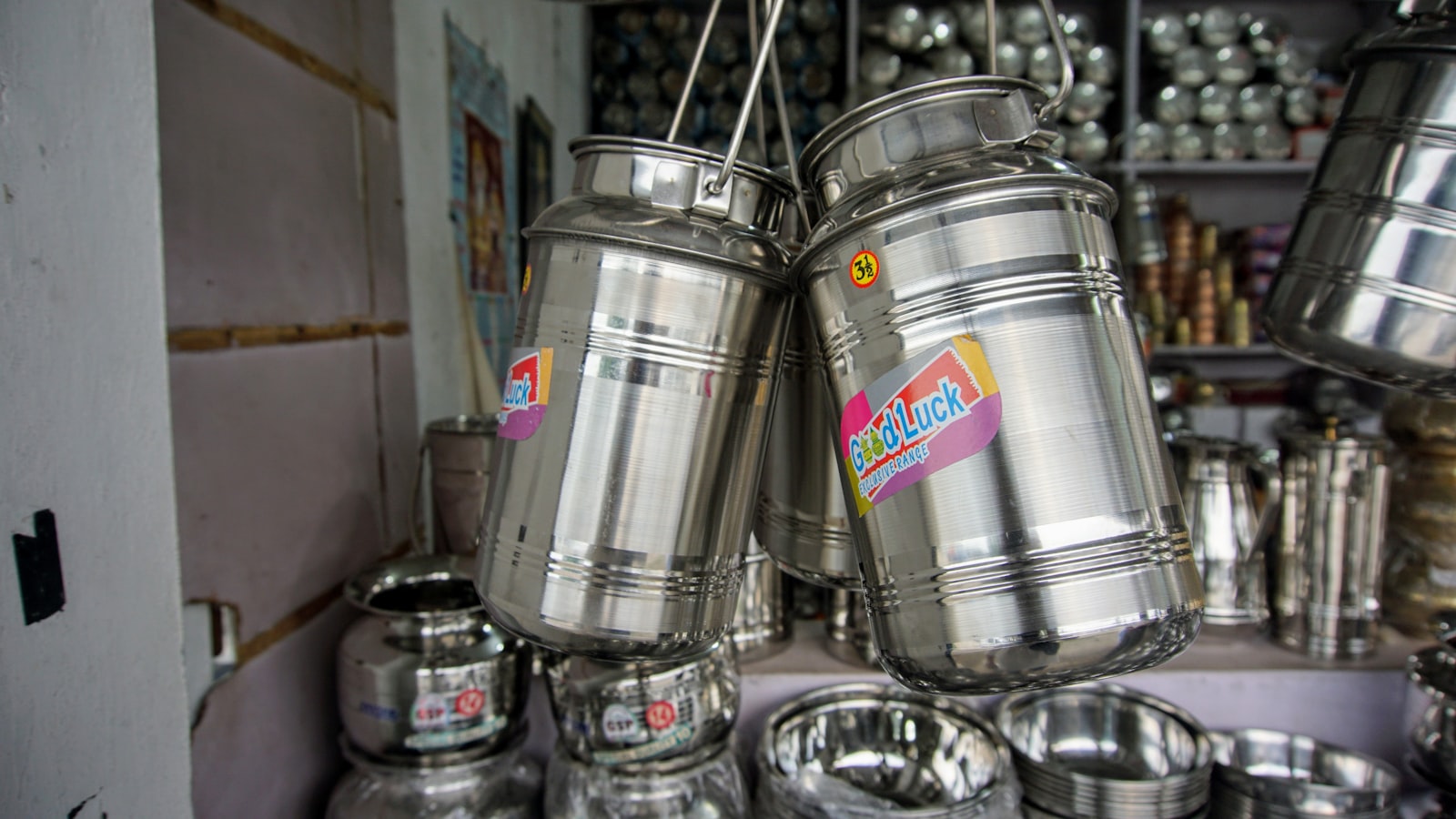
Long before any delivery app promised food at your door within the hour, Singapore already had a system that did precisely that, built not on algorithms but on trust, routine and a stack of well-worn metal tins. The tingkat — a set of stacked containers carried by handle, filled with home-style dishes and delivered daily to offices and homes — is one of the island’s quieter culinary traditions, and one that has proven remarkably durable even as the food landscape around it has been transformed by convenience apps and cloud kitchens.
What a tingkat actually is, and how it works
A traditional tingkat consists of several stacked tin compartments, typically three or four, each holding a different component of a meal — rice in one, a vegetable dish in another, a meat or fish curry in a third — all secured together by a metal clasp and carried by a single handle. The system dates back to a period when home-cooked meals were delivered to office workers who had no easy way to eat lunch at home, and the same tingkat would be collected each evening, washed, and refilled the following day for the next delivery. It is, in effect, a subscription meal service that predates the concept by the better part of a century.
Why the format has endured
- Portion control built into the design, with each compartment sized for a single serving
- A daily rotation of dishes rather than a fixed, static menu
- A genuinely personal relationship between provider and customer, often built over years
- An inherently low-waste system, since the same tins are reused daily rather than discarded
The people who kept the tradition running
Tingkat services in Singapore have historically been run by small, often family-operated kitchens, many specialising in a particular regional style — Peranakan, Teochew, or a specific Indian home-cooking tradition — passed down along with the recipes themselves. What distinguishes a serious tingkat provider from a mass-produced meal service is precisely this specificity: a family recipe cooked the same way for decades, adjusted only slightly for the seasons or the customer’s specific preferences, rather than a menu engineered for broad appeal. That personal continuity is increasingly rare in a food landscape built around scale, and it is worth actively supporting where it survives.
“My mother ran this from our kitchen for thirty years before I took over,” one tingkat provider told us. “The customers who have been with us that long, I know exactly how they like their curry — less spicy on Mondays because that’s when their kids eat too, more on Fridays.”
A tradition connected to a wider culture of carried, wrapped food
The tingkat sits within a broader Singapore tradition of food built around portable, reusable vessels rather than disposable packaging, a lineage that connects it, in spirit if not in mechanics, to other patient, wrapped or contained traditions such as the best bak chang and rice dumplings, where the leaf itself becomes part of the eating experience. Both traditions reward the kind of unhurried attention that has, in recent years, found renewed appreciation among diners tired of anonymous delivery packaging. If you are building a home pantry that honours this same spirit of considered provisioning, our guide to how to stock a proper home pantry is a useful companion piece.
Where the tradition sits today
Tingkat services have adapted, in recent years, to a customer base increasingly conscious of dietary needs, offering low-sodium, diabetic-friendly or vegetarian rotations alongside the traditional format, while largely preserving the daily, personal relationship that has always defined the service. Some newer operators have modernised the container itself, moving toward reusable but lighter materials, while keeping the fundamental promise intact: a different, home-style meal delivered each day, cooked by someone who knows your preferences well enough not to need reminding. It is a quietly impressive piece of infrastructure that long predates modern food-tech, and one that continues to serve households, offices and elderly residents who value routine and genuine home cooking over novelty.
A system worth understanding, not just using
What makes the tingkat worth writing about, beyond nostalgia, is how much it reveals about an older, more considered model of food delivery — one built on relationship rather than transaction, and on reusable vessels rather than single-use packaging. As Singapore’s dining culture, covered broadly across Dining & Drinks, continues to celebrate speed and novelty, the tingkat’s quiet persistence is a useful reminder that some of the island’s best food systems were built generations before anyone thought to call them innovative, and alongside traditions like the Nanyang coffee story, it remains one of the clearest windows into how Singapore actually feeds itself, day to day, away from the headlines.
Choosing a tingkat provider today
For a household considering signing up, the process still resembles something closer to a personal introduction than a transaction: a phone call, sometimes a conversation about dietary preferences or restrictions, and often a trial week before committing to a longer arrangement. This is worth embracing rather than treating as friction — the personal calibration is exactly what separates a good tingkat relationship from an anonymous meal subscription. Ask existing customers for referrals where possible, since a provider’s reputation within a tight-knit customer base is usually a far more reliable indicator of quality than any online review.
Why the ritual still matters
There is something genuinely valuable in the daily rhythm a tingkat imposes: a set collection and delivery time, a rotating but familiar set of dishes, and the small, recurring pleasure of opening a stack of warm tins rather than a plastic delivery bag destined for the bin. In an era of infinite on-demand choice, that constraint — someone else deciding what you eat today, based on years of understanding your preferences — has become, unexpectedly, one of its more appealing qualities rather than a limitation. It asks something of the eater too: a willingness to return the empty tins, to give notice for a day off, to treat the arrangement as a relationship rather than a one-off order, and that reciprocity is, in its own modest way, part of what keeps the whole system working as smoothly as it has for so many decades.
Renée has covered Singapore's restaurants for over a decade, with a soft spot for the kitchens most people walk past.