The Return of the Bar Cart
A well-stocked bar cart is one of the most flattering objects a home can own. Here is how to build and style one that actually gets used at every gathering.
 By Priya Nair
29 August 2026 · 6 min read
By Priya Nair
29 August 2026 · 6 min read
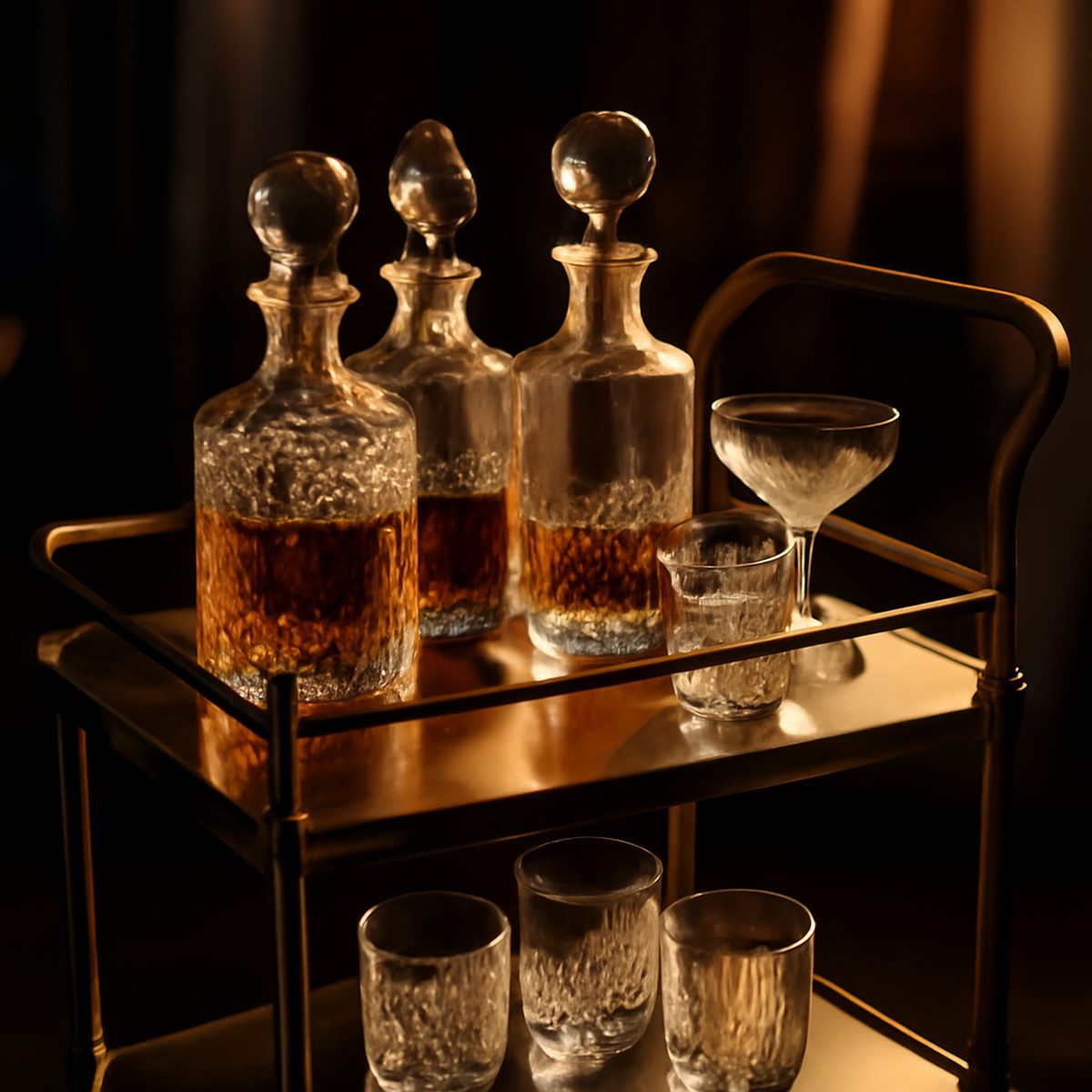
There was a period, not so long ago, when the bar cart felt like an artefact of a different era — something inherited from a grandparent’s dining room, mildly amusing, rarely used for its actual purpose. That period has passed. The bar cart is back in the considered home, not as nostalgia but as a genuinely useful piece of furniture: a self-contained, portable, endlessly flattering way to host without ever needing to leave the room to fetch a bottle.
What separates a bar cart that earns its place from one that becomes a dusty prop is almost entirely a matter of editing. A cart with too many bottles looks cluttered; one with too few looks unfinished. Getting the balance right is a small, satisfying design problem, and one worth taking seriously if the cart is going to do real work rather than simply sit in a corner looking decorative.
Choose the Cart Before the Contents
The cart itself sets the tone for everything that follows. Brass and mixed-metal frames read as warmer and more traditional; matte black or smoked glass reads as considerably more contemporary. Two tiers is generally more useful than three — the lower shelf for glassware and mixers, the upper for spirits and the tools of the trade — and a cart with a lip or rail around each shelf earns its keep the first time it is wheeled, rather than carried, across an uneven floor. Casters matter more than most buyers expect; smooth-rolling, well-sized wheels are the difference between a cart that gets used daily and one that stays permanently parked because moving it is a hassle.
The Spirits: Fewer, Better, Actually Used
A genuinely well-stocked bar cart rarely needs more than six or seven bottles to cover the vast majority of what guests will actually ask for: a good gin, a versatile whisky, a white rum, a decent vermouth, an amaro or bitter liqueur, and one or two personal favourites. This is not about scrimping — it is about the same editing instinct that runs through building a home bar worth pouring from, where a tightly curated selection, chosen with real care, consistently outperforms a crowded shelf of half-finished bottles nobody quite remembers buying.
For anyone building genuine expertise rather than just a nice-looking display, understanding how to actually taste and evaluate what is on the cart matters as much as the styling. Our guide on how to taste whisky like you know how is a good place to start for the whisky shelf specifically.
Glassware: The Detail Guests Actually Notice
Mismatched, chipped or overly casual glassware undermines even the best-stocked cart faster than any other single mistake. Four to six of each essential shape — a rocks glass, a coupe or martini glass, a highball — in a consistent style, is worth more than a large, mismatched collection accumulated over years. Crystal is not obligatory, but weight and clarity matter: a glass that feels substantial and pours cleanly does real work in making a simple drink feel considered.
Tools, Displayed Rather Than Hidden
Unlike a fully concealed home bar, a cart’s whole appeal is visibility — the tools should be attractive enough to sit out rather than tucked into a drawer. A good jigger, a proper bar spoon, a sturdy shaker and a channel knife or peeler for garnish cover most needs, and displaying them in a small tray or vessel on the lower shelf keeps the cart functional without looking cluttered. A single ice bucket with tongs, kept genuinely stocked rather than purely decorative, is the detail that signals the cart is meant to be used rather than admired. The same thinking applies to the morning ritual, as our guide to coffee and tea stations at home explains.
A bar cart that never gets touched is just furniture pretending to be hospitality.
Styling It So It Still Looks Considered Empty-Handed
The best bar carts hold their composition even mid-party, once several bottles have been lifted off and a few glasses removed. This comes down to symmetry and negative space in the initial arrangement — leaving visible gaps between groupings rather than packing every surface, so that a bottle’s absence does not immediately read as a hole in the display. A small plant, a stack of good coasters, or a single piece of ceramic can anchor the composition and keep it feeling deliberate even as bottles come and go through the evening. This overlaps neatly with the thinking in our piece on designing a home for entertaining, where the same principle — objects that still look right mid-use — applies across an entire home rather than a single cart.
Placement Within the Room
Where a bar cart lives matters almost as much as what sits on it. Positioned near, but not directly against, a main seating area, it stays within easy reach without becoming an obstacle in the room’s main circulation path. A spot near a window benefits from natural light catching glassware and crystal decanters beautifully in the late afternoon, though direct, sustained sun should generally be avoided, since it can fade labels and, over time, subtly alter the colour of spirits left in clear glass. Corners that otherwise go unused — beside a sideboard, near the end of a sofa, in the transitional space between a living and dining area — tend to suit a cart particularly well, giving it a sense of its own defined territory rather than competing for space with the room’s primary furniture.
For households that entertain often, a cart on genuinely smooth-rolling casters earns its keep by moving easily from a quiet corner to the centre of a gathering and back again once the evening winds down. For households that rarely move it at all, a slightly heavier, more furniture-like cart with a stronger visual presence can anchor a room permanently, functioning almost as a piece of sculpture between uses rather than a purely mobile object.
A Small Object, a Large Effect
Few pieces of furniture do as much social work per square foot as a properly stocked bar cart. It invites guests to help themselves, gives a host a legitimate reason to step away from the kitchen, and turns even a modest gathering into something with a little ceremony to it. Choose the cart with intent, edit the contents honestly, and it earns a permanent place in the room rather than a seasonal one. For more on entertaining and home design, explore our Homes & Culture section.
Priya tours the homes most people only glimpse from the road, and asks how they are really lived in.