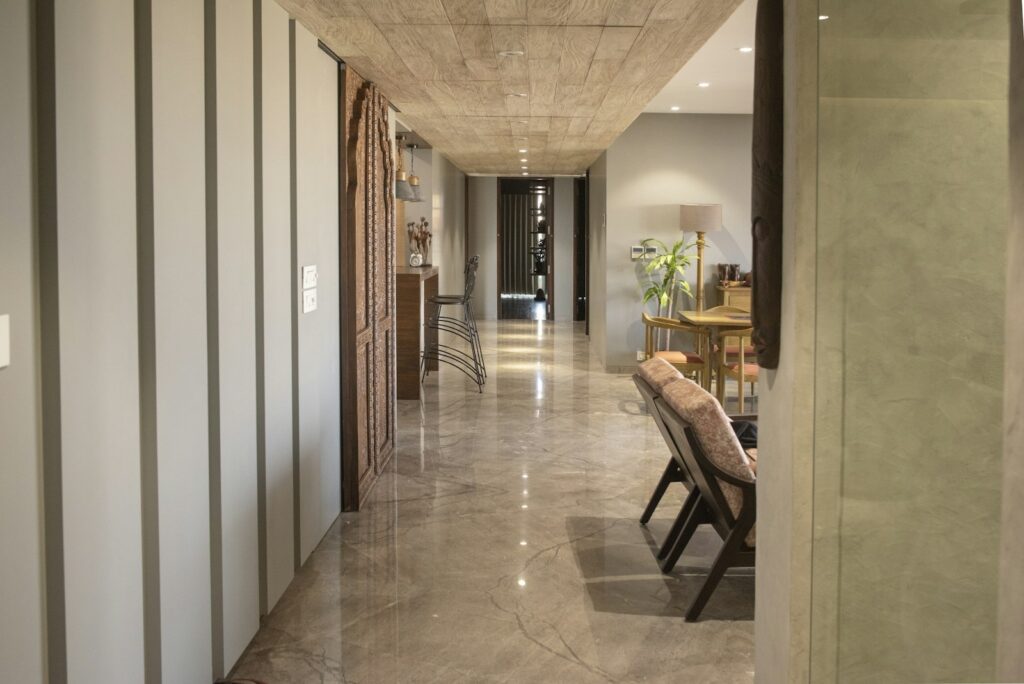
The Best Materials for a Timeless Anteroom
An anteroom is rarely renovated alone, so its materials need genuine staying power. Stone, timber panelling, and restraint outlast passing trends.
 By Priya Nair
1 September 2026 · 5 min read
By Priya Nair
1 September 2026 · 5 min read

An anteroom occupies a peculiar architectural role — smaller and more intimate than a foyer, more formal than a hallway, existing as a genuine pause between two more significant spaces rather than a destination in its own right. Historically found preceding a grand reception room or a private study, the anteroom has quietly reappeared in considered contemporary homes as a small buffer space that adds a sense of sequence and anticipation to how a house unfolds. Choosing materials for a room whose entire purpose is transitional requires a particular kind of restraint — nothing should shout, and everything should age well, since an anteroom is precisely the sort of space that gets noticed only when it’s wrong.
Why timelessness matters more here than almost anywhere
An anteroom is rarely renovated on its own; it tends to be refreshed only when the larger rooms it connects are redone, which means its materials need to remain genuinely handsome for considerably longer than a bedroom or a powder room might reasonably be expected to. This argues strongly against trend-driven material choices — a fashionable colour or pattern that feels current now risks reading as dated well before the connecting rooms warrant their own renovation. Materials with a genuinely long design history — natural stone, quality timber, fine plaster — tend to serve an anteroom’s particular longevity requirement far better than anything chasing a contemporary moment.
Flooring choices built to outlast trends
Stone remains the anteroom’s most reliable flooring choice, and a honed rather than polished finish generally suits the room’s quieter, more intimate character better than a glossy surface built to impress from a distance. Marble, limestone, and travertine all perform well here, chosen less for showiness than for the way natural stone’s veining and subtle colour variation reward closer, slower attention — precisely the kind of attention an anteroom, as a genuine pause point, tends to invite.
- Honed marble or limestone — a classic choice that ages gracefully and suits the room’s transitional formality.
- Parquet or herringbone timber — warmer underfoot, particularly effective where the anteroom connects to timber-floored rooms on either side.
- Encaustic or cement tile — a more textured, patterned option for anterooms with a period or heritage design language.
Walls and joinery: where restraint pays off
Panelled or plastered walls, finished in a muted, considered palette, suit an anteroom’s quiet transitional role better than anything more assertive. Timber panelling to dado height, finished in a deep, satin lacquer or left in a natural oiled finish, brings genuine warmth and craft without competing for attention with whatever grander room lies beyond. Where wall space allows, a single well-chosen piece of art or a mirror does more for an anteroom’s character than an elaborate material scheme — the room’s job is to prepare the eye for what comes next, not to be the destination itself.
The role of a considered anteroom in a larger sequence
An anteroom’s material palette should relate sensibly to the spaces on either side of it, functioning as a genuine bridge rather than an abrupt shift in design language. This is closely related thinking to what governs a well-designed timeless vestibule or timeless foyer, and reading these pieces together is genuinely useful for anyone planning a full entry sequence rather than a single isolated room. The same underlying principle — materials chosen for longevity and quiet transition rather than individual statement — runs through all three spaces.
An interior architect who has designed several anterooms for Singapore heritage and landed properties noted that the room’s success is often measured by what visitors don’t consciously notice: “if someone remembers walking through a beautiful room but can’t quite describe the anteroom before it, that’s usually a sign it did its job.”
Hardware and small details that carry outsized weight
In a room this restrained, small material details do proportionally more visual work than they would in a larger, busier space. Door hardware, light switch plates, and any visible ironmongery deserve genuine consideration in an anteroom — a cheap, mismatched switch plate stands out far more starkly against a considered plaster or timber wall than it would against a busier, more decorated backdrop. Choosing hardware in a finish that relates to the room’s overall material logic — aged brass against warm timber, blackened steel against cooler stone — is a small investment that pays off precisely because the room offers so little else to distract from it.
Ceiling treatment and the fourth surface
The ceiling of an anteroom is often overlooked entirely, treated as a flat white plane simply because the walls and floor have consumed all the design attention. But given the room’s intimate scale, the ceiling sits close enough to be genuinely noticed, and a small architectural gesture here — a simple cornice, a subtle change of finish, or even a considered paint colour slightly darker than the walls — adds real depth without competing with the room’s overall restraint. In anterooms with generous ceiling height, a modest decorative plaster detail can echo grander ceiling treatments found elsewhere in a home without attempting their full scale or drama, functioning as a quiet nod rather than a competing statement.
Where a home features more elaborate ceiling work in its principal rooms, the anteroom’s ceiling should generally take cues from that language in a simplified form, maintaining a coherent sense of architectural vocabulary as a visitor moves from the transitional space into the grander room beyond. This kind of restraint, applied consistently across a sequence of connected spaces, is precisely what separates a home that feels genuinely considered from one where each room was designed in isolation from the next.
A room built to disappear gracefully
The best anterooms succeed by being genuinely unremarkable in the best sense — materials chosen with enough care and restraint that the room simply performs its transitional role without calling attention to itself, decade after decade, regardless of what design trends move through the rooms around it. That quiet, sustained competence is precisely what timeless material choice is meant to achieve. Explore more considered interior guidance in our Homes & Culture section.
Priya tours the homes most people only glimpse from the road, and asks how they are really lived in.