The Best Everyday GMT Watches
A good GMT watch is one of the rare complications that genuinely justifies itself in daily life, especially for anyone who travels often for work.
 By Daniel Koh
30 August 2026 · 6 min read

Most complications on a watch dial exist for show. A GMT function is one of the rare exceptions — a genuinely useful piece of engineering that solves a problem most frequent travellers actually have. For a Singapore-based reader whose week might include a call with New York in the morning and a flight to Tokyo in the evening, a GMT watch is less a flex than a quiet, practical tool. Choosing the right one, though, means understanding what the complication actually does before shopping on looks alone.
What a GMT Watch Actually Does
A true GMT watch has a fourth hand — usually longer and often arrow-tipped — that completes one full rotation every 24 hours, rather than the standard 12. Paired with a rotating or fixed 24-hour bezel, this hand lets the wearer track a second time zone at a glance, without doing mental arithmetic or fumbling with a phone. Some GMT movements allow the main hour hand to be adjusted independently, in one-hour jumps, without stopping the watch or affecting the minute hand — an underrated feature for anyone who actually crosses time zones often, since it means local time can be updated the moment a flight lands, with home time preserved on the 24-hour hand.
This distinguishes a genuine GMT from what the trade sometimes calls an “office GMT” — a watch with a 24-hour hand but no independent hour-hand adjustment, which is attractive but noticeably less useful for someone who actually needs to reset local time regularly.
What to Look For
Independent hour-hand adjustment
For genuine travel use, this is the single most important spec. It transforms the complication from decorative to functional.
Legible 24-hour markings
A bezel or dial ring with high-contrast markings — often split into day and night halves by colour — makes the second time zone readable at a glance, which matters more than it sounds when checking the time on the move.
A case size that suits daily wear
GMT watches can run larger than a typical everyday piece, given the added dial complexity. Anything from 38mm to 41mm tends to sit comfortably under a cuff and pairs well with both a suit and casual wear, in the same way a well-proportioned field watch earns its everyday status through restraint rather than size.
Matching the Watch to the Traveller
Someone who travels occasionally, mostly within the region, may find a simpler 24-hour hand sufficient — a visual reminder of home time rather than a tool requiring precise independent adjustment. A genuinely frequent flyer, crossing three or four time zones on a regular basis, will get real, daily value from independent hour-hand adjustment and should prioritise it over case finishing or bezel material. As with choosing storage for a working collection, the right answer depends entirely on actual use patterns rather than aspiration.
“I bought my first GMT because it looked good,” one collector admits. “I kept wearing it because I actually use the function every single week. That’s rarer than people think with complications.”
Bezel Materials and Practicality
Ceramic bezels resist scratching far better than aluminium and hold their colour longer under daily wear and Singapore’s strong daylight, though they carry a price premium and can, in rare cases, chip on a hard knock rather than simply scuffing. Aluminium bezels are more affordable and easier to service if damaged, but will show wear over years of daily use. Sapphire bezels, found on a handful of higher-end pieces, offer the best scratch resistance of all but at a cost that puts them out of reach for most everyday buyers. For a genuinely everyday piece worn daily in a demanding climate, ceramic tends to offer the best balance of durability and cost.
Strap and Bracelet Choices
- A steel bracelet suits the tool-watch character of most GMTs and holds up well to daily wear and humidity
- A rubber or fabric strap works well for a more casual, warm-climate rotation and dries quickly after a humid day
- Leather straps, while handsome, need more care in Singapore’s climate and are better suited to occasional wear than daily rotation
Pairing It With the Rest of a Collection
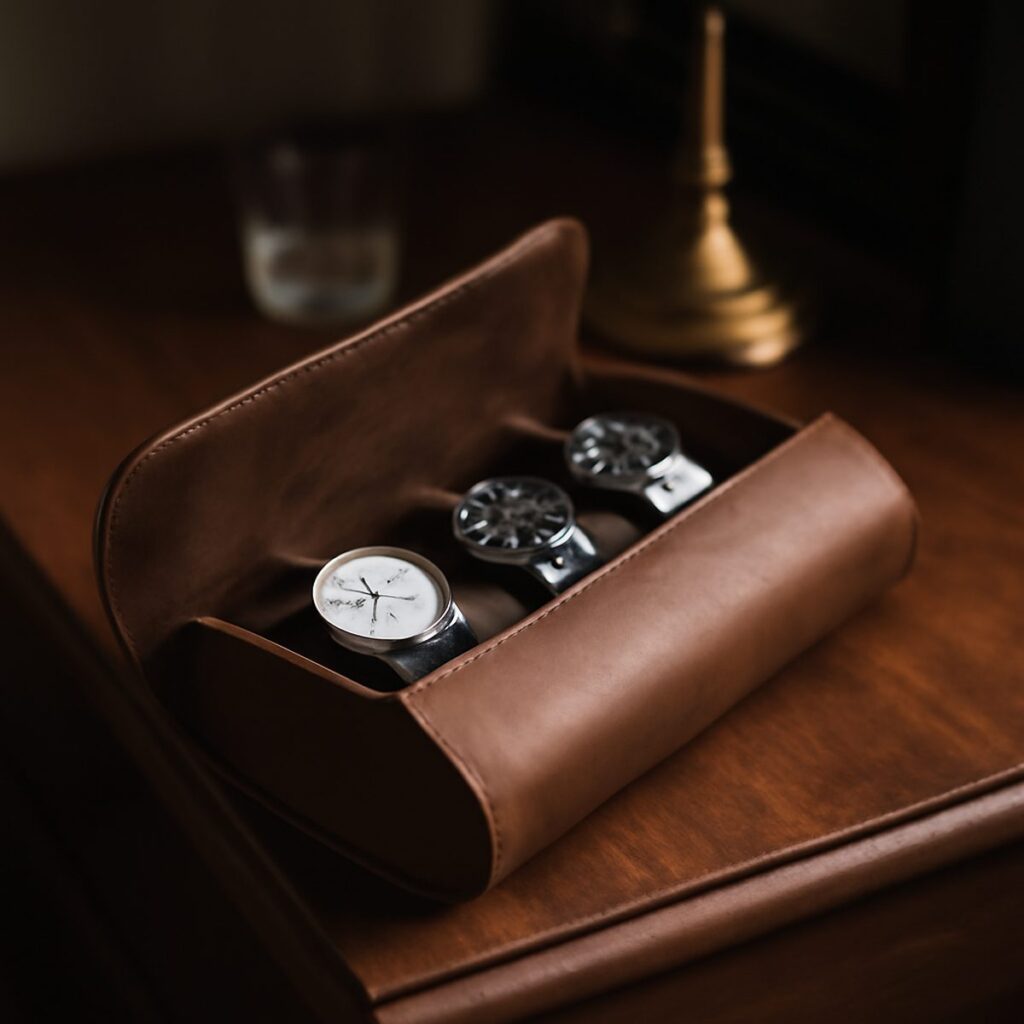
A GMT rarely needs to be the only watch in a working rotation — it earns its place alongside, rather than instead of, a simpler everyday piece or something built for the water, such as a dive-proportioned everyday watch. Together, a well-chosen small collection covers most of a considered wearer’s actual needs without duplicating function unnecessarily. Whatever the eventual choice, it is worth storing properly too — a good watch roll or single-post winder, discussed at greater length elsewhere in our style and watches coverage, protects the investment as much as the purchase decision itself.
Where the Complication Actually Pays Off
The genuine value of a GMT reveals itself in small, unglamorous moments rather than dramatic ones. It is glancing at the wrist during a layover to confirm whether it is too early to call a colleague back home, or setting local time the moment a flight lands without touching a phone still in airplane mode. It is knowing, without calculation, whether a counterpart in a different time zone is likely to be at their desk. None of this is dramatic, but it is precisely the kind of quiet, repeated usefulness that separates a complication worth owning from one that exists purely to impress.
Price ranges vary enormously across the category, and it is worth resisting the assumption that a higher price automatically means a more useful GMT function. Several genuinely well-engineered options with true independent hour-hand adjustment sit well below the most recognisable names in the category, while some expensive, well-regarded watches use the simpler “office GMT” mechanism that offers less day-to-day utility for a frequent traveller. Read the specification sheet carefully before assuming that spend and function move together — with this particular complication, they often do not.
A Note on Setting and Servicing
Because the GMT function adds mechanical complexity, it is worth having any prospective purchase serviced by someone genuinely familiar with the specific movement, rather than a generalist. Ask how the independent hour-hand jump is achieved mechanically — some movements use a simple jumping mechanism that is robust and easy to service, others a more delicate construction that costs more to maintain over the watch’s lifetime. This is a reasonable question to ask before buying, not an obscure technical detail; the answer materially affects how much the watch will cost to own over a decade of regular use.
In the end, the best everyday GMT is simply the one whose complication you will actually use — not the one with the most impressive spec sheet sitting unused in a drawer. Buy for the travel you actually do, not the travel you imagine doing, and the watch will earn its place on the wrist for years.
Daniel has spent fifteen years arguing that the best watch is the one you never take off.