The Art of the Console Table
The console table is the first and last thing a guest sees in many homes, yet it is often styled as an afterthought. Here is how to get it properly right.
 By Priya Nair
29 August 2026 · 6 min read
By Priya Nair
29 August 2026 · 6 min read
Every home has a first and last surface — the one a guest passes on the way in and the one they glance at on the way out, keys in hand. In most Singapore homes, whether a landed house with a proper foyer or an HDB flat with barely a metre of entry space, that surface is the console table. It is, in many ways, the most under-considered piece of furniture in the house, treated as an afterthought long after the sofa and dining table have been debated at length, when it is arguably the piece that does the most quiet work of setting a home’s tone.
Choosing the Right Proportions First
The console table’s job is architectural before it is decorative — it needs to fit its space without crowding a hallway that is likely already narrow. As a rule, a console should sit no more than 30 to 35 centimetres deep in a genuinely tight entry, leaving enough clearance for two people to pass comfortably. Length should relate to the wall it sits against rather than simply filling all available space; a console that runs the full length of a wall can feel institutional, while one occupying roughly two-thirds leaves room for a plant, a mirror, or simply negative space, which reads as considered rather than sparse.
Height matters more than most people realise. A console set too low disappears visually and becomes a dumping ground for bags and mail; one set at a proper 80 to 85 centimetres reads at eye level for anything displayed on it and discourages the casual pile-up that undermines even a beautifully chosen piece. For the broader argument in favour of the piece itself, our case for the console table explains why it deserves a place in almost any entrance.
Materials That Age Rather Than Date
Because a console table is seen daily, in passing, its material should reward closer inspection rather than merely photograph well. Solid wood — walnut, oak, a warm teak suited to Singapore’s climate — will develop a genuine patina over years, the same quality that makes a well-chosen piece of fine furniture worth the initial investment. Stone or marble tops introduce coolness and weight, particularly effective in a foyer that receives direct light, though they demand more careful placement of anything left on the surface to avoid staining.
Metal-framed consoles, in brass or blackened steel, have become popular for smaller entries precisely because their visual lightness keeps a narrow hallway from feeling boxed in — a strategy worth considering for anyone furnishing a genuinely tight space rather than a grand foyer. In a narrow hallway, the floor deserves the same thought as the furniture, and our notes on choosing and styling a runner rug pair naturally with a slender console.
The Rule of Three, Loosely Applied
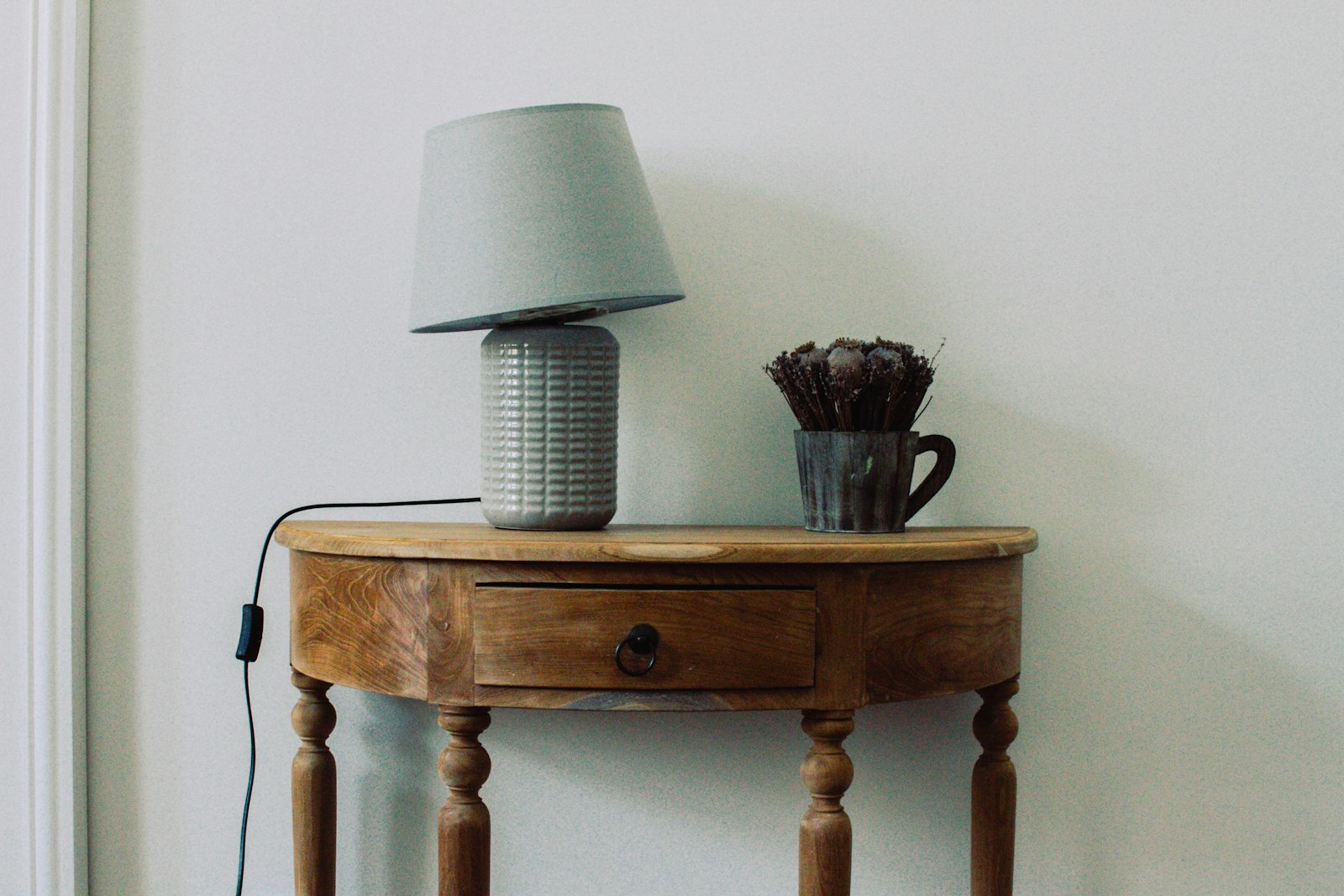
Styling a console table well comes down to restraint more than accumulation. A common and reliable approach is to group objects in odd numbers of varying height — a lamp for verticality, a low bowl or tray for horizontal weight, and one smaller object, perhaps a small sculpture or a single stem in a vessel, to complete the composition. This is the same underlying logic that governs a well-considered gallery wall or any other curated surface in the home: variation in scale prevents the eye from resting on any single element too long, while restraint in quantity keeps the whole arrangement legible.
- One lamp, chosen for warmth of light rather than sheer decorative presence, does more for a hallway’s atmosphere than any overhead fixture.
- A tray or bowl for keys and mail keeps the console functional without letting the function take over visually.
- Leave at least a third of the surface genuinely empty — negative space is what makes the styled portion read as intentional rather than crowded.
The Mirror Question
A mirror above the console is almost a design cliché at this point, but clichés persist because they work. In a smaller entry, a well-proportioned mirror does genuine, functional work — reflecting available light back into the space and offering a last practical check before leaving the house. The mistake most homeowners make is choosing a mirror sized to match the console below rather than the wall above it; a mirror slightly narrower than the table but considerably taller tends to look more deliberate than one that matches the console’s dimensions exactly.
“The console is the handshake of a home,” one Singapore interior stylist told us. “People decide how a house feels before they’ve even reached the living room.”
Avoiding the Catch-All Trap
The console table’s proximity to the front door makes it uniquely vulnerable to becoming a catch-all — the place where mail, umbrellas, and half-opened parcels accumulate faster than anywhere else in the house. The fix is rarely more storage; it is usually a nearby, less visible surface for the genuinely functional overflow, paired with a firm household habit of clearing the console at the end of each day. A console with a drawer or a lower shelf, rather than an open top alone, gives a place for keys and everyday clutter to disappear into rather than sit in view.
Done properly, a console table becomes one of the hardest-working pieces in a home — practical enough for daily use, considered enough to greet guests well, and personal enough to shift with the seasons, a fresh stem or a different bowl enough to change its character without any real expense. For more ideas on furnishing a home with this same restraint, visit our Homes & Culture section.
Placement Beyond the Front Door
While the entryway is the most obvious home for a console table, it is far from the only one. A console behind a sofa, used to divide an open-plan living space, performs a similar organisational role while adding a surface for lamps or books that a low coffee table cannot always accommodate without crowding the seating area. In a dining room, a console along one wall becomes a natural staging point for serving, useful well beyond the occasions when it is dressed for display.
Wherever it sits, the console table works because it occupies a narrow footprint while offering a genuine sense of intention — proof that a home does not need a large piece of furniture to make a considered statement, only a well-chosen one placed with real thought about how it will actually be used, day after day, long after the initial styling has settled into habit.
Seasonal Refresh Without Overhaul
One of the console table’s quiet advantages is how cheaply its character can be refreshed. Swapping a ceramic bowl for a woven tray, or a single stem for a small branch of foliage, shifts the entire feel of an entryway without touching the furniture itself. This is a far more sustainable approach to seasonal decorating than replacing furniture outright, and it keeps the console feeling current without ever feeling trend-driven — the difference between a home that evolves gently and one that is perpetually being renovated.
Priya tours the homes most people only glimpse from the road, and asks how they are really lived in.