A Slow Weekend in Bergamo
An hour from Milan yet a world away, Bergamo's walled hilltop rewards the unhurried. Here is how to spend a slow weekend among its ramparts, piazzas and cafes.
 By Marcus Lim
1 September 2026 · 6 min read
By Marcus Lim
1 September 2026 · 6 min read
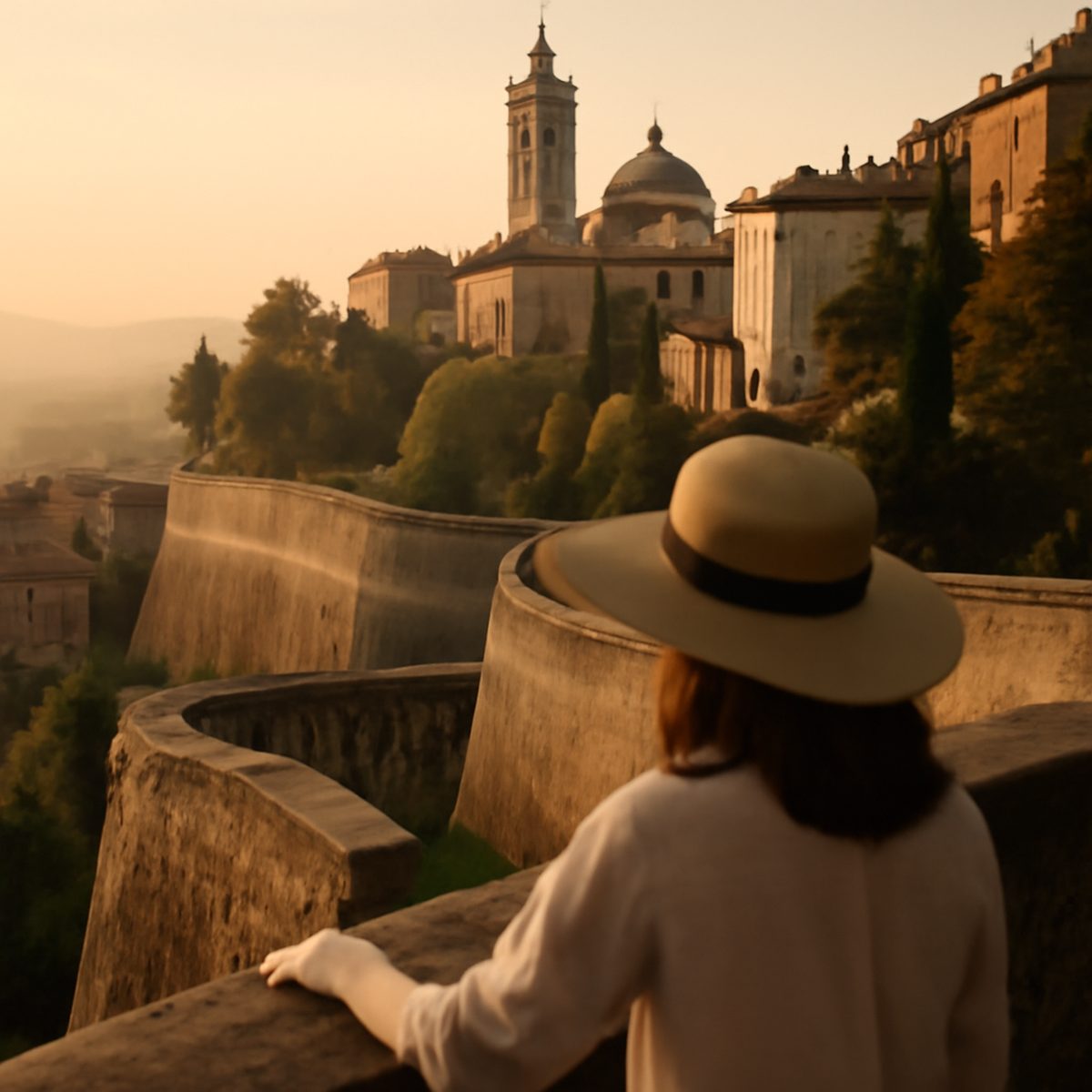
Most travellers see Bergamo only from the air, since its airport funnels budget flights into Milan and the wider Lombardy plain. This is their loss and, for a while yet, your gain. Just above that busy airport rises one of northern Italy’s most complete and least spoiled hill towns, a walled upper city of honey-coloured stone that has changed remarkably little in centuries. Bergamo rewards precisely the traveller who does the opposite of the crowds: who stays, slows down and lets the town unfold over a weekend rather than an afternoon.
The city has two halves. Below sprawls the Città Bassa, the lower town, modern and workaday. Above, reached by a funicular that climbs through the ramparts, sits the Città Alta, the upper town, a near-perfect medieval and Renaissance ensemble ringed by mighty Venetian walls. It is the upper town you have come for, and it is best savoured slowly.
The walls and the funicular
Bergamo’s defining feature is its circuit of sixteenth-century walls, built by the Venetians and so intact that they now form a broad, tree-shaded promenade around the entire upper town. Walking them is the essential Bergamo experience, a slow loop of shifting views: the Lombardy plain stretching south toward Milan, the foothills of the Alps rising north, the terracotta roofs of the town spilling below. Do it at golden hour, when the stone warms and the light lengthens, and you will understand the city at once.
Getting up to the walls is a pleasure in itself, for the funicular that links the two towns is part of the fabric of daily life here. Climbing gently through the fortifications, it does in a few unhurried minutes what a taxi could never do: it changes your register, lifting you out of the modern town and into the old. Anyone who appreciates the appeal of the cable car village will recognise the small magic of ascending slowly to a place cars cannot easily reach.
Piazzas and the pace of the day
The heart of the upper town is its main square, a stage set of medieval and Renaissance architecture where the city has gathered for eight hundred years. Around it cluster a splendid basilica, an ornate chapel and an old civic tower, but the real pleasure is not architectural tourism; it is sitting at a cafe table with a coffee or an aperitivo and watching the square go about its evening. Bergamo rewards this kind of stationary travel, the slow accumulation of a place through observation rather than sightseeing.
Give yourself over to the northern Italian rhythm. A long breakfast, a morning walk on the walls, a lingering lunch, an afternoon that goes nowhere in particular, an aperitivo as the light fades. This is the tempo the town was built for, and fighting it only spoils the visit. Rise late, let lunch stretch into the afternoon, and treat the evening aperitivo as the day’s quiet centrepiece rather than a prelude to something busier.
Bergamo is a city best measured not in sights seen but in hours unhurried. Stay a second night, and it stops being a stopover and becomes a place.
The table
Lombardy eats richly, and Bergamo eats richly even by Lombard standards. This is the land of casoncelli, the local stuffed pasta dressed with butter, sage and pancetta, and of polenta in a dozen guises, often served alongside slow-braised meats or the region’s celebrated cheeses. The cooking is hearty, buttery and entirely unlike the olive-oil lightness of the south, a reminder that Italy is not one cuisine but many.
Eat where the locals eat, in the plain trattorie of the lower town as much as the upper, and drink the robust reds of the surrounding hills. A weekend here is as much a table as a townscape, and the two are inseparable.
Making a weekend of it
The temptation, given the flights, is to treat Bergamo as a single day. Resist it. The town gives its best in the early morning and the late evening, when the day-trippers have gone and the upper town belongs to those who stayed. Two nights is the minimum for the place to work its quiet effect; three is better still.
Bergamo also sits within easy reach of northern Italy’s other slow pleasures, making it a fine base or a first stop. The unhurried, food-led spirit connects it directly to a slow weekend in Bologna and to the Adriatic calm of a slow weekend in Trieste, while the mountains to the north open onto the walking country of the quiet villages of the Italian Dolomites. Any of these makes a natural companion to a Bergamo weekend.
Beyond the walls
Should you tire of the upper town, and you may not, the lower city rewards a gentle afternoon of its own. It is here that Bergamo does its everyday living, in handsome nineteenth-century streets and arcades, in an elegant theatre and in the kind of unshowy shops and cafes that serve residents rather than visitors. The contrast is instructive: above, a preserved medieval jewel; below, a working Italian city getting on with its week. Walking between the two, ideally on foot down the old stepped paths rather than by funicular, gives a fuller sense of the place than either half offers alone. Look, too, for the art: the city’s picture gallery holds a quietly outstanding collection of Renaissance painting, the sort of small, serious museum that would draw queues in a more famous town and here can be enjoyed in near solitude. It is one more instance of Bergamo’s central charm, a city that offers a great deal and demands almost nothing in return.
The city’s great virtue is that it asks so little and gives so much. There are no queues to endure, no headline sights to fight through, only a beautiful walled town to be walked, eaten in and enjoyed at whatever pace suits you. Come slowly, stay a little longer than you planned, and Bergamo will reward you as the crowds passing overhead will never know. For more weekends in this unhurried spirit, the Travel & Stays section is full of them.
Marcus writes on travel and hospitality across Asia, and is happiest a long way from a lobby.