Understanding the Art of the Chigai-dana Shelf
The chigai-dana is the staggered display shelf of the Japanese alcove: a small masterclass in asymmetry, restraint and showing very little, very well.
 By Priya Nair
2 September 2026 · 6 min read
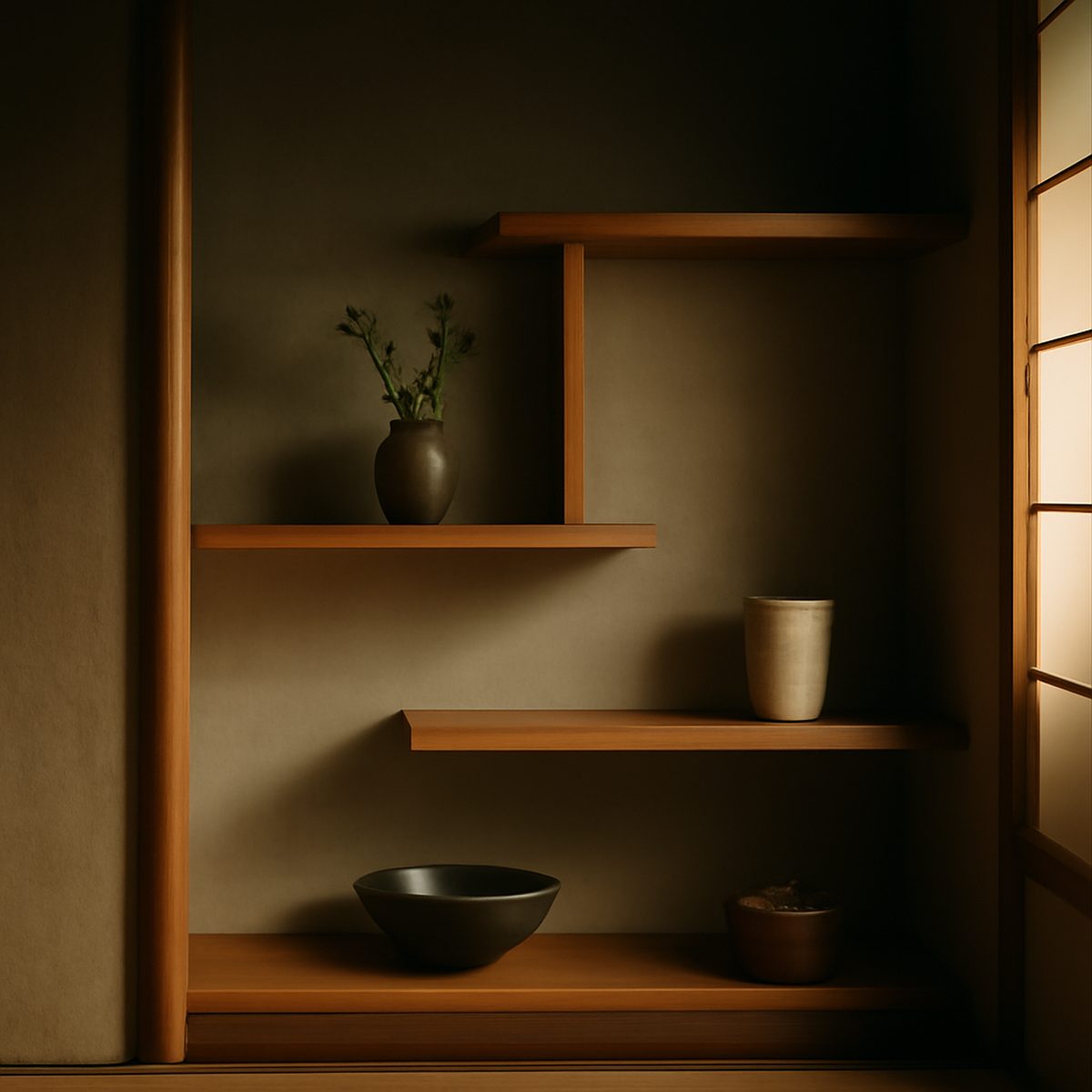
In the formal reception room of a traditional Japanese house, beside the tokonoma alcove where a single scroll hangs, you will often find a set of shelves that seem, at first glance, to be built slightly wrong. They do not line up. Two levels sit at different heights, joined by a small vertical riser, so the whole arrangement steps up and across in a way that no Western shelving would dare. This is the chigai-dana, the staggered shelf, and its apparent wrongness is in fact one of the most refined pieces of design thinking anywhere in the domestic world.
To understand the chigai-dana is to understand a whole philosophy of how objects should be shown. Where the Western instinct is to align, to make shelves level and symmetrical and full, the chigai-dana does the opposite: it staggers, it leaves space, and it displays almost nothing. In that restraint lies its genius, and a lesson that reaches far beyond the tatami room.
The logic of the stagger
The defining feature is the offset. The two main shelves sit at different heights, connected by a short upright, so the eye is led on a gentle diagonal journey up and across rather than being presented with a flat, static grid. This asymmetry is deliberate and deeply considered. It creates movement and tension within a small space, and it reflects a broader Japanese aesthetic preference for the irregular over the perfectly balanced, the same sensibility that governs the tatami room itself.
The stagger also solves a real problem of display: it gives objects of different heights their own natural home, and it prevents the deadening effect of a row of things all sitting on one level. Each object on a chigai-dana is granted its own stage, and the space between them is as carefully weighted as the objects themselves. The Western cousin of this idea, an open stand of tiers for display, is considered in our piece on the case for the étagère.
The art of empty space
What strikes the Western eye most about the chigai-dana is how little it holds. A single vase, a small box, a scroll rolled and resting, and a great deal of deliberate emptiness. This is not shelves waiting to be filled; the emptiness is the point. In the Japanese aesthetic, the space around an object, the ma, is what allows the object to be truly seen, and a crowded shelf destroys exactly the quality it is meant to display.
We do not decorate the shelf, one craftsman explained. We give the object room to breathe, and the room breathes with it.
This is the hardest lesson for the accumulating Western home to absorb, and the most valuable. It connects to the wider discipline of the considered alcove and recess: a niche is most powerful when it holds one right thing, framed by space, rather than many competing ones.
Craft in the joinery
A proper chigai-dana is a piece of fine joinery, made without visible nails or fixings, the timber chosen for its quiet grain and finished to a soft, hand-rubbed sheen. The small vertical riser between the shelves, the delicate returns at the ends, the way the whole assembly floats within the alcove, all of it demands the kind of precision that the best Japanese cabinetmaking is known for.
This is furniture as architecture, built into the room rather than placed in it, and it shares that integrated, made-in-place quality with pieces like the mizuya cabinet. The material is honest, the joinery is exquisite, and nothing is added that does not need to be there.
What it teaches the modern home
You do not need a tatami room to learn from the chigai-dana. Its lessons, stagger rather than align, leave space rather than fill it, show one considered object rather than many, and let the joinery speak quietly, apply to any shelf in any home. The next time you are tempted to fill a run of shelving edge to edge, remember the chigai-dana and its confident, disciplined emptiness.
Borrowing the idea for a Western room
You do not need to build a tatami room or a formal alcove to bring the chigai-dana’s thinking into a contemporary home, and the attempt to translate it is instructive in itself. The essential move is to abandon the Western instinct for the level, symmetrical, fully-stocked shelf and to experiment instead with the offset. A pair of floating shelves set at different heights, joined visually rather than physically, creates the same gentle diagonal journey for the eye, and a joiner can build the idea into an alcove or a chimney breast without any reference to its origins being obvious. What reads, to the visitor, is simply that the arrangement is more graceful and more alive than a conventional grid.
The harder lesson to import is the emptiness. A Western home tends to treat a shelf as storage to be maximised, filling every inch until the eye has nowhere to rest, and the chigai-dana proposes the opposite discipline: choose few objects, give each one generous space, and treat the gaps between them as part of the composition rather than as waste. This is difficult precisely because it asks us to display less than we own, which runs against every acquisitive instinct. Yet it is the single most transformative idea the staggered shelf offers, and it costs nothing to try. Clear a shelf you have crowded, put back only the three or four things you genuinely love, arrange them with real attention to the space around them, and the improvement is immediate. That, in the end, is the gift of the chigai-dana to the modern home: not a style to copy, but a way of seeing that turns display from accumulation into art.
The staggered shelf endures because it understood something we are only now relearning in our cluttered homes: that beauty comes not from abundance but from selection, and that the space around a thing is what allows us to see it. To display less, and better, is the whole art of it. For more on the disciplines of the considered interior, our Homes & Culture writing keeps returning to the quiet and the deliberate, and the chigai-dana may be its purest expression.
Priya tours the homes most people only glimpse from the road, and asks how they are really lived in.