Understanding the Art of the Mizuya Cabinet
The mizuya cabinet, Japan's kitchen tansu, is among the great storage pieces. How its sliding doors, latticed screens and joinery still earn a place.
 By Priya Nair
2 September 2026 · 6 min read
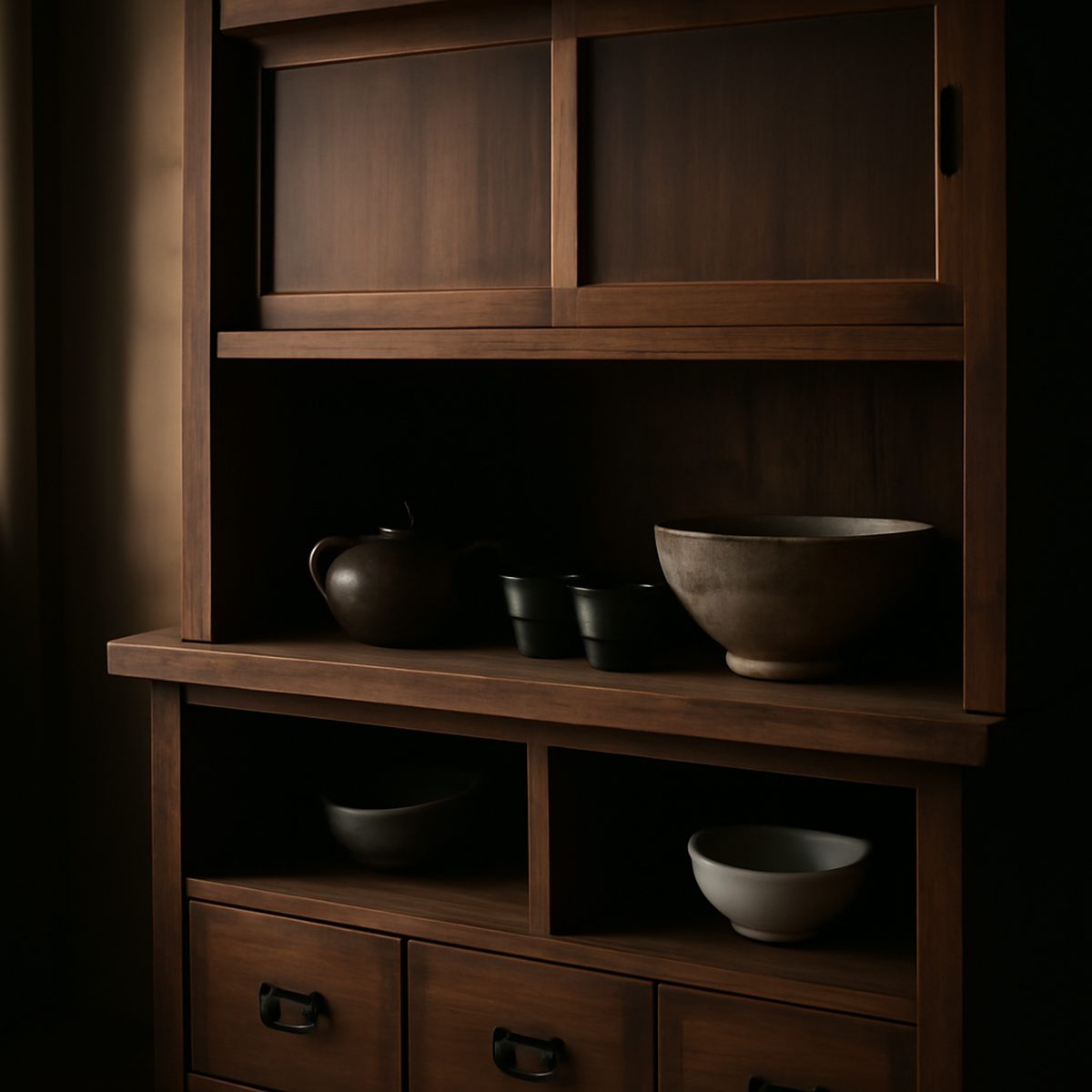
Among the many forms of Japanese tansu, the cabinetry that furnished the traditional house, the mizuya holds a special place. It is the kitchen cabinet, the piece that stored the crockery, the utensils and the provisions of a household, and it evolved over centuries into one of the most quietly intelligent storage objects ever made. To understand the mizuya is to understand a whole philosophy of how things should be kept: visible where useful, hidden where not, and always within the honest logic of good joinery.
What a mizuya is
The word mizuya refers to the kitchen or scullery area of a traditional Japanese home, and by extension to the freestanding cabinet that served it. A classic example is a substantial two-part chest, often as tall as a person, built of a warm timber such as cypress, cedar or kiri, with a combination of sliding doors, hinged doors, open shelves and small drawers. It belongs to the same great family as the tansu chest, sharing its material honesty and its ironwork, but where the clothing tansu is about drawers, the mizuya is about the full vocabulary of storage in one piece.
The intelligence of the sliding door
The signature of the mizuya is its sliding doors, and they are worth pausing on. Unlike a hinged door, a sliding one needs no clearance to open, so a mizuya can sit in a tight kitchen and still give full access without a swing arm knocking into the cook. Many mizuya combine solid sliding panels with latticed or screened sections, sometimes backed with fine wire mesh or wooden grilles, so that ventilated storage, essential for food and damp crockery, sits alongside closed cupboards. That latticework is close kin to the joinery we admire in the art of the kumiko panel, and it does the same double duty, structure and beauty in one.
A mizuya answers a question every kitchen still asks: how to keep many different things close to hand, some on show, some out of sight, in one honest piece of furniture.
Built to be honest
Traditional mizuya are joined, not glued and screwed, and they wear their construction openly. The hand-forged iron pulls, the exposed joinery, the way the grain runs, all of it is part of the object’s character rather than something to be hidden behind a smooth veneer. This is furniture in the same register as the traditional Japanese interior more broadly, the aesthetic that governs the tatami room, where nothing is disguised and everything is exactly what it appears to be. The result ages beautifully; a good mizuya looks better at eighty years old than at eight.
How to use one today
The mizuya’s genius is that it was never really tied to its original job. Freed from the traditional kitchen, it makes a superb storage piece anywhere in a modern home. In a dining room it holds tableware and linen, the open shelves for the everyday pieces, the closed cupboards for the rest. In a hall it becomes a handsome catch-all; in a study, a place for papers and objects. It sits happily among other Japanese storage forms, and anyone drawn to its logic will find a lighter cousin in the getabako cabinet, the traditional shoe chest, which applies the same discipline to a smaller job.
For the Singapore home, the mizuya carries a practical warning and a practical promise. The warning is humidity: solid-timber antique cabinetry needs stable conditions, and a genuine old mizuya will move, and possibly split, if swung between fierce air-conditioning and tropical damp. Keep it out of direct sun and away from an air-conditioner’s blast, and it will settle. The promise is that its ventilated, mixed storage suits a tropical kitchen unusually well, and its warm timber lends a modern flat exactly the grounding, tactile presence that so much contemporary cabinetry lacks. The same thinking about warmth and storage extends to modern kitchen equipment, as our case for the plate warming drawer argues in a more contemporary key.
Buying and living with one
Genuine antique mizuya are collected and can be costly, and the market has its share of marriages and reproductions, so it pays to buy from a dealer who understands the form. Look at the joinery and the back boards, which on a real old piece will show honest age and hand-tooling; examine the ironwork, which should feel forged rather than cast; and check that the two halves, if it is a two-part chest, actually belong together. A good example will have the soft, deep patina that only decades of handling and beeswax can produce, and it will feel substantial when you slide the doors.
If a true antique is beyond reach, or too fragile for a working kitchen, the mizuya’s logic can be borrowed rather than bought. A sympathetic contemporary maker can build a cabinet on the same principles, sliding doors, mixed open and closed storage, ventilated panels, honest joinery, in a stable modern timber better suited to the tropics. What matters is not the provenance but the thinking: storage organised with intelligence, built to be repaired, and beautiful in its function. That is the real inheritance of the mizuya, and it is one any home can claim. Its stepped cousin turns storage into architecture, as our piece on the art of the kaidan dansu explains.
Why it still matters
The mizuya endures because it solved, centuries ago and with great elegance, a problem every home still has. It combines open and closed storage, ventilated and sealed, large and small, in a single piece built to last generations and to be repaired rather than replaced. It asks nothing but a little care and gives back decades of quiet service and beauty. In a world of flat-pack cabinetry designed to be thrown away, the old kitchen tansu is a standing rebuke and a standing inspiration. Whether you buy an antique or commission a piece in its spirit, what you take home is a way of thinking about storage that treats it as worthy of real craft. That, more than the timber or the ironwork, is the inheritance worth having. For more of the storage traditions worth learning from, our homes and culture desk keeps returning to the pieces built to be kept, and the mizuya is one of the finest.
Priya tours the homes most people only glimpse from the road, and asks how they are really lived in.