The Best Places for Terraced Salt-Pan Landscapes
From tidal salt flats to mountain evaporation terraces, the pans of Asia hold a strange, mirrored beauty that rewards the traveller who arrives at first light.
 By Marcus Lim
31 August 2026 · 6 min read
By Marcus Lim
31 August 2026 · 6 min read
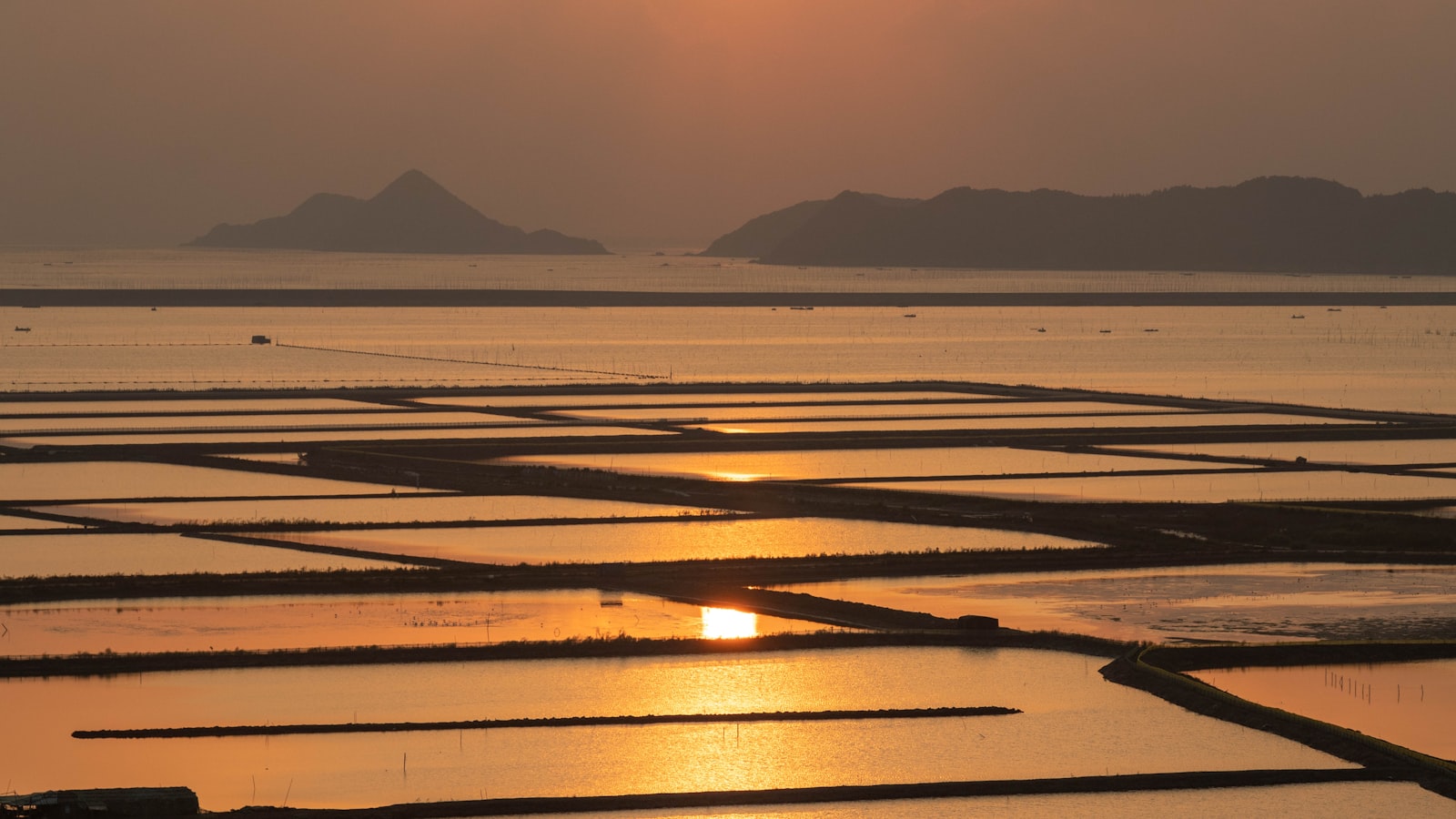
There is a particular hour, just after dawn and before the day’s heat sets in, when a salt pan stops being a piece of agricultural infrastructure and becomes something closer to a mirror laid flat across the land. The water is still. The colour runs from pearl to rose to a deep mineral pink, depending on the salinity and the microorganisms doing quiet chemical work below the surface. It is, on the right morning, one of the most improbably beautiful sights in Asian travel — and one that almost nobody plans a trip around, which is precisely its charm.
Why terraced salt landscapes reward the patient traveller
Salt has been harvested along Asia’s coasts and highland basins for centuries, and the terraces built to do it are, in their way, as considered as any rice paddy. Water is drawn in from the sea or a saline spring, then walked down a cascade of shallow pans, each one a little more concentrated than the last, until crystals form on the surface like a thin skin of frost. The geometry is functional rather than decorative, which is exactly why it photographs so well — nothing about it is arranged for effect. A visit rewards those who go slowly: arriving at first light, watching the harvesters rake the crust into small white pyramids, and resisting the urge to treat a working livelihood as scenery.
Where to find them
The best-known terraces sit in pockets rather than a single belt. Coastal Vietnam has stretches where the pans catch the last violet light of evening, and a short detour off the main highway will put you among them with almost no other visitors in sight. Parts of eastern Java hold volcanic-fed salt terraces that stain a deeper red than their coastal counterparts, owing to iron in the local water. Further north, mountain basins in Yunnan have produced salt by evaporation for well over a thousand years, using a lattice of bamboo troughs that channel brine down a hillside in a manner closer to sculpture than industry.
Each of these landscapes rewards a different kind of visit. The coastal pans are best seen at sunrise or late afternoon, when low light picks out the geometry of the walls. The mountain terraces are worth the longer drive precisely because so few travellers make it that far — ask locally, and a guide from a nearby town can usually arrange an early start that avoids both the crowds and the worst of the midday glare.
What a considered visit looks like
- Go with a local guide or a small operator who has an existing relationship with the harvesting families — this is someone’s working land, not a public attraction.
- Time it around the dry season, when the pans are active and the crystallisation is visible; during the wet months many terraces are simply flooded fields.
- Keep to the raised paths between pans. The walls are thinner than they look and a misstep can undo hours of a harvester’s work.
- Buy the salt, if it is offered. It is usually the single most direct way to support the community whose land you have come to photograph.
Accommodation near the best terraces tends to be modest — a family-run guesthouse rather than a resort — which suits the pace of the visit. Pair a salt-terrace morning with an afternoon exploring a nearby terraced paddy landscape, since the two forms of land-shaping often sit within an hour of each other and share the same golden light. Travellers drawn to Asia’s other water-carved coastal geographies might also enjoy the quieter salt marsh and coastal flat retreats a little further along the same shoreline.
“You learn to read a salt pan the way you’d read tide charts — the colour tells you exactly how many days until harvest,” a third-generation salt farmer in coastal Vietnam told us, watching a line of workers rake the morning’s crust.
The wider appeal of a working landscape
Part of what makes these places compelling is that they were never designed to be looked at. Unlike a temple or a garden, a salt terrace exists purely to solve a problem — how to turn seawater into a preservable, saleable mineral — and the beauty is incidental, a by-product of physics and light. That incidental quality is increasingly rare in travel, where so much of what we visit has been built, at least in part, with an audience in mind. A salt pan at dawn owes nothing to anyone watching.
For readers building a longer coastal itinerary, our Travel & Stays section carries further guides to the working landscapes and quieter coastlines that reward exactly this kind of unhurried attention — the places that ask you to adjust your schedule to theirs, rather than the other way round.
What to pack, and what to leave behind
Bring more sun protection than you think you need. Salt pans reflect light in a way that ordinary beaches don’t — the white crust bounces glare back up from below as well as down from above, and a morning that feels mild by nine can leave exposed skin burnt by lunchtime. A wide-brimmed hat, long sleeves in breathable linen and a polarising filter for anyone bringing a camera are all worth the extra weight in the bag. Leave the drone at home unless you’ve confirmed in advance that the site permits them; several of the better-known terraces have quietly banned aerial filming after early-morning flights disturbed harvesters mid-shift.
Footwear matters more than most travellers expect. The raised paths between pans are often narrow, sometimes slick with a thin film of brine, and proper closed shoes with grip will serve you far better than the sandals that feel natural in a hot climate. A local guide will usually have a spare pair on hand for anyone who turns up unprepared, which tells you something about how often visitors get this wrong.
A final word on timing
If there is one piece of practical advice worth taking from this guide, it is to check the harvest calendar before you book anything. A salt pan out of season is simply a flooded field, pretty enough in its own right but missing the crystalline detail that makes the terraces worth the detour. Most harvesting communities can tell you, roughly, which weeks will be active; a message sent a fortnight ahead is usually enough. The reward, when the timing lines up, is a landscape that looks entirely unlike anywhere else in the region — geometric, luminous, and quietly indifferent to the fact that you came to see it. Combine the detour with a night or two somewhere unhurried nearby, and the salt terraces stop being a single striking photograph and become instead the anchor of a slower, more considered few days on the coast.
Marcus writes on travel and hospitality across Asia, and is happiest a long way from a lobby.