The Best Materials for a Warm Kitchen
A kitchen can be immaculate and still feel cold. Here is how material choice, not colour alone, is what actually makes a kitchen feel warm to be in.
 By Priya Nair
30 August 2026 · 5 min read
By Priya Nair
30 August 2026 · 5 min read
A kitchen can be immaculately designed, expensively fitted and still feel faintly clinical to stand in. The usual culprit is not the layout or the appliances but the materials — an all-white, high-gloss scheme that photographs beautifully but reads as cold the moment someone actually starts cooking in it. Warmth in a kitchen is not really about colour, though colour plays a supporting role. It is about texture, and specifically about how many genuinely tactile materials the eye and hand can find in the room.
This matters more, not less, in Singapore, where a kitchen frequently sits open to the living and dining areas and is on display for most of the day. A cold kitchen does not stay contained to itself; it sets the temperature, so to speak, for the whole floor.
Timber Cabinetry as the Foundation
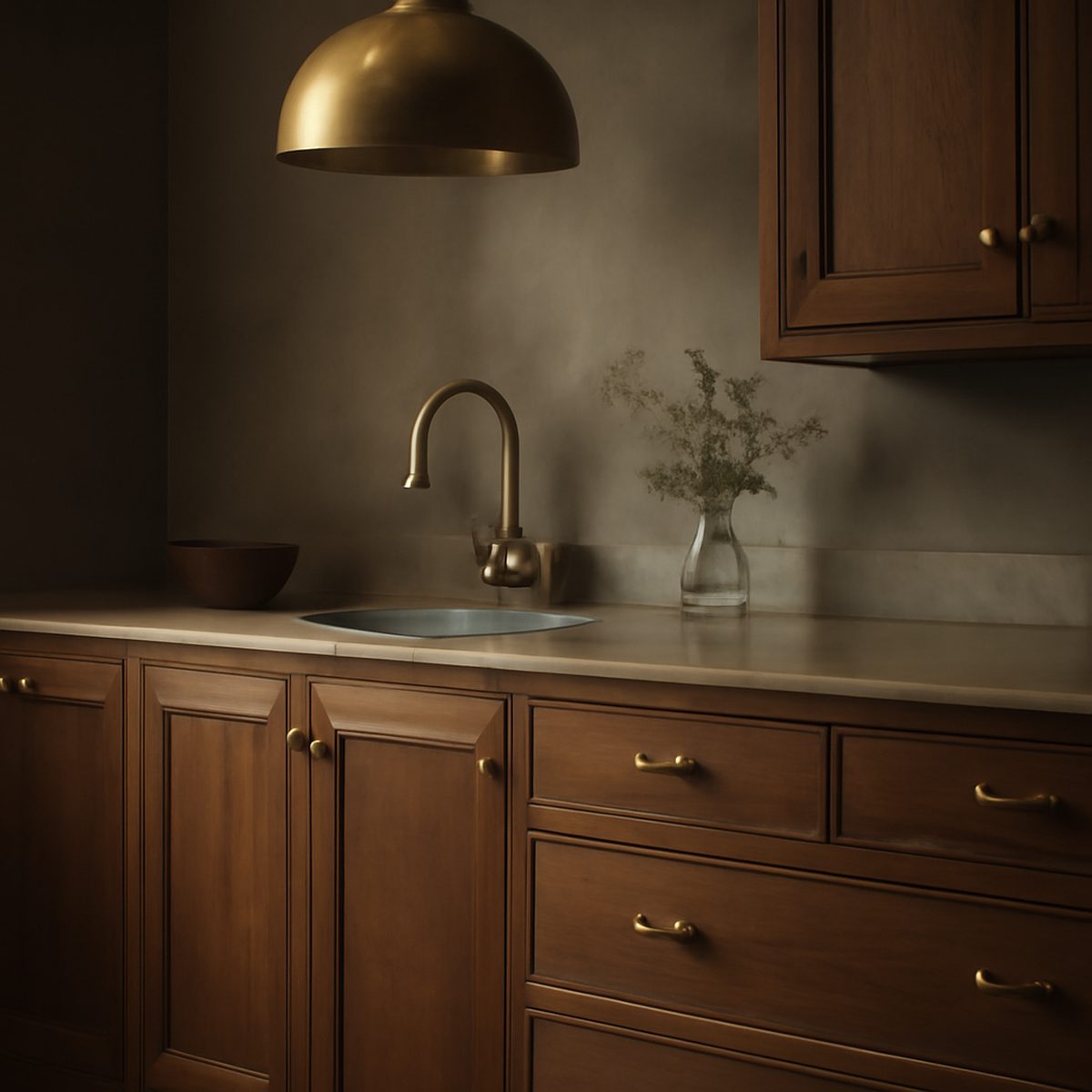
Nothing does more to warm a kitchen than timber cabinetry, and it does not need to dominate the room to have an effect. A run of oak or walnut base cabinets beneath a paler stone worktop introduces warmth exactly where hands and eyes spend the most time, without requiring the whole kitchen to commit to a heavy, all-timber look. Even a single timber element — an island front, a run of open shelving, a plinth detail — does noticeably more for the room’s atmosphere than an equivalent area of painted joinery.
Where budget allows only one warm material, this is generally where to spend it. Timber cabinetry ages well, develops character rather than looking dated, and provides the tactile contrast that stone, glass and steel elsewhere in the kitchen genuinely need to avoid feeling sterile.
Stone That Reads as Soft, Not Cold
Worktop material does not have to sacrifice warmth for durability. A honed rather than polished stone finish absorbs light rather than bouncing it back sharply, and reads considerably warmer as a result, even in the same colour. Warmer-toned stones — a soft travertine, a stone with visible ochre or umber veining — do more work again, without needing to depart from a broadly neutral palette. This is closely related to the material logic in our guide to the best materials for a timeless kitchen, where longevity and warmth are treated as compatible goals rather than a trade-off.
Materials That Add Warmth Without Adding Clutter
- Brushed or unlacquered brass hardware, which develops a soft patina rather than staying coldly reflective.
- A woven or rattan pendant shade over an island, introducing texture at eye level.
- Terracotta or ceramic tiling on a splashback, in place of glass or stainless steel.
Lighting as a Material Choice
Lighting is easy to overlook as a “material,” but colour temperature does as much to warm or cool a kitchen as any physical surface. A scheme of cool white downlights alone will make even the warmest timber and stone read as sterile; layering in warmer, lower-level lighting — under-cabinet strips, a pendant over the island, even a single warm accent light — changes the entire feel of the room after dark, which in Singapore’s consistent daylight hours is when the kitchen is used for the longest, most social stretch of the day.
“We changed nothing structural,” one Singapore homeowner said of a recent kitchen refresh. “New handles, warmer lighting, and the room felt like a different place.”
Fabric and Softness in an Unexpected Room
A kitchen rarely includes soft furnishings, which is part of why it can feel harder-edged than the rest of a home. Introducing even a small amount of fabric — cushioned stools at an island, a woven runner on an adjacent dining table, linen café curtains over a window — does more for the room’s perceived warmth than most homeowners expect, precisely because it is unusual in a room otherwise dominated by hard surfaces.
Balancing Warmth With Practicality
The genuine challenge in a warm kitchen is keeping the tactile materials in the zones that can handle them, and reserving the most hard-wearing, easy-clean surfaces for the areas that see the heaviest daily use. Open timber shelving looks wonderful but collects grease near a hob; a woven pendant shade should sit well clear of any steam or splatter zone. Warmth and practicality are not opposites, but they do need to be zoned deliberately rather than applied uniformly across the whole room, with the more delicate materials kept back from the hob, the sink and the main preparation run.
A useful way to think about this zoning is to divide the kitchen mentally into a “working” band — the hob, sink and immediately adjacent worktop, where hard, wipeable, heat-resistant surfaces should dominate — and a “living” band, typically the island seating area, open shelving and any adjoining dining space, where warmer, softer materials can be introduced far more freely. This division allows a kitchen to be genuinely practical in the parts that need it and genuinely warm in the parts that are actually lingered in.
Colour Undertone, Not Just Colour
Even within a broadly neutral palette, undertone changes how warm a kitchen feels considerably. A white cabinet with a cool, blue-grey undertone will always read colder than one with a warm, slightly creamy undertone, even though both would be described simply as “white” on a paint chart. The same is true of stone worktops, where a grey with cool blue veining feels noticeably different underfoot and at eye level than a grey with warmer taupe or ochre veining. Testing samples together, in the kitchen’s actual light, before committing to a full material palette avoids the common mistake of choosing materials individually that clash once installed as a whole.
A genuinely warm kitchen is less about a single design trend and more about a deliberate mix of textures working together — timber against stone, brass against ceramic, soft light against hard surfaces. For more on building a kitchen with both warmth and longevity in mind, our Homes & Culture section covers cabinetry, materials and lighting in depth, alongside our related look at the art of the open-plan kitchen for households designing the space to flow into living and dining areas.
Priya tours the homes most people only glimpse from the road, and asks how they are really lived in.