The Art of the Pocket Watch, Today
Long before the wristwatch, timekeeping lived in a waistcoat pocket. Here is why the pocket watch still has a genuine place in a considered wardrobe.
 By Daniel Koh
30 August 2026 · 6 min read

The pocket watch is one of the few objects that can be genuinely said to have invented an entire category of manners. For roughly three centuries, checking the time meant reaching into a waistcoat, drawing out a case on a chain, and opening it with a small, practised motion — a gesture that carried its own quiet formality long before the wristwatch made timekeeping instant and casual. That the pocket watch survives at all today, well over a century after the wristwatch overtook it, says something about the appeal of an object that asks you to slow down slightly in order to use it.
A brief case for why it disappeared, and why it did not
The wristwatch won out for reasons that had nothing to do with elegance and everything to do with practicality — soldiers in the First World War needed to check the time without stopping to dig through a pocket, and the habit stuck once the war ended. The pocket watch never actually vanished from production; it simply moved from a daily necessity to an occasional, considered object, kept alive by tailors, collectors and anyone who still wears a waistcoat with any regularity. Understanding that history is useful context for anyone curious about how mechanical watch movements work more broadly, since the pocket watch and the wristwatch share almost identical mechanical DNA — the pocket watch simply came first, by several hundred years.
It is worth remembering, too, that plenty of the complications collectors prize in modern wristwatches — perpetual calendars, minute repeaters, tourbillons — were first developed and refined in pocket watch movements, simply because the larger case gave watchmakers more room to work. In that sense the pocket watch is not a curiosity sitting outside the story of horology; it is the origin point most of that story is built on, and a surprising amount of contemporary watchmaking vocabulary only makes sense once you understand the pocket watch it was originally scaled down from.
What makes a modern pocket watch worth owning
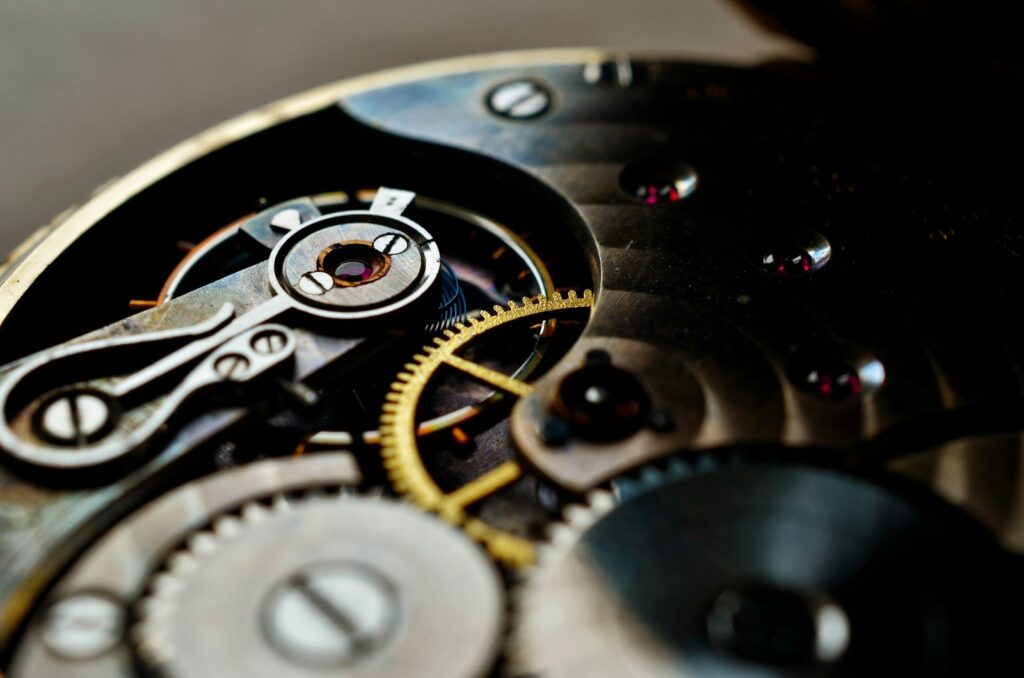
A pocket watch bought today is rarely bought out of necessity, which changes what to look for. The case size can be considerably larger than a wristwatch would allow, since it never has to sit comfortably against moving skin, and this is where a lot of pocket watches indulge in dial work — enamel, guilloché, open-worked movements visible through a display back — that would feel excessive on the wrist but reads as appropriately generous in the palm of a hand. Look for a genuine mechanical movement rather than a quartz one; part of the appeal of a pocket watch is the tactile ritual of winding it, and a quartz movement removes exactly the element that makes the object worth carrying in the first place. A hunter case, which closes over the dial with a hinged cover, protects the watch better for daily carry than an open-faced case, though the latter is arguably more elegant for occasional wear.
The essential parts to understand
- The chain — either a single Albert chain with a T-bar that fastens through a buttonhole, or a double Albert with a chain running to each waistcoat pocket.
- The case — hunter (closed, protected) versus open-faced (dial always visible, generally considered more formal).
- The movement — mechanical hand-wound is the traditional and most satisfying choice; automatic pocket watches exist but are less common and somewhat miss the point.
- The crown — pocket watches are wound and set from the crown at the top, much like a traditional wristwatch, though the winding ritual feels notably different held in the hand.
Wearing one without looking like a costume
The line between “considered eccentricity” and “fancy dress” with a pocket watch is thinner than most other accessories, and it comes down almost entirely to context and restraint. A pocket watch worn with a full three-piece suit, chain visible across the waistcoat, works because the whole outfit is already formal enough to support the gesture. Worn with a blazer and no waistcoat, it needs a dedicated watch pocket or a discreet chain clipped to a belt loop, kept simple and unobtrusive rather than treated as a costume piece. The goal is for the watch to read as a genuine, functional accessory that happens to be unusual, not as a deliberate throwback performance. This is very much the same instinct that governs restrained, considered dressing more broadly — the object should feel inevitable within the outfit, not like the outfit was built around it.
“People assume a pocket watch is about nostalgia, but the ones who wear it well treat it exactly like any other good watch — they just have to be slightly more deliberate about it,” says a Singapore watch dealer who still sells a handful of mechanical pocket pieces every year, mostly to younger collectors.
Buying one today
Vintage pocket watches remain relatively accessible compared to vintage wristwatches, largely because demand has stayed low for decades even as supply has not — a genuine window for anyone wanting a well-made mechanical object without paying wristwatch prices. Look for a reputable dealer, have the movement serviced before wearing it regularly, and treat the purchase with the same diligence you would apply to any pre-owned watch purchase, since a pocket watch that has sat unused for decades will usually need attention before it can be trusted to keep good time. A handful of contemporary makers still produce new mechanical pocket watches too, for anyone who would rather start with a warranty than a restoration project.
An object worth the small ceremony
What the pocket watch offers, in the end, is not efficiency — the wristwatch will always be faster to check — but a small, repeated ceremony that most modern accessories have stripped away entirely. Drawing it out, opening the case, reading the time, closing it again: it is a gesture that takes perhaps four seconds longer than glancing at a wrist, and those four seconds are, for the people who still carry one, rather the point. For more on the mechanics and history behind the pieces we wear, browse the rest of our Style & Watches coverage.
Daniel has spent fifteen years arguing that the best watch is the one you never take off.