The Art of the Considered Landing and Stairwell
A stairwell is a pause built into a home's architecture. A guide to lighting it properly, furnishing the landing well, and using the wall for more than paint.
 By Priya Nair
30 August 2026 · 6 min read
The stairwell and its landings are the most travelled square footage in most homes and the least considered. We rush through them, phone in hand, on the way to somewhere that matters more — and so they default to storage overflow, forgotten paint colours, and lighting installed purely for function. That is a missed opportunity. A landing is a pause built into the architecture of a house, and treated properly it can be one of the more quietly satisfying spaces in the entire home.
Light first, always
Stairwells are frequently the darkest circulation space in a house, tucked between floors with limited access to natural light. A single overhead bulb rarely does the space justice. Layering light — a pendant or chandelier that spans the full height of the stairwell, supplemented by wall-mounted sconces at each landing — transforms a stairwell from purely functional to genuinely atmospheric. Our piece on layered lighting covers the principle in more depth, but a stairwell is where it matters most, since poor lighting here is both a safety issue and an aesthetic one.
Treating the landing as a room, briefly
A generous landing — anything over a metre or so of clear floor — deserves furnishing rather than emptiness. A slim console table, a single chair positioned to catch morning light, or a small reading nook built into a window recess can turn a wasted transitional space into somewhere a household member actually wants to pause. This does not require much: one considered piece of furniture and a lamp will do more for a landing’s character than an entire room’s worth of decoration crammed in without editing.
The gallery wall opportunity
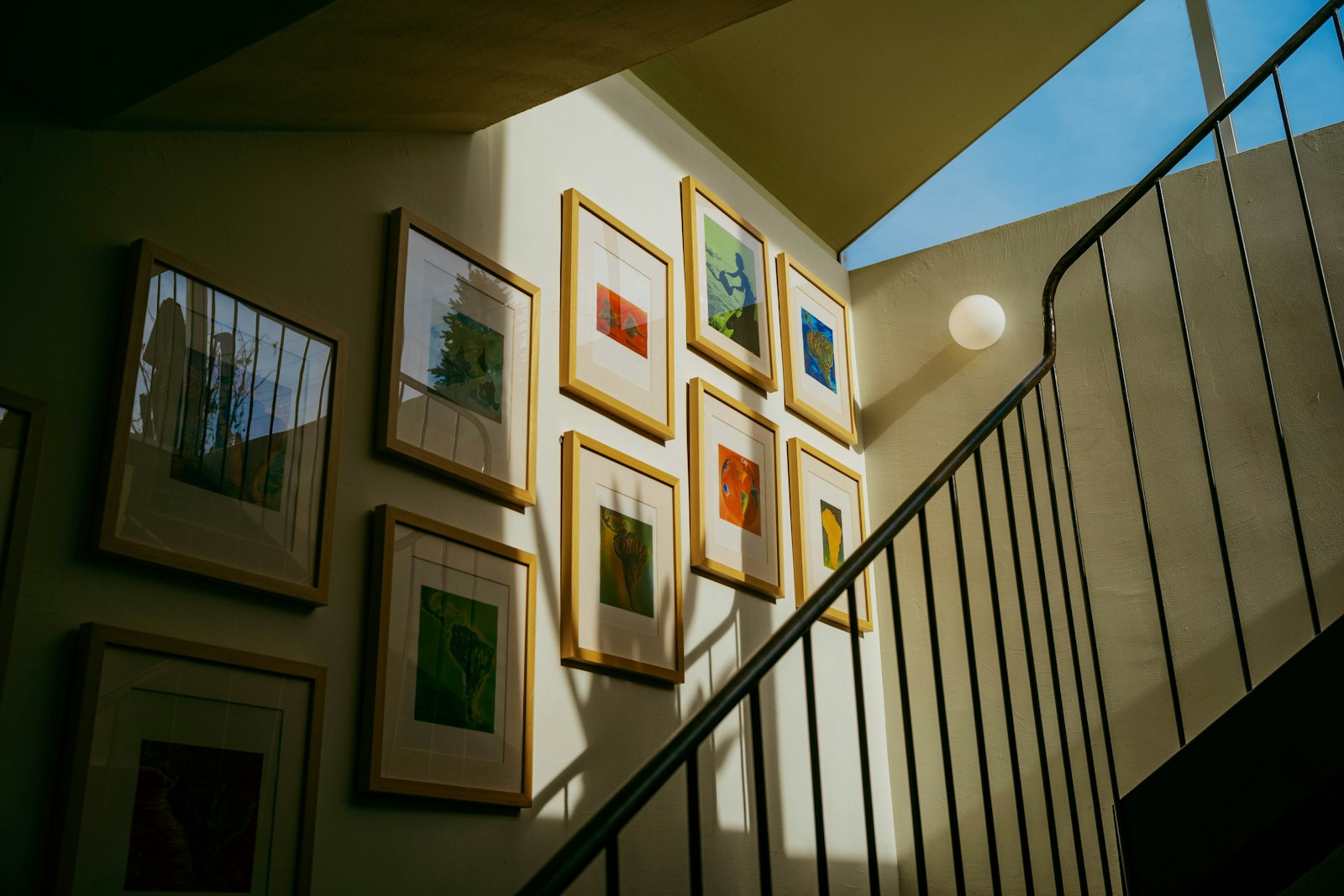
A stairwell wall, rising through two or more storeys, is one of the few genuinely dramatic surfaces in a typical home — and one of the most underused for art or photography. A considered gallery wall, arranged to follow the rake of the stairs rather than fighting it, draws the eye upward and gives the whole space a sense of narrative as you climb. Family photographs, a mix of black-and-white and colour, or a collection built slowly over years all suit this treatment better than a single oversized print, which can feel static against the movement of a staircase.
Materials that survive daily traffic
- Runners over bare stone or timber treads reduce noise and add grip, particularly valuable in a household with children or older family members navigating the stairs daily.
- A durable, washable wall finish on the lower half of a stairwell, where hands and shoulders brush against the wall most often, saves a full repaint every few years.
- A well-anchored handrail, in timber or blackened metal depending on the home’s broader material palette, does double duty as both safety feature and design statement.
Storage without clutter
A landing that also serves as a family’s daily thoroughfare tends to accumulate the things nobody quite wants to deal with — school bags, umbrellas, a stack of parcels waiting to be opened. Resisting that drift takes a small, deliberate system: a shallow basket for the umbrellas, a hook or two for bags in transit, and a firm household habit of clearing the landing at the end of each day. It is a minor discipline, but one that determines whether the space you have just lit and furnished so carefully actually reads as considered, or simply as a slightly nicer catch-all.
The space beneath a staircase is one of the most valuable and most frequently wasted volumes in a home. Built-in cabinetry here — for shoes, coats, or household overflow — keeps the rest of the entryway and landings clear, which matters enormously for a space whose whole purpose is circulation. If your entry sequence needs the same treatment, our guide to the entryway as first impression covers the principles that apply equally here: less clutter, more considered storage, and a clear sense of what belongs on display versus what belongs behind a door.
“The stairwell is the spine of the house,” a Singapore architect told us. “Get the light and the proportions right there, and the rest of the home feels connected in a way it otherwise wouldn’t.”
Scaling the treatment to the home
Not every home has room for a dramatic double-height stairwell with a gallery wall climbing beside it. In a shophouse or an HDB flat, the same principles apply at a smaller scale: a single well-placed light fixture, one piece of art at eye level on the half-landing, a runner in a colour that ties the floors together. The goal is not grandeur but intention — making sure a space that every household member passes through daily receives even a fraction of the thought given to the rooms at either end of it.
The half-landing as a small destination
Many staircases turn at a half-landing, and that pivot point deserves particular attention, since it is where the eye naturally rests while climbing. A single striking object — a well-chosen vase, a piece of sculpture, a framed print with real presence — placed on a narrow shelf or console at this turn gives the whole ascent a moment of punctuation. It need not be large; in a tight stairwell, a small, considered object often reads better than an oversized one that crowds the passage.
Colour and how it behaves vertically
A stairwell is one of the few spaces in a home experienced from multiple angles and multiple floors simultaneously, which makes colour choice slightly more complex than in an ordinary room. A single strong colour, carried consistently from the ground floor landing to the top, gives the stairwell a sense of cohesion and can make a narrow space feel more generous than it is. Painting each landing a different colour, by contrast, tends to fragment the space and draw attention to how compact it actually is. If natural light is limited, a warm off-white or soft plaster tone will do more to keep the stairwell feeling open than a fashionable dark colour, however handsome that might look in a single photograph.
A stairwell handled with care becomes a small daily pleasure rather than a corridor to rush through. For more on treating every corner of a home with the same consideration, visit our Homes & Culture section, where no square footage is considered too minor to design properly.
Priya tours the homes most people only glimpse from the road, and asks how they are really lived in.