The Art of the Balmacaan Coat
The Balmacaan's raglan sleeve and unfussy cut have kept it in rotation for over a century. Here is why it remains one of the more versatile coats around.
 By Daniel Koh
31 August 2026 · 6 min read

Named, according to most accounts, after a Scottish estate near Inverness where it was reportedly first worn for country pursuits, the Balmacaan coat has spent well over a century doing exactly the same thing without much fuss: covering a suit, blocking wind and rain, and asking almost nothing of the wearer in return. It is not a coat that draws attention to its own tailoring the way a sharply structured overcoat does, and that restraint is precisely the source of its longevity. Where more overtly formal coats have cycled in and out of fashion across the decades, the Balmacaan has simply persisted, worn by people who wanted a coat to disappear into rather than perform in.
The raglan sleeve, explained
The defining structural feature of a Balmacaan is its raglan sleeve, cut in one continuous piece from the collar to the wrist rather than set in at a separate shoulder seam, as most tailored jackets and coats are constructed. This produces a distinctly looser, more relaxed shoulder line than a structured set-in sleeve, with none of the crisp, built-up shoulder that defines a formal overcoat like a Chesterfield. The trade-off is practical as much as aesthetic: a raglan sleeve allows considerably greater freedom of movement, which is part of why the cut originated in outerwear intended for country and active use rather than formal city wear. For more on the sleeve itself and the coats built around it, see the art of the raglan overcoat.
That looseness through the shoulder and upper arm is also what gives the Balmacaan its distinctive, slightly relaxed silhouette when worn — a coat that hangs from the neck rather than sitting rigidly on a built shoulder, softer in profile than most of its tailored contemporaries. A close relative with a similar fold-down collar is explored in the quiet case for the bal collar coat.
Collar, closure and the details that matter
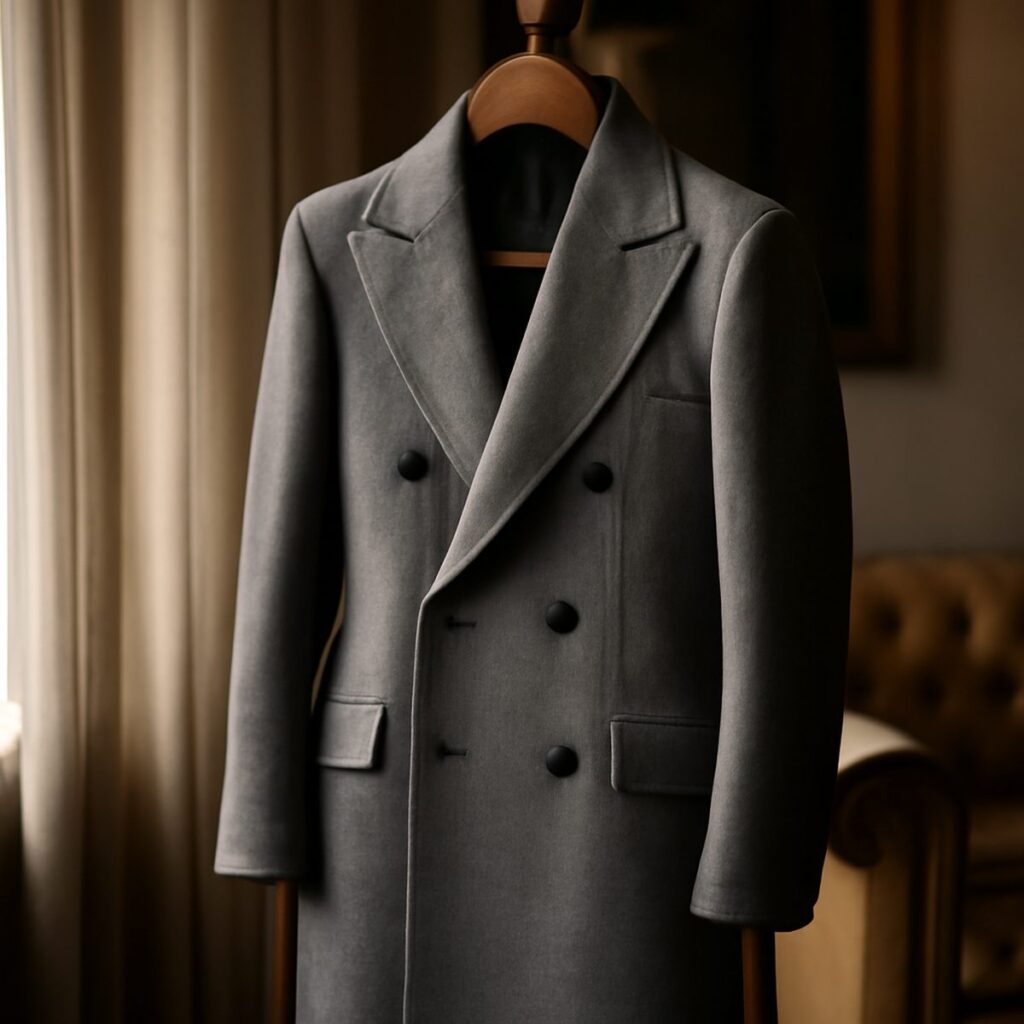
A traditional Balmacaan is cut with a turned-down collar rather than the notched lapel more common on formal overcoats, fastening at the top in a way that allows it to be worn closed against wind and rain or open over a suit, depending on the occasion. Single-breasted construction is standard, typically with a fly front that hides the buttons behind a placket for a cleaner line — a small detail, but one that separates a genuinely well-made Balmacaan from a more generic raglan-sleeved coat sold under the same name without the same attention to finishing.
Length has traditionally sat somewhere around the knee, long enough for genuine weather protection without the full formality of a longer overcoat, though modern interpretations vary this somewhat depending on the wearer’s preferred proportions.
How it compares to related styles
The Balmacaan sits in interesting company among raglan-sleeved and relaxed-fit outerwear more broadly. It shares its loose, practical shoulder construction with the trench coat, though without the trench’s belt, epaulettes and military detailing — a useful comparison for readers weighing the two against each other in our piece on the trench coat, reconsidered. Against a more overtly formal option, it stands in fairly clear contrast to the structured shoulder of the paletot coat, a useful comparison for anyone deciding between a more relaxed and a more tailored approach to outerwear.
What unites this wider family of coats is a shared instinct toward practicality over ceremony — garments built to be worn often and easily rather than reserved for particular occasions.
“The Balmacaan is the coat you reach for without thinking, which is exactly what makes it genuinely hard to replace once you’ve owned a properly well-made one,” says one London-trained tailor now based in Singapore, who fits several clients for the style each year.
A short history worth knowing
The Balmacaan’s rise coincided with a broader shift in menswear during the late nineteenth and early twentieth centuries, as country pursuits and outdoor leisure activities became more fashionable among the classes who had previously dressed exclusively for city and formal occasions. Coats built for movement and weather resistance, rather than for standing still in a drawing room, found a growing audience as a result, and the Balmacaan’s loose, practical construction fit that moment precisely. It moved from country estates into wider general use over the following decades, adopted by anyone who valued its practicality over its origins, and by the mid-twentieth century had become a recognisable staple in menswear catalogues across both Britain and America, worn as often by city commuters as by anyone actually engaged in the country pursuits it was originally cut for.
That journey from specific, occasion-bound origin to genuinely universal everyday garment is a pattern shared by a number of menswear’s enduring classics, and it is worth remembering when a coat’s original purpose feels entirely disconnected from how most people actually wear it today. The Balmacaan’s practicality simply outlasted the specific context it was designed for, which is, in the end, the clearest sign of genuinely good design.
What to look for when buying
- Check the raglan seam construction. A well-executed raglan seam should sit cleanly without puckering; poor construction here is immediately visible under close inspection.
- Consider fabric weight against local climate. A lighter wool or wool-blend suits a transitional wardrobe far better than a heavy winter-weight cloth for anyone based somewhere genuinely tropical.
- Mind the proportions. A Balmacaan’s loose shoulder can read as sloppy if the rest of the cut is too generous; the best versions balance looseness through the shoulder with a cleaner line through the body.
A coat built to be worn, not admired
Part of what makes the Balmacaan worth reconsidering today is precisely its lack of ceremony. It does not demand a particular suit, a particular occasion, or a particular season within a narrow window — a genuinely versatile mid-weight version earns its place across a meaningful stretch of the year, worn over both tailoring and more casual separates without ever looking out of place in either context. For readers building out a considered outerwear rotation, it pairs naturally with our broader coverage in the Style & Watches section, where the full range of the season’s essential pieces is covered in more depth, from tailoring fundamentals through to the small accessories that finish a considered look properly.
Daniel has spent fifteen years arguing that the best watch is the one you never take off.