A Primer on Coffee Grinding and Burrs
Ask most coffee obsessives what to buy first and they will point past the machine entirely, to the grinder. Here is why the grind matters more than the brew.
 By Renée Tan
31 August 2026 · 6 min read
By Renée Tan
31 August 2026 · 6 min read
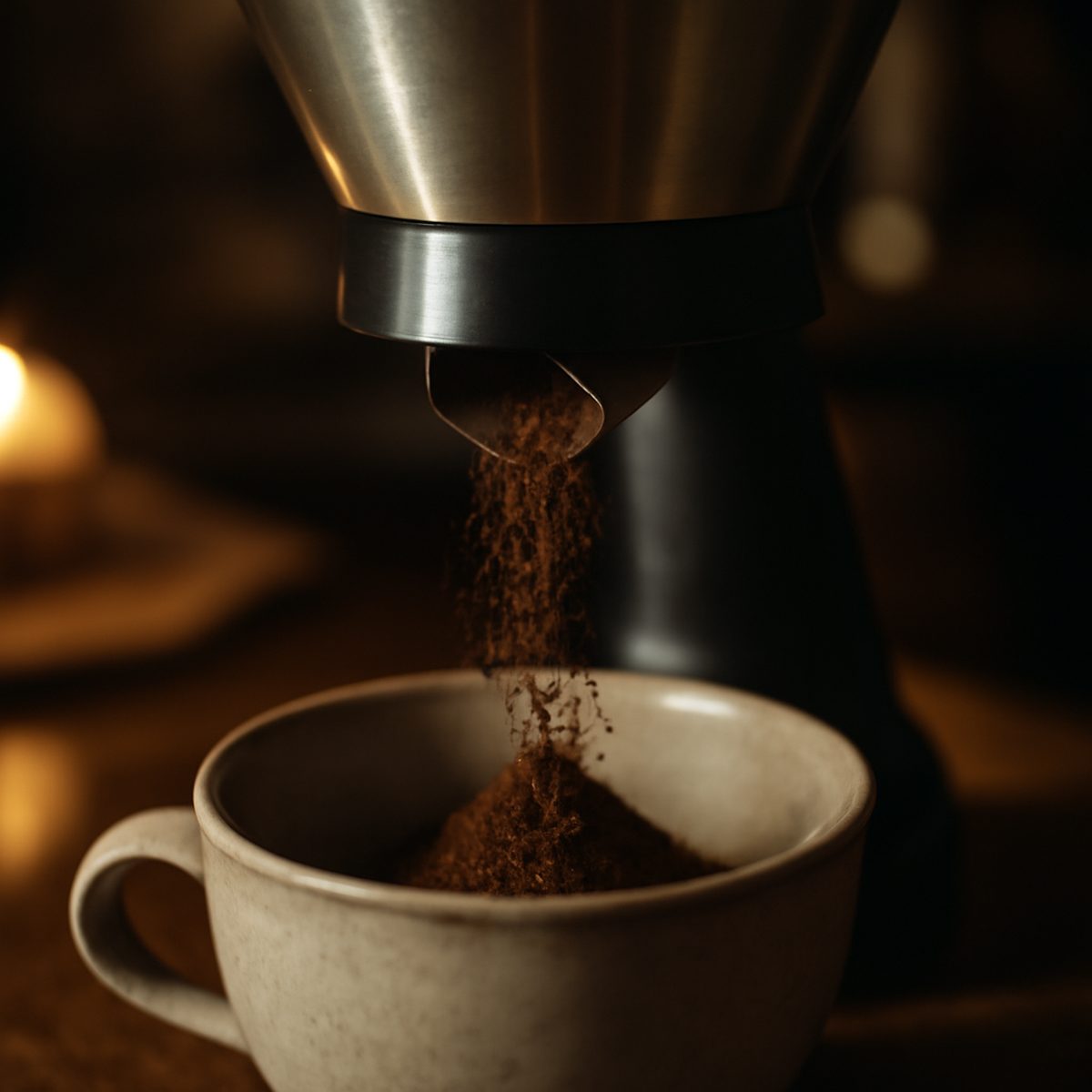
The single most common mistake in home coffee setups is spending generously on a brewer while treating the grinder as an afterthought, sometimes skipping it entirely in favour of pre-ground beans. This is roughly backwards. Grind consistency affects extraction more than almost any other variable in the brewing process, and an inconsistent grind — a mix of large chunks and fine dust from a cheap blade grinder — will produce a muddled cup no matter how carefully everything downstream is measured. Understanding what a burr grinder actually does, and why burr shape and quality matter as much as they do, is the single most useful piece of coffee knowledge a home brewer can acquire.
Blade Versus Burr
A blade grinder works like a small blender: a spinning blade chops beans into progressively smaller pieces with no control over the final size, producing a wildly uneven mix of coarse fragments and fine powder in the same batch. A burr grinder instead crushes beans between two abrasive surfaces set at a fixed, adjustable distance apart, producing particles of a much more consistent size determined by that gap. The practical consequence is significant: uneven grounds extract unevenly, with the fine particles over-extracting into bitterness while the coarse ones under-extract into sourness, often in the very same cup. A consistent burr grind allows water to pass through the grounds at a uniform rate, extracting flavour evenly rather than fighting itself.
Conical Versus Flat Burrs
- Conical burrs, shaped like a cone sitting inside a ring, tend to run cooler and produce a slightly more textured grind distribution, often associated with a rounder, sweeter cup by proponents.
- Flat burrs, two parallel ring-shaped discs, are generally considered to produce a marginally more uniform particle size, favoured by some for clarity and definition in the cup.
- In practice, the gap between the two designs matters less than burr quality and maintenance — a well-made conical grinder will consistently outperform a poorly made flat one, and vice versa.
- Larger burrs, regardless of shape, generally grind faster and generate less heat than smaller ones doing the same job, which matters more as grind volume increases.
Matching Grind Size to Brew Method
Different brewing methods require meaningfully different grind sizes, and getting this wrong is one of the most common reasons a cup tastes off despite good beans and careful technique. Espresso demands a fine, almost powdery grind to create enough resistance for pressurised extraction in a short time. Pour-over methods sit in the middle, a texture often compared to coarse sand. French press and cold brew both want a considerably coarser grind, closer to breadcrumbs, since the extended steeping time would over-extract a finer grind into unpleasant bitterness. A single grinder capable of covering this full range, with fine and repeatable adjustment between settings, is worth more to a serious home brewer than almost any other piece of equipment in the kitchen — more, arguably, than the brewer itself.
An independent roaster who has spent years advising home brewers on equipment put it this way: “People bring me their beans asking why the coffee tastes wrong. Half the time it’s not the beans at all, it’s the grinder underneath them.” It is advice worth taking seriously before assuming a disappointing cup means the beans themselves were the problem.
Grind Freshness and Storage
Ground coffee loses aroma and flavour far faster than whole beans, since grinding dramatically increases the surface area exposed to oxygen. Ideally, beans should be ground immediately before brewing, not hours or days in advance — a rule that applies even to good pre-ground coffee, which begins losing its character within roughly thirty minutes of grinding regardless of packaging. This is the single strongest practical argument for owning a grinder at all rather than relying on pre-ground beans purchased for convenience: freshness at the point of grinding is simply not something that can be preserved once lost, however well the beans were roasted or however well they were sealed beforehand.
Beyond the Grinder: Building Out a Home Setup
A good grinder is the foundation, but it sits within a wider set of decisions worth understanding together — how beans are roasted before they ever reach the grinder, and how they are subsequently brewed once ground correctly. Readers building out a fuller home coffee routine will find useful grounding in how origin and terroir shape a bean’s character before it is ever roasted, in how roasting profile changes what that character becomes, and in how extraction variables affect the final cup once brewing begins in earnest. Those working primarily with filter methods rather than espresso may find more direct value in a dedicated guide to choosing and brewing filter coffee, which covers grind size and ratio in more specific detail for that format.
Where to Start
For a home brewer upgrading one piece of equipment at a time, the grinder is the sensible place to begin, even ahead of the brewer itself. A modest brewer paired with a genuinely good burr grinder will consistently outperform an expensive brewer paired with inconsistent grounds. Buy the best burr grinder the budget allows, adjust it patiently across a few cups until the grind size matches the intended brew method, and grind only what is needed immediately before brewing. It is unglamorous advice, but it is the advice that separates a genuinely good home cup from one that merely looks the part. For more on building out a considered dining and drinking life at home, our Dining & Drinks section covers the wider territory in detail.
Dialling In: A Patient Process, Not a One-Time Setting
Buying a good grinder is only the first step; dialling it in for a specific bean and brew method is an ongoing, slightly fiddly process that many new owners underestimate. Beans vary in density and moisture depending on origin, roast level and even how recently they were roasted, which means a grind setting that worked perfectly for one bag may need adjusting for the next, even within the same brew method. The sensible approach is to change one variable at a time — grind size first, holding water temperature and brew time steady — and taste deliberately after each adjustment rather than guessing at a large change and hoping it lands. A cup that tastes sharp, sour or thin generally wants a finer grind, giving water more surface area and time to extract fully; a cup that tastes flat, bitter or muddy generally wants a coarser one, pulling back on over-extraction. This kind of deliberate, incremental tasting is slower than simply picking a setting and sticking with it indefinitely, but it is exactly the habit that separates someone who owns a good grinder from someone who has actually learned to use one, and it pays off within a matter of days rather than requiring months of practice to notice a genuine improvement in the cup.
Renée has covered Singapore's restaurants for over a decade, with a soft spot for the kitchens most people walk past.