The Best Chukka and Desert Boots
Chukka and desert boots are often confused but genuinely different. A buyer's guide to both, and how to choose a pair that truly earns its keep well.
 By Daniel Koh
30 August 2026 · 6 min read
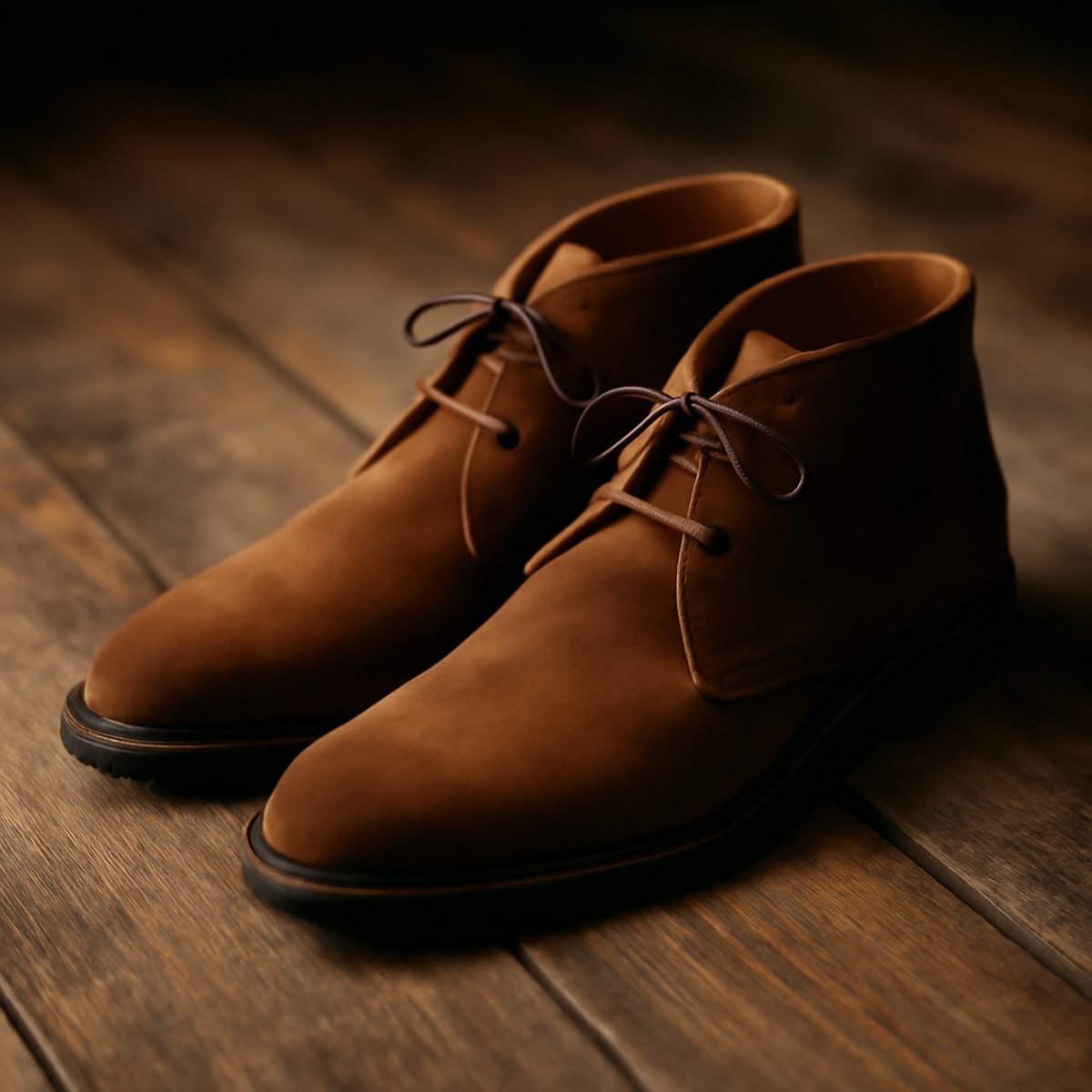
Chukka and desert boots are so frequently used interchangeably that most people own a pair without knowing precisely which they have — or that there is, in fact, a meaningful difference between the two. Both are simple, low-cut ankle boots with two or three pairs of eyelets and minimal decoration, and both trace their origins to military footwear rather than formal shoemaking. But the distinction matters to anyone buying with genuine intent, and it affects both how the boot looks and how it wears in.
The actual difference
A chukka boot, strictly defined, is a smooth-leather ankle boot with a leather or lightly stacked leather sole, generally polished to a degree and cut with slightly more refinement — a boot that can pass in business-casual settings without much difficulty. A desert boot, by contrast, is specifically the style popularised by Clarks from the late 1940s onward: suede upper, unlined construction, and most distinctively, a crepe rubber sole, originally borrowed directly from military boots worn by British officers in North Africa during the Second World War, whose soft, cushioned texture and pale colour gave the style its name.
In practice, “chukka” has become something of a catch-all term for the general silhouette, while “desert boot” refers more specifically to that particular suede-and-crepe combination. Understanding the distinction is mostly useful for knowing what you are actually buying — a smooth-leather chukka with a leather sole dresses up considerably better than a suede desert boot with its distinctive crepe sole, which reads as more casual regardless of how it is styled.
What to look for in construction
- Genuine suede or full-grain leather uppers, rather than a bonded or corrected-grain leather that will crease unattractively and wear poorly.
- A proper crepe sole for true desert boots — it should have real give underfoot and a visibly textured, slightly irregular surface, distinct from a moulded rubber sole made to merely resemble crepe.
- Minimal stitching and a clean, unfussy silhouette — the appeal of both styles lies substantially in their simplicity, and boots with excessive detailing tend to undercut the point.
- A snug but not tight fit through the ankle, since the low-cut design offers little structural support if the fit is wrong.
How to wear each
A smooth-leather chukka in a dark brown or black earns its place in a business-casual wardrobe, working comfortably with chinos or even a lighter, unstructured suit where a full oxford or derby would feel too formal. It is a genuinely useful bridge piece for exactly the kind of wardrobe our guide to the weekend wardrobe, elevated covers — smart enough for most daytime occasions without tipping into anything resembling a formal shoe.
A true suede desert boot sits at the more casual end of the spectrum and is better paired with denim, cotton trousers or, in warmer climates, a lightweight linen trouser rolled at the ankle. It does not suit a suit particularly well, the crepe sole and soft suede reading as too relaxed for tailoring, but it is close to unbeatable as an everyday boot for a warm-climate wardrobe, breathable and comfortable in a way few other boots manage.
Caring for suede and crepe
Suede requires different care from smooth leather, and it is worth investing in a proper suede brush and a dedicated protector spray before the first wear rather than after the first stain. Brush regularly, in the direction of the nap, to lift dust and restore texture, and treat any water exposure immediately with a suede-specific product rather than allowing it to dry unattended, which tends to leave a visible tide mark. Crepe soles, meanwhile, are notoriously vulnerable to oil and certain solvents, which can cause the rubber to soften and degrade prematurely — worth bearing in mind if wearing desert boots regularly in a kitchen, workshop or similarly exposed environment.
“People treat desert boots as disposable because they’re inexpensive,” a Singapore-based cobbler told us. “A well-made pair, properly cared for, will easily outlast several cheaper alternatives.”
Getting the fit right
Because both styles sit low on the ankle with minimal structural support, an accurate fit matters more here than with a taller boot that can compensate for minor sizing errors through lacing and ankle support. Try both styles on with the socks you actually intend to wear them with, and pay particular attention to width across the ball of the foot rather than length alone — a chukka or desert boot that is technically the right length but too narrow will crease unattractively across the vamp far sooner than one that fits properly through the widest part of the foot. Given the low cut, there is also little room to hide a fit that is slightly too large; unlike a lace-up derby, there is no boot shaft to take up the slack, so a boot bought a half-size too big will visibly gape at the ankle with every step.
Break-in time varies by construction: a Goodyear-welted leather chukka will typically need several wears before the sole and upper fully relax to the foot, while a simpler cemented-construction desert boot softens more quickly but also wears out somewhat faster as a result. Budget accordingly, and avoid wearing a new pair on a day that demands a great deal of walking until you have a proper sense of how they behave and flex after the first few outings.
Building a small rotation
For anyone building a considered shoe wardrobe from a modest starting point, a pair of each — a smooth chukka in dark brown for slightly smarter occasions, a suede desert boot in a warm tan for everything else — covers an enormous range of everyday situations without requiring more than two pairs of boots. Rotate them rather than wearing either daily, allowing each pair at least a day to air out and the sole to recover its shape, and both should comfortably outlast several years of regular wear. For more on building out a shoe rotation with genuine intent, our guide to how to build a shoe wardrobe and our broader Style & Watches archive are worth reading alongside this piece.
Daniel has spent fifteen years arguing that the best watch is the one you never take off.